Category Archives: Books

books

Armadale illustrations

thomas, george h 5              thomas, george h 6

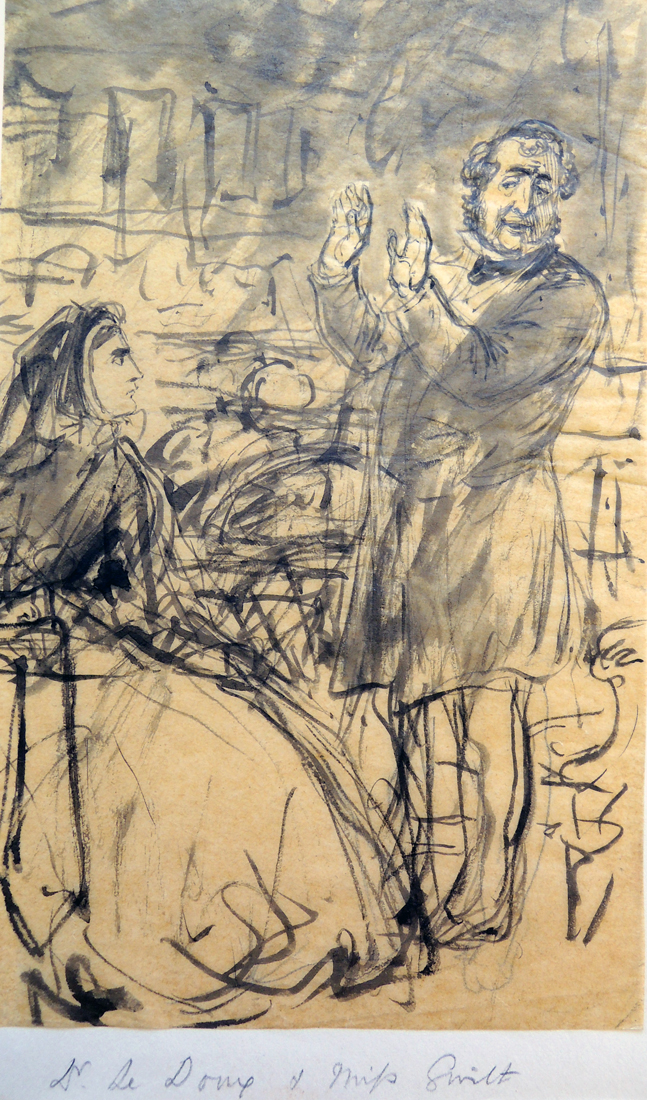
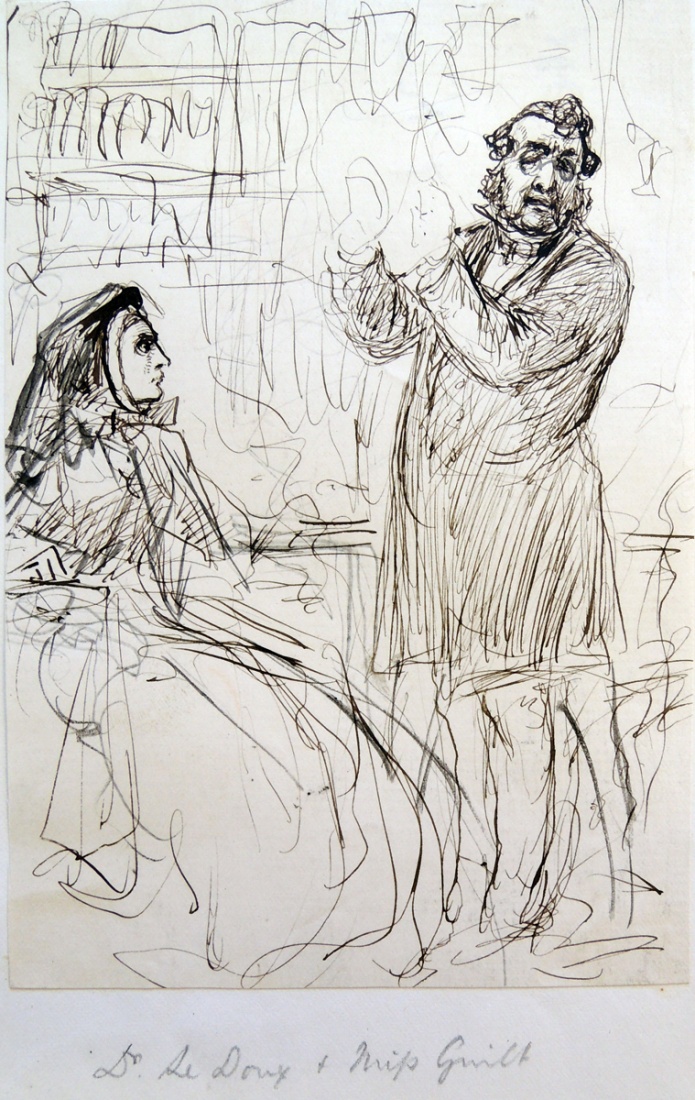
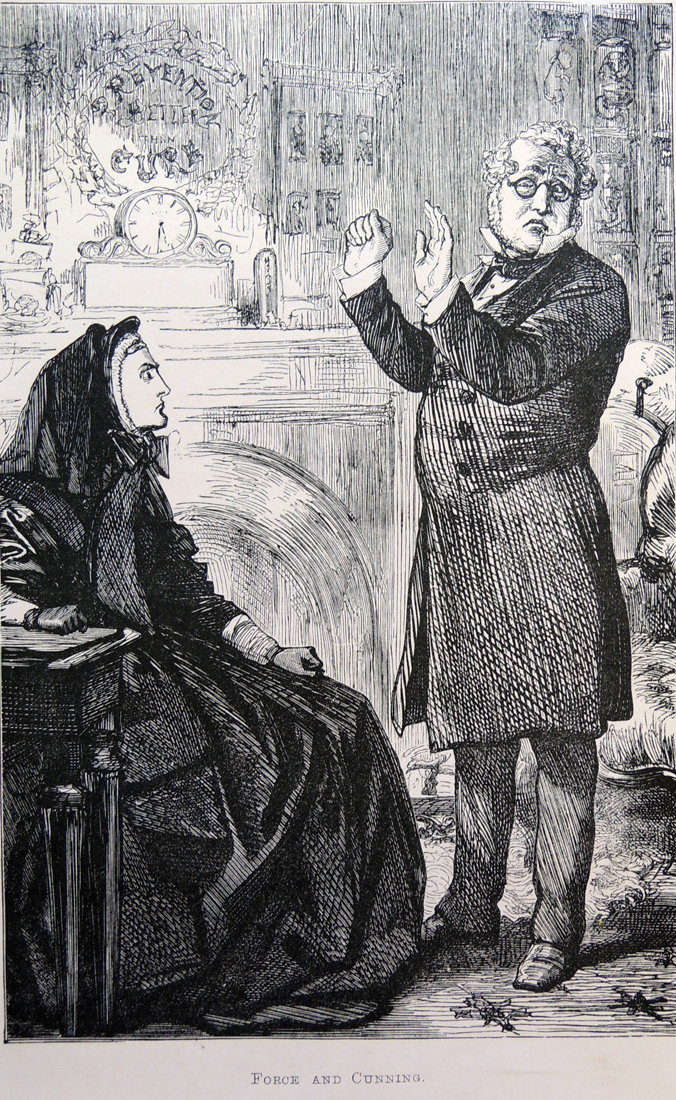
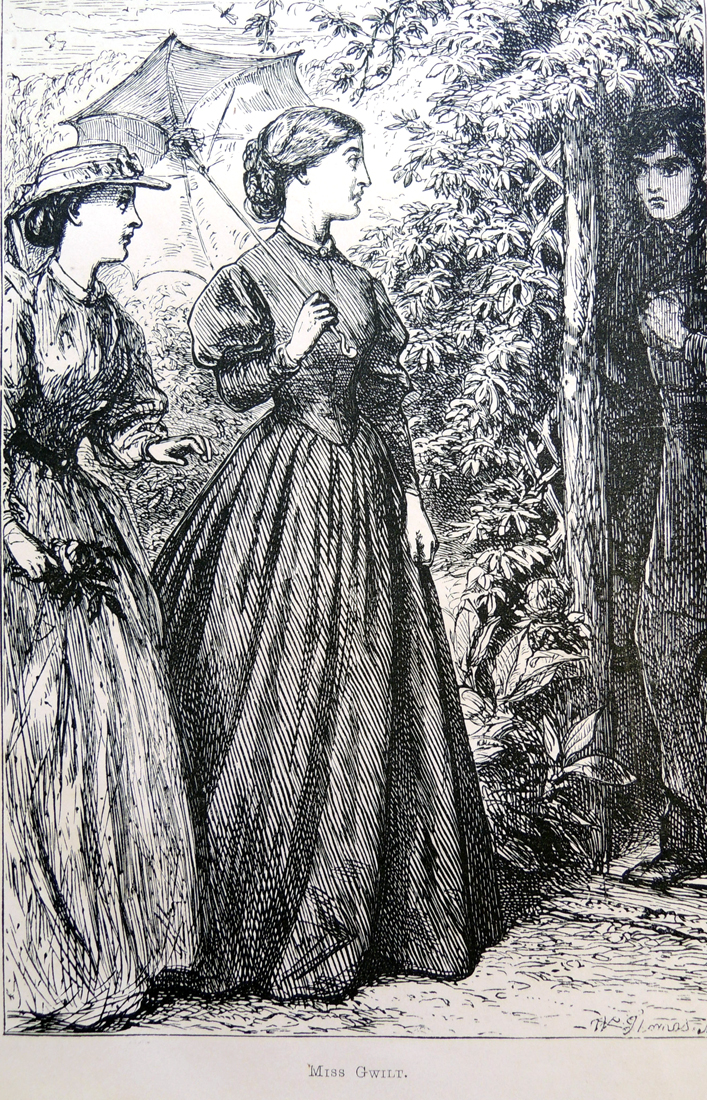
Miss Gwilt, Armadale, v. 1. Preliminary drawings and final wood engraving

thomas, george h 3


According to Mark Bills, writing for the Oxford Dictionary of National Biography, the British artist George Housman Thomas (1824-1868) apprenticed to the wood engraver George Bonnar, learning to both design and cut engravings for illustrations.

Thomas spent several years in New York City illustrating books, newspapers, and banknotes, alongside his younger brother William Luson Thomas (1830-1800). Back in London, Thomas became “one of the first, if not the first, to draw on wood direct from life.”

The Graphic Arts Collection is fortunate to hold a number of Thomas’ preliminary sketches for the illustrations of Wilkie Collins’ Armadale (1866), offering a look at how the original design changed in the engraving of the image. Collins (1824-1889) was one of the most successful writers of Victorian England. Armadale, his longest novel, received a mixed reception when published, probably due to the scandalous portrayal of its female villain, Lydia Gwilt. For more about the author, see: http://www.wilkie-collins.info/index.htm

thomas, george h 2                        thomas, george h 4

Force and Cunning, v.2

Wilkie Collins (1824-1889), Armadale (London: Smith, Elder and Company, 1866). 20 wood engravings designed by George Housman Thomas (1824-1868), engraved by his brother William Luson Thomas.

Read Thomas’s obituary: http://en.wikisource.org/wiki/The_Times/1868/Obituary/George_Housman_Thomas


Penguin Designer Classics

lady chatterley2

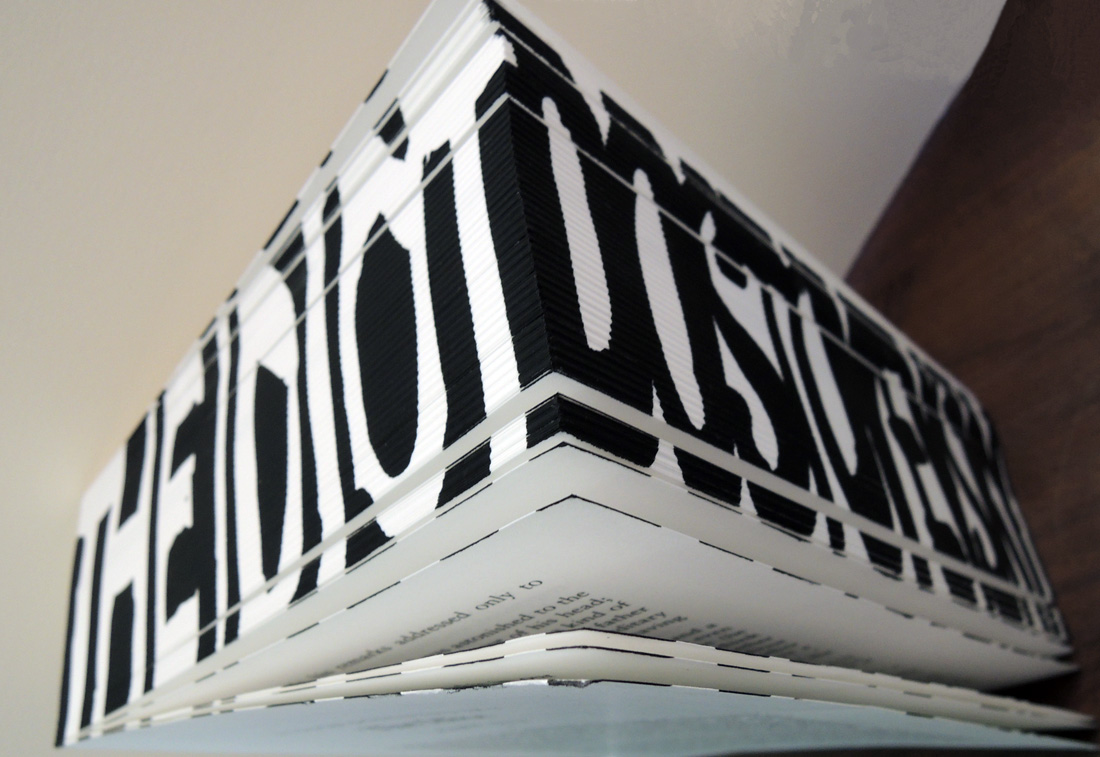
Fyodor Dostoyevsky (1821-1881), The Idiot (London: Penguin/Penguin designer Classics, 2006). Designed by Ron Arad (born 1951). One of 1000 copies. Graphic Arts Collection GAX 2014- in process.

Since 1946, Penguin Books has been publishing Penguin Classics in volumes individually designed in unexpected formats. For their 60th anniversary in 2006, five Penguin Designer Classics were crafted by five internationally known artists, most with no previous experience in book design. Each volume was released in an edition of 1000 copies, with a transparent Plexiglas (Perspex) box serving as the book’s slipcase, which also supplies protection for the curious designs. The Graphic Arts Collection now has four of the five out-of-print classics.

The Israeli industrial designer and architect Ron Arad chose to publish Dostoyevsky’s The Idiot bound but without boards, stating “by not wanting to have a cover, it ended with the book becoming an amazing object that is alive, but which maintains its transparency. It becomes a glorious box with a book inside, almost like a monument.” The title and author are printed on the fore-edges of the paperback.

lady chatterley


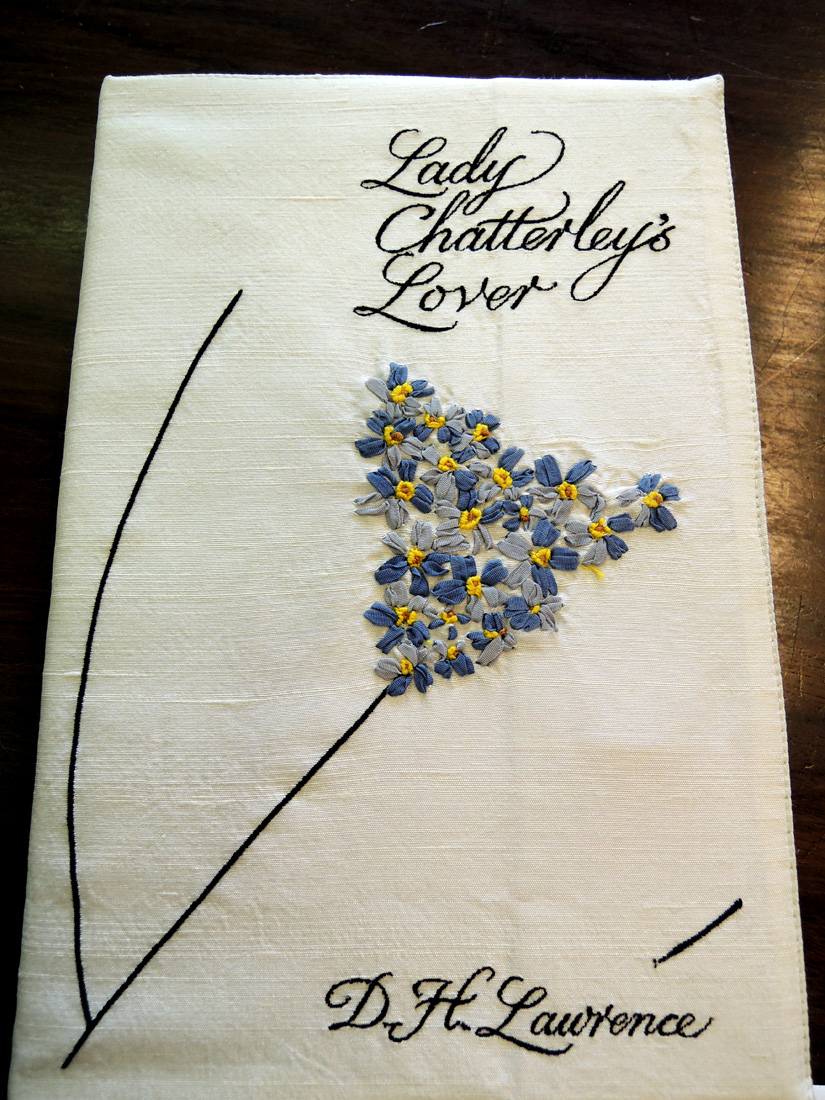
D.H. Lawrence (1885-1930), Lady Chatterley’s Lover (London: Penguin/Penguin Designer Classics, 2006). Designed by Sir Paul Smith (born 1946). One of 1000 copies. Graphic Arts Collection GAX 2014- in process.

Lady Chatterley’s Lover (first published in 1928) was given to the British fashion designer Sir Paul Smith, who bound the volume in a silk jacket delicately embroidered with flowers and title information, along with the Penguin logo on the spine.


bindings tender

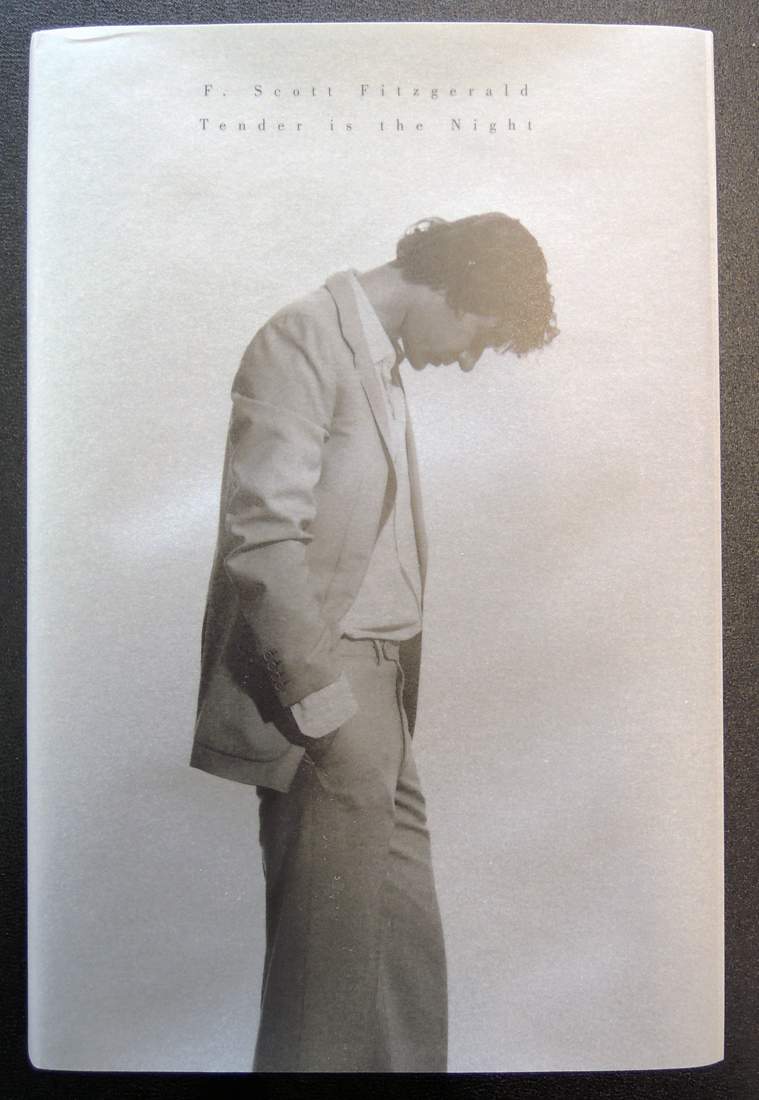
F. Scott Fitzgerald (1896-1940), Tender Is The Night: A Romance (London: Penguin/Penguin Designer Classics, 2006) Designed by Sam Taylor-Wood (born 1967). One of 1000 copies. Graphic Arts Collection GAX 2014- in process.

Tender is the Night was first published in Scribner’s Magazine between January and April, 1934. For the new edition, American photographer Sam Taylor-Wood constructed a translucent dust jacket printed with a soft, almost muffled photograph, seen both from the front and the back. The tranquility of the scene is continued in the type, barely visible at the top.

bindings tender2

Also acquired was Fyodor Dostoyevsky (1821-1881), Crime and Punishment (London: Penguin/Penguin designer Classics, 2006) Designed by Fuel. One of 1000 copies. Graphic Arts Collection GAX 2014- in process.

The graphic design firm Fuel was founded in 1991 by London artists Damon Murray and Stephen Sorrell. In general, Fuel books are initiated and compiled by the firm itself so this volume is fairly unique within their catalogue. The brown paper wrapper they created is printed in red with Russian text sandwiched between the English.

Still to be found is Gustave Flaubert (1821-1880), Madame Bovary, designed by the Spanish artist Manuel Blahnik (born 1942) founder of the high-end shoe brand Manolo Blahnik.

Of Light and Shade

rothchild of light2

rothchild of light

A specialist on the art of Leonardo, Jean Paul Richter (1847-1937) completed a translation and examination of the artist’s notebooks entitled Literary Works of Leonardo in 1883. Chapter 3 of volume 1 presents six books on the effects of light and shade, which are now available in full text online (III. Six Books on Light and Shade).

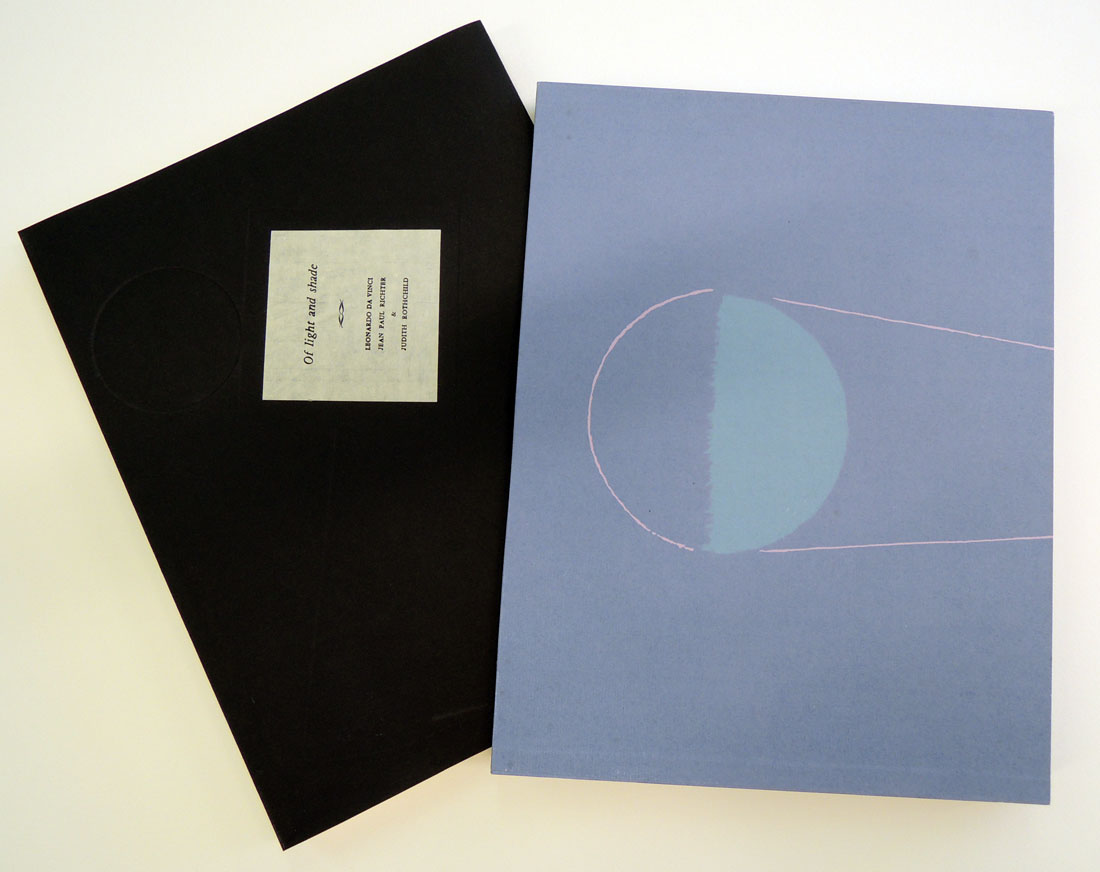
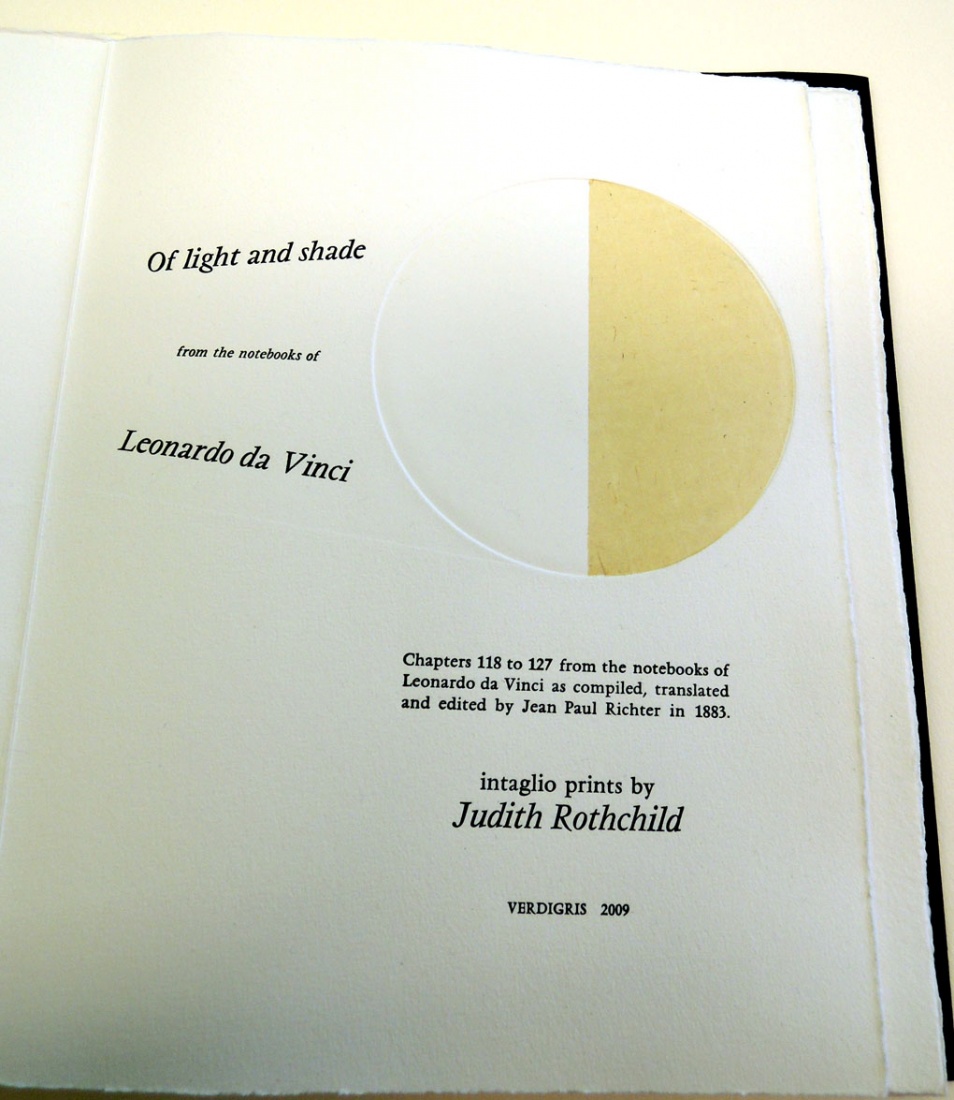
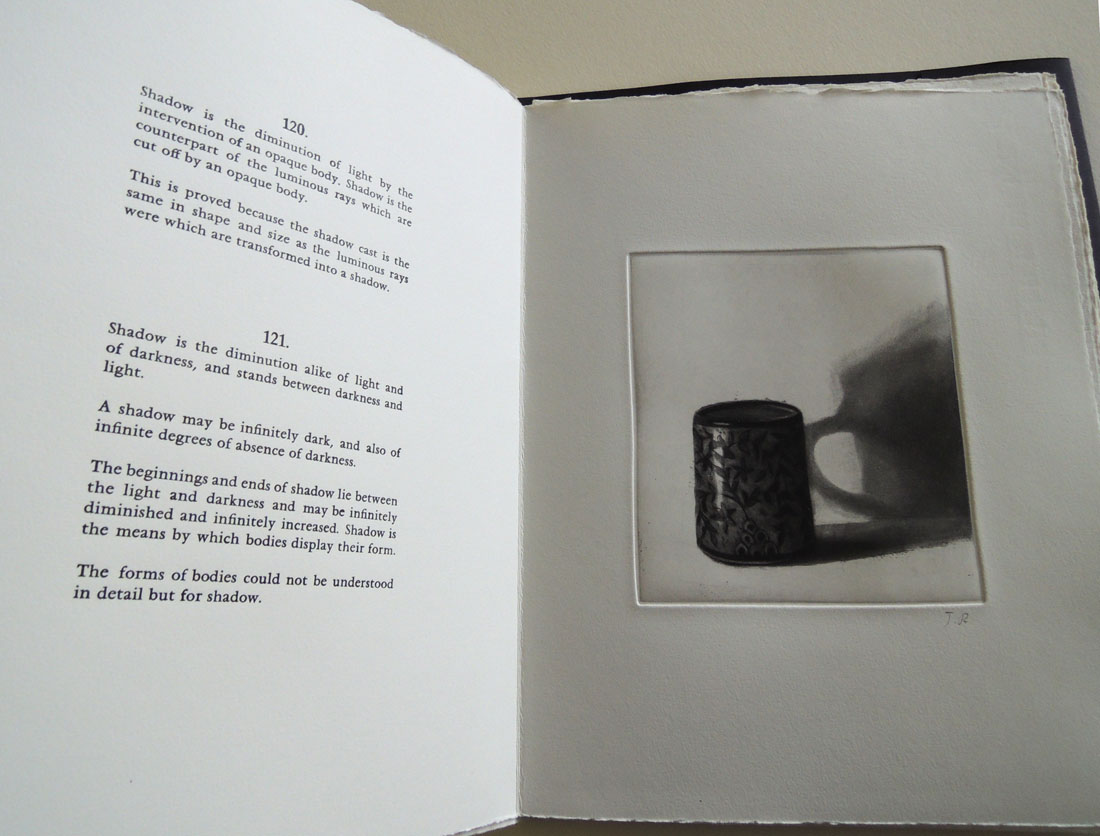
In response to these chapters, the contemporary artist Judith Rothchild created six intaglio prints, using mezzotint with rocker, roulette and, dry point additions. These were matched with text set by Mark Lintott in Vendome Romain and printed by him on an Albion press. Lintott bound the entire set in wrappers and a slipcase covered with handmade papers screenprinted by Rothchild.

Leonardo da Vinci, Of Light and Shade from the Notebooks of Leonardo da Vinci…as compiled, translated, and edited by Jean Paul Richter. Intaglio prints by Judith Rothchild ([Octon, France]: Verdigris Press, 2009). Copy 9 of 15. Graphic Arts Collection GAX 2014- in process.

rothchild of light3
118. Of Light. “The lights which may illuminate opaque bodies are of four kinds. These are: diffused light as that of the atmosphere, within our horizon. And Direct, as that of the sun, or of a window or door or other opening. The third is Reflected light; and there is a fourth, which is that which passes through [semi] transparent bodies, as linen or paper or the like, but not transparent like glass, or crystal, or other diaphanous bodies, which produce the same effect as though nothing intervened between the shaded object and the light that falls upon it; and this we will discuss fully in our discourse.” http://www.sacred-texts.com/aor/dv/

Leonardo da Vinci (1452-1519), The Literary Works of Leonardo da Vinci, compiled and edited from the original manuscripts, by Jean Paul Richter … (London: S. Low, Marston, Searle & Rivington, 1883). Marquand Library Oversize ND1130 .L56q


Happy Birthday Don Bachardy

bachardy portrait10

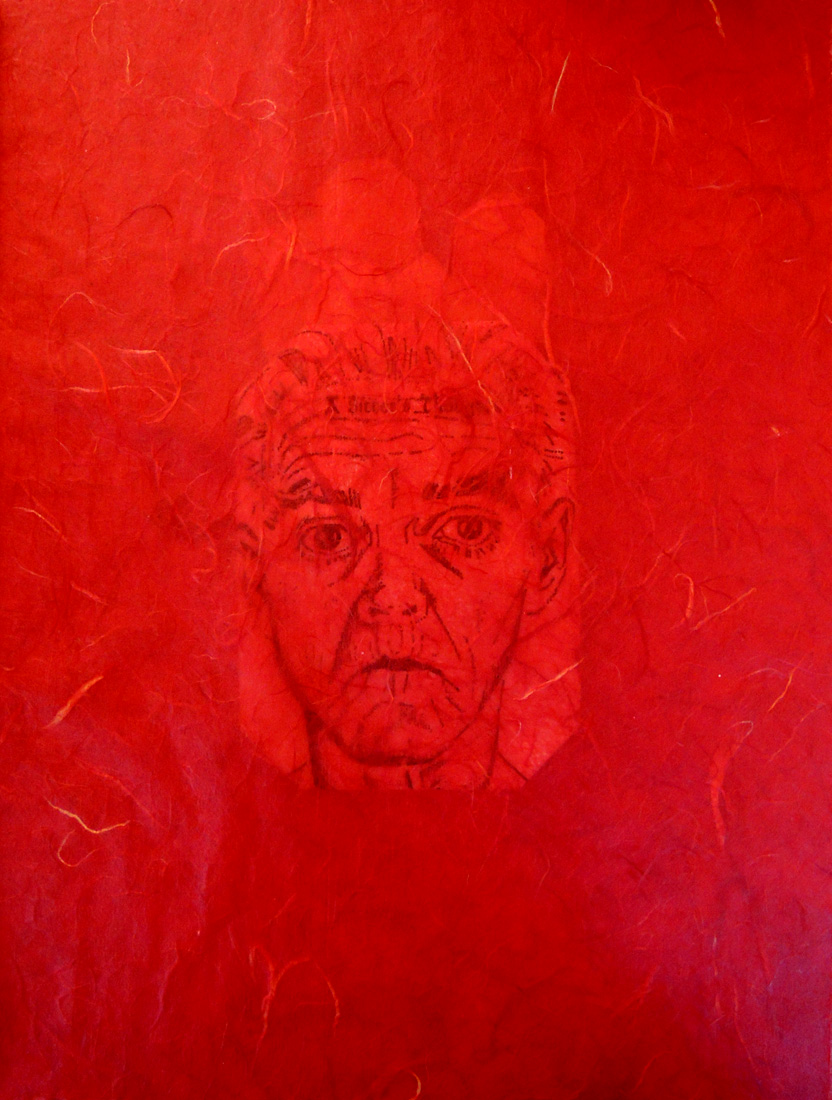
Inside back cover, image under Japanese paper

Next month on May 18, portrait artist Don Bachardy will celebrate his eightieth birthday. Thanks to the generosity of Peter Putnam, Class of 1942 (1927-1987) and the Mildred Andrews fund (named for his mother), the Graphic Arts Collection holds 27 portrait drawings by this talented California artist. In addition, Putnam donated several books of Bachardy’s portraits, including October (1981) and Don Bachardy: 100 Drawings (1983). .

bachardy portrait2    bachardy portrait3

bachardy portrait9      bachardy portrait8
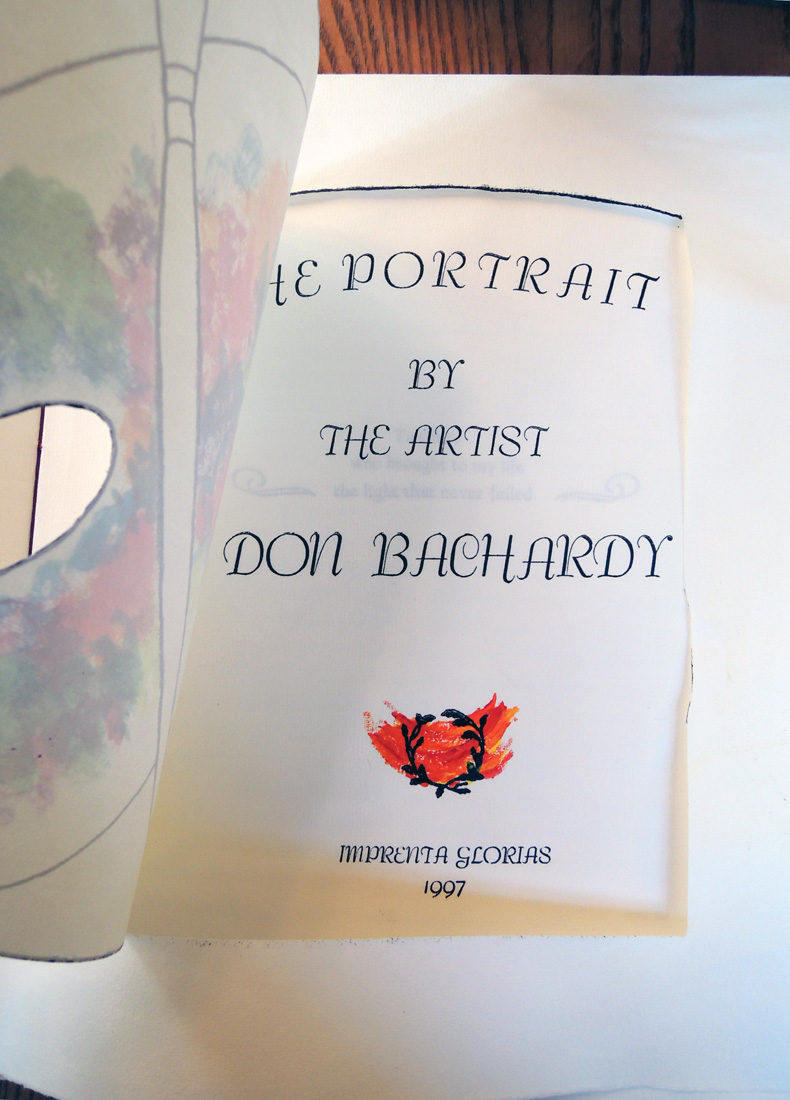
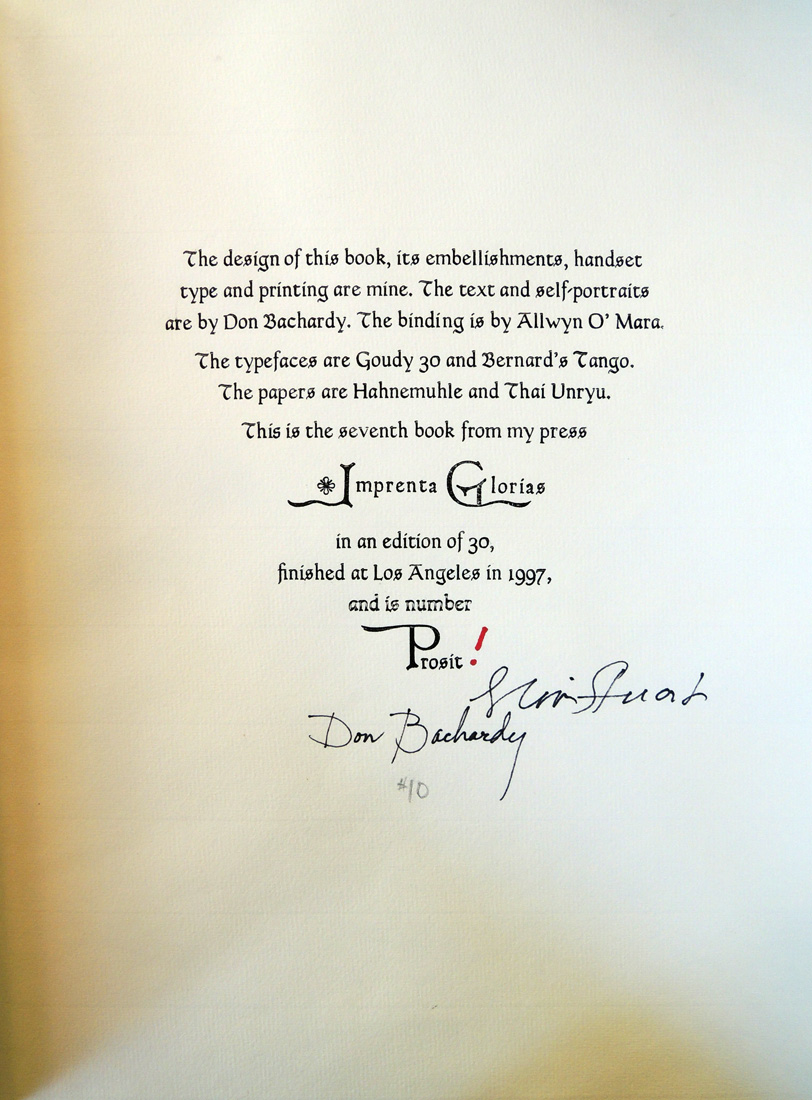
To these gifts, we added the collaboration between Bachardy and the actress/printer Gloria Stuart (1910-2010), published through her private press Imprenta Glorias. The design of the book, embellishments, handset type, and printing were all accomplished Stuart, while the images and text are by Bachardy. All 30 copies were bound by Allwyn O’Mara.

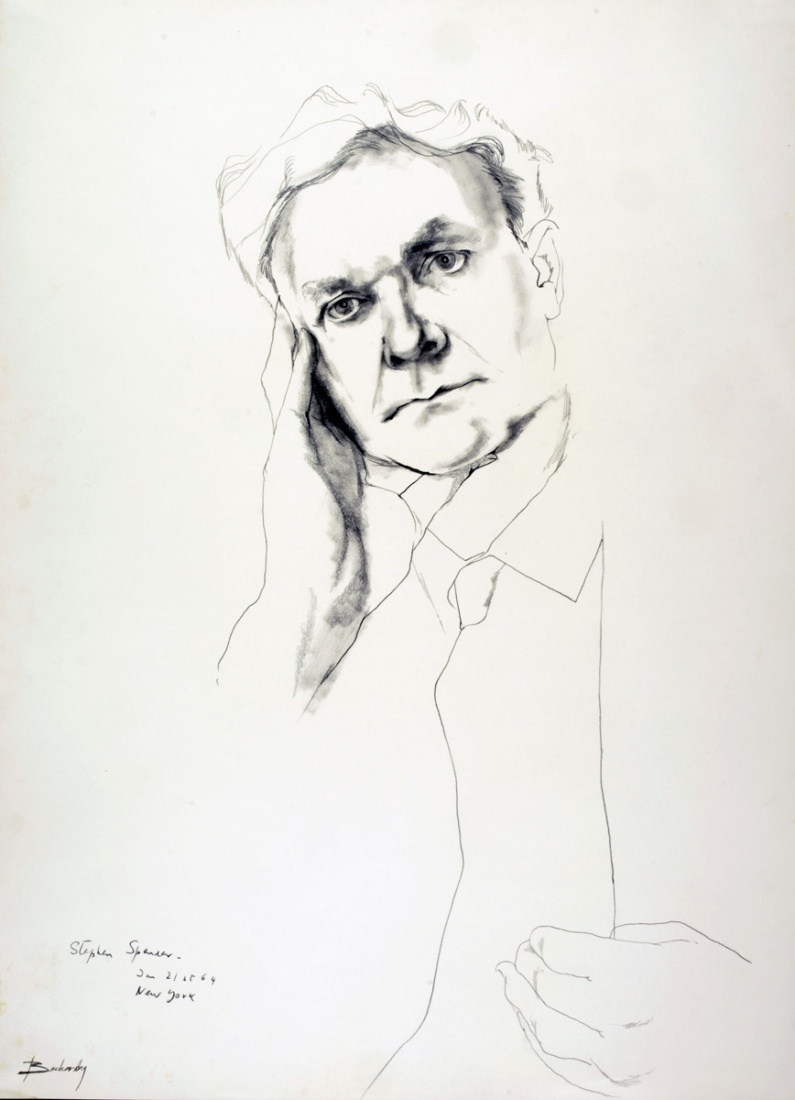
bachardy spender drawingsDon Bachardy (born 1934), Portrait of Stephen Spender, January 21, 1964. Pencil on paper with ink wash. Graphic Arts Collection. Gift of Peter Putnam, Class of 1946

bachardy portrait4


bachardy winter

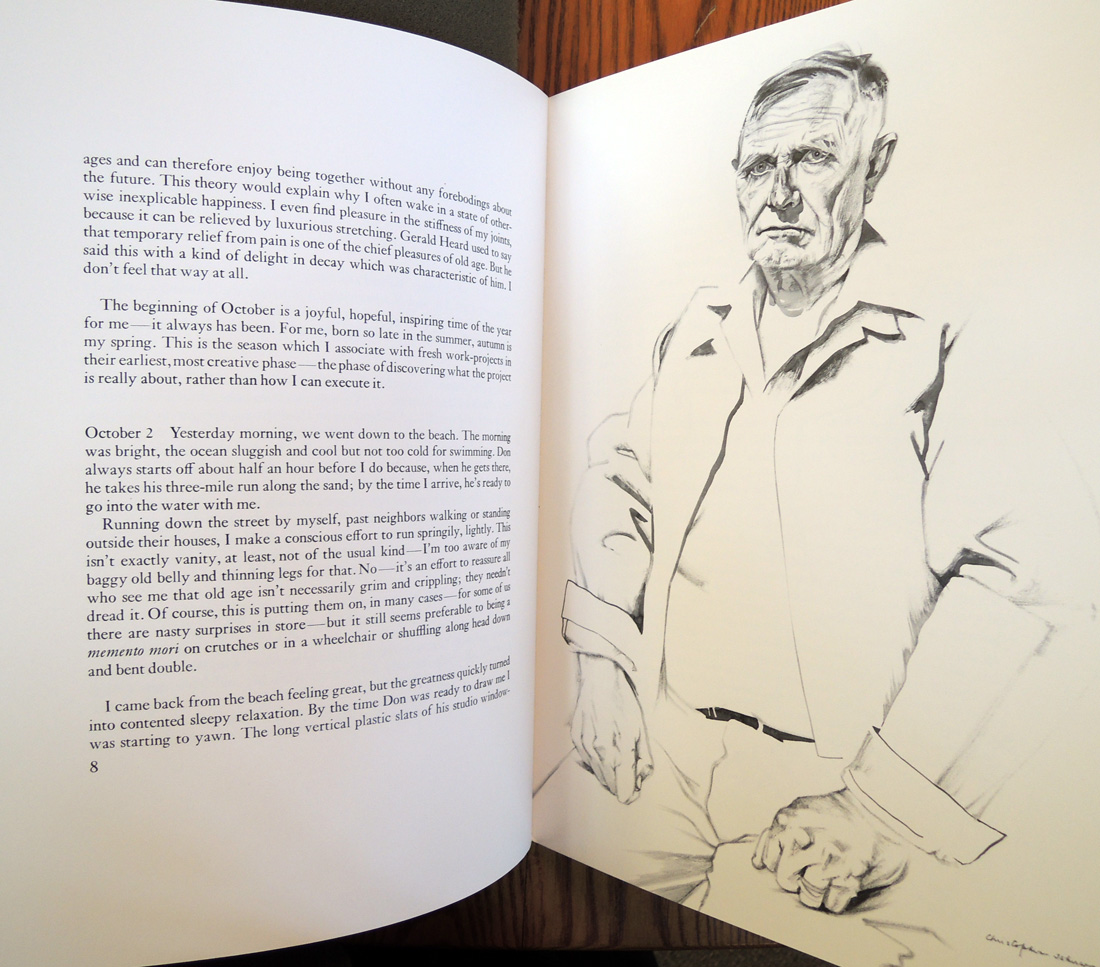
Christopher Isherwood (1904-1986), October, drawings by Don Bachardy (Los Angeles, Calif.: Twelvetrees Press, 1981). Graphic Arts Collection (GA) Oversize PR6017.S5 Z47 1981q

Don Bachardy (born 1934), Don Bachardy, one hundred drawings (Los Angeles: Twelvetrees Press, 1983). Graphic Arts Collection (GA) NC139.B24 A4 1983

Don Bachardy (born 1934), The Portrait ([Los Angeles]: Imprenta Glorias, 1997). Copy 10 of 30. Graphic Arts Collection (GAX) Oversize Z232.I326 B32q


Tempesta, “Raging death steers the boat”

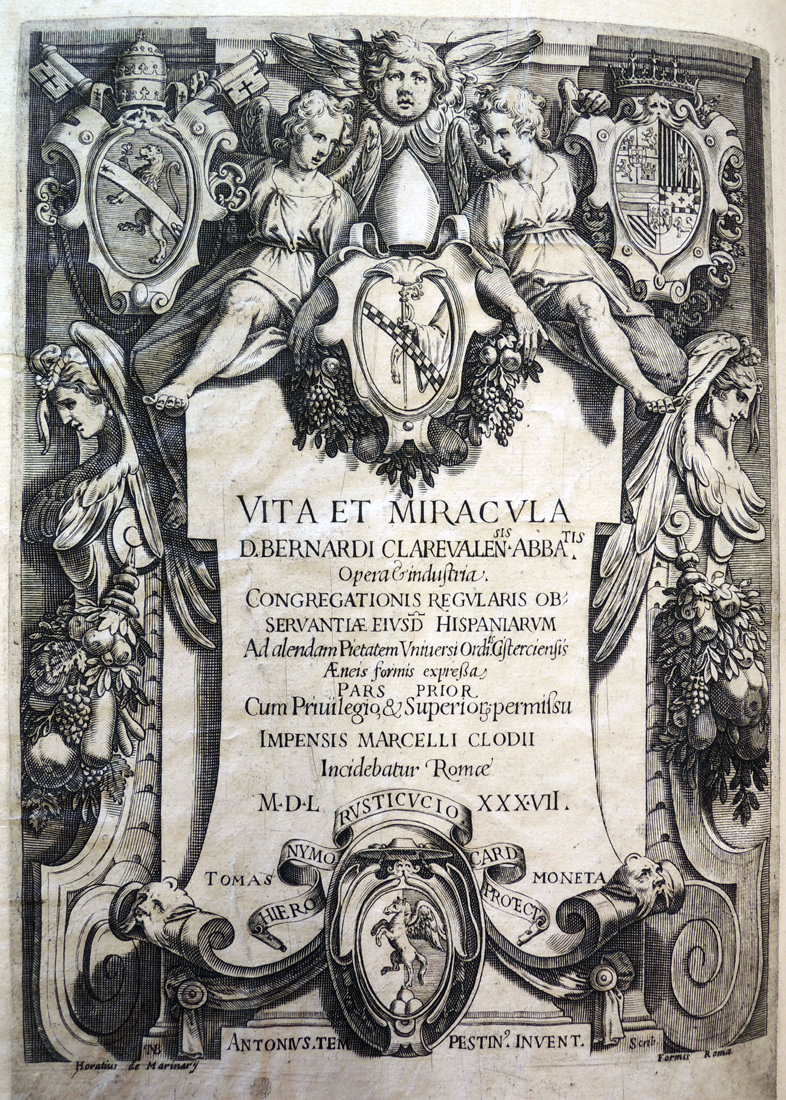
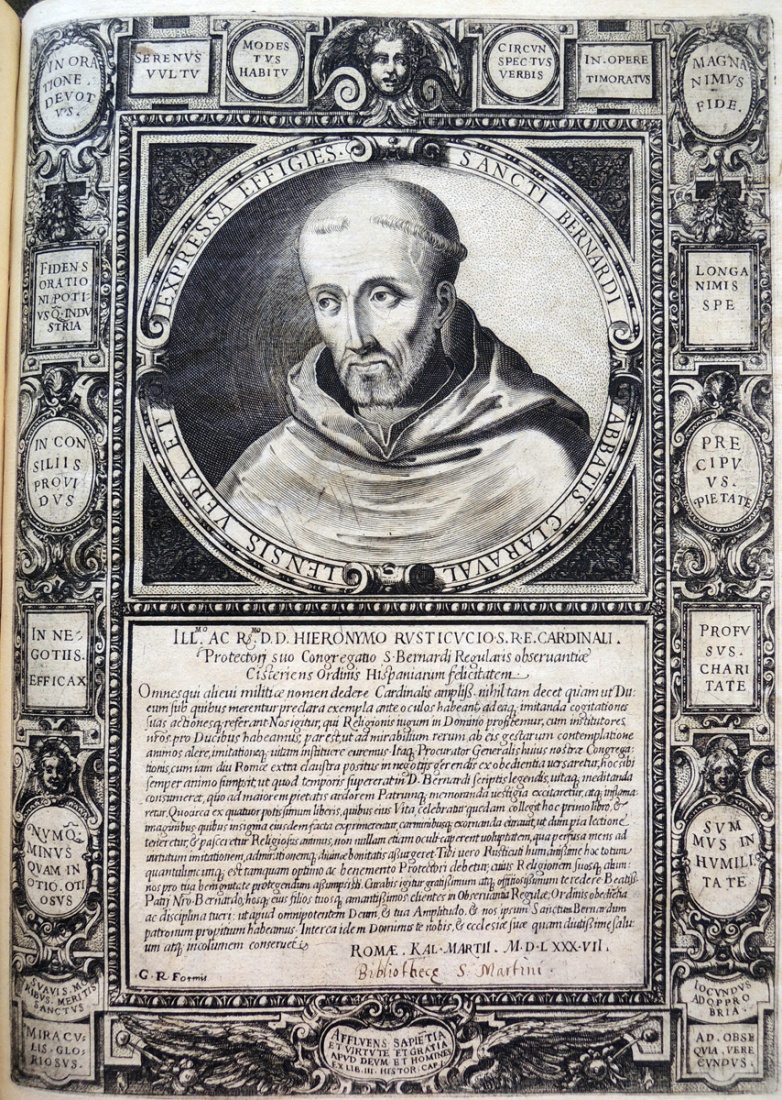
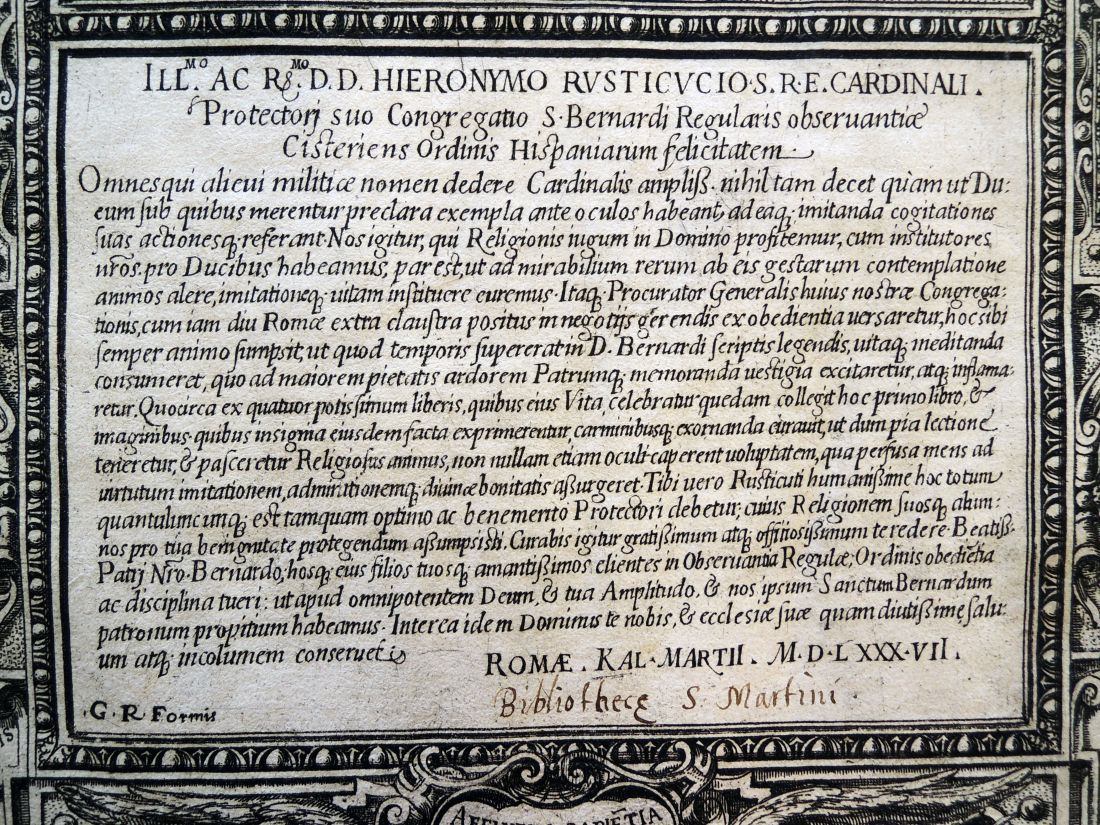
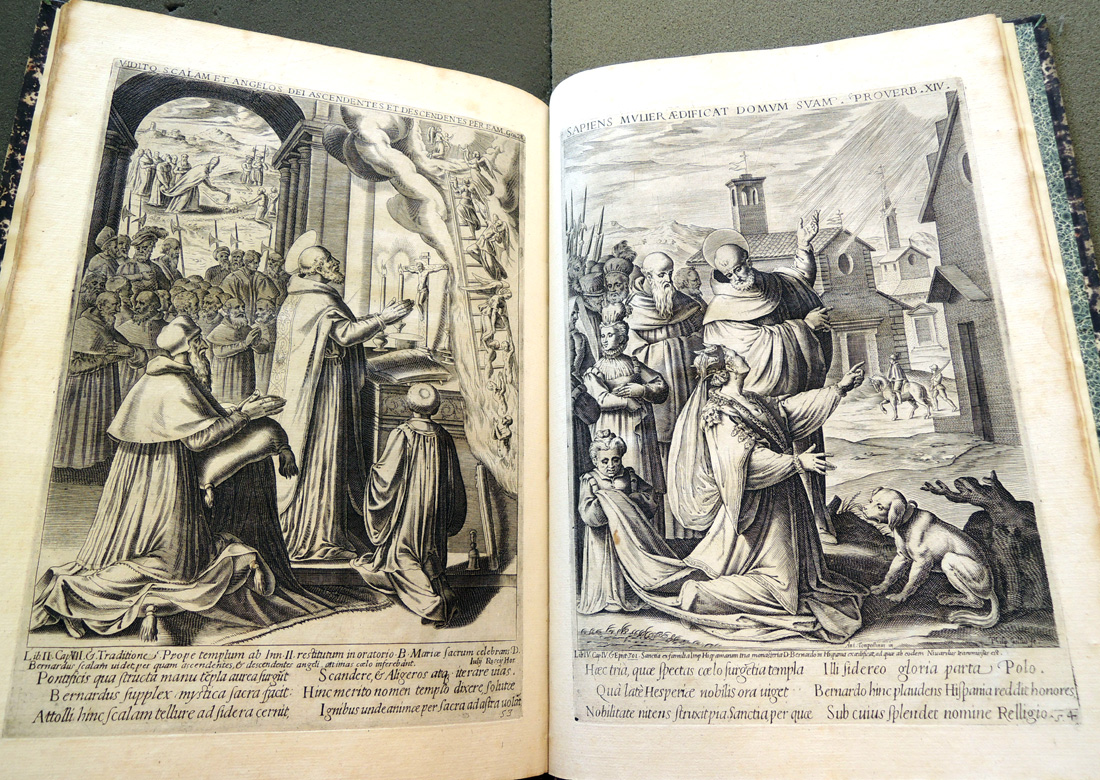
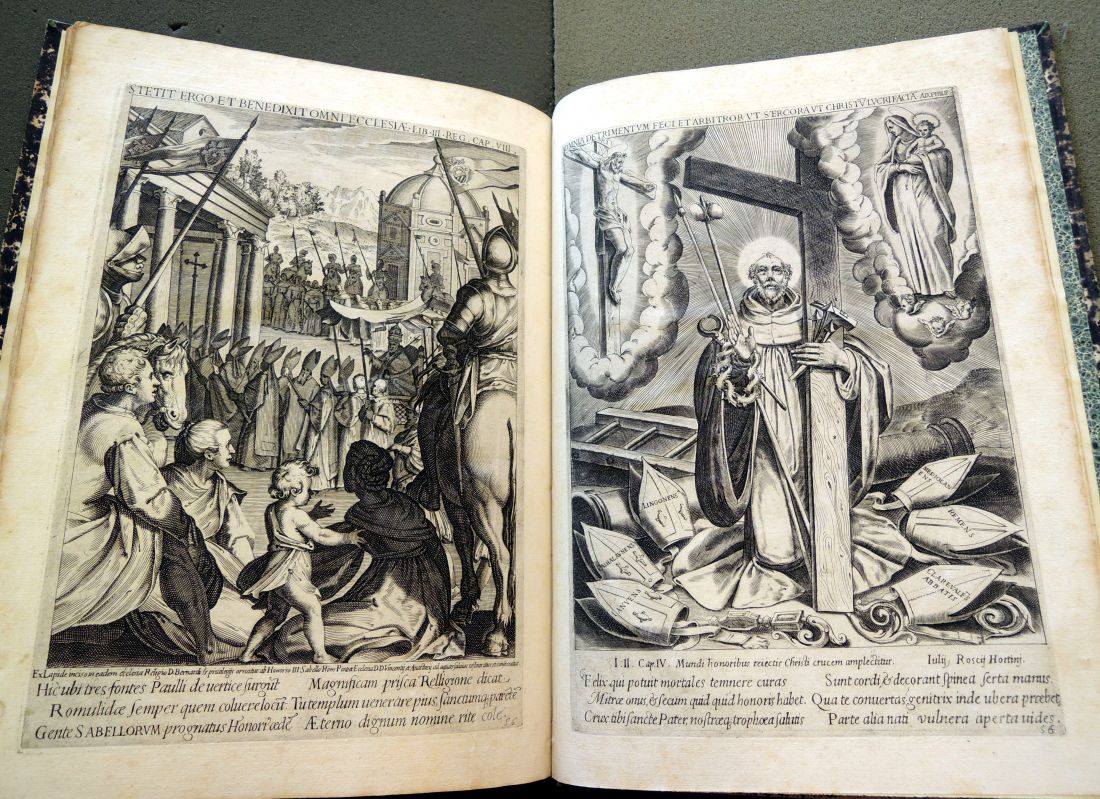
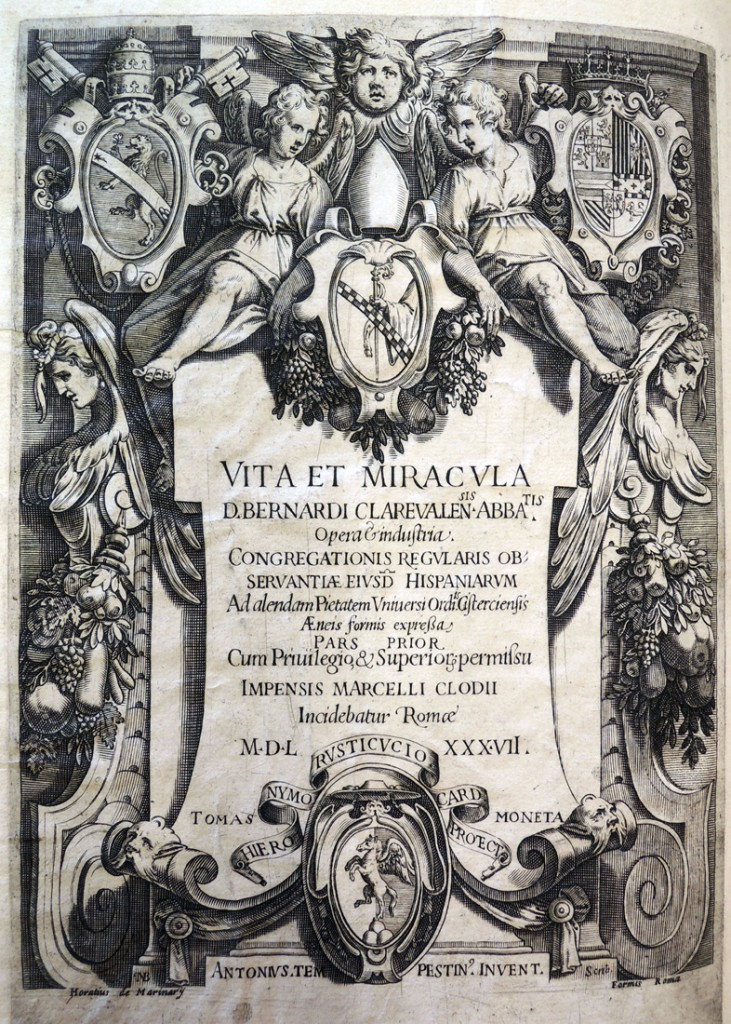
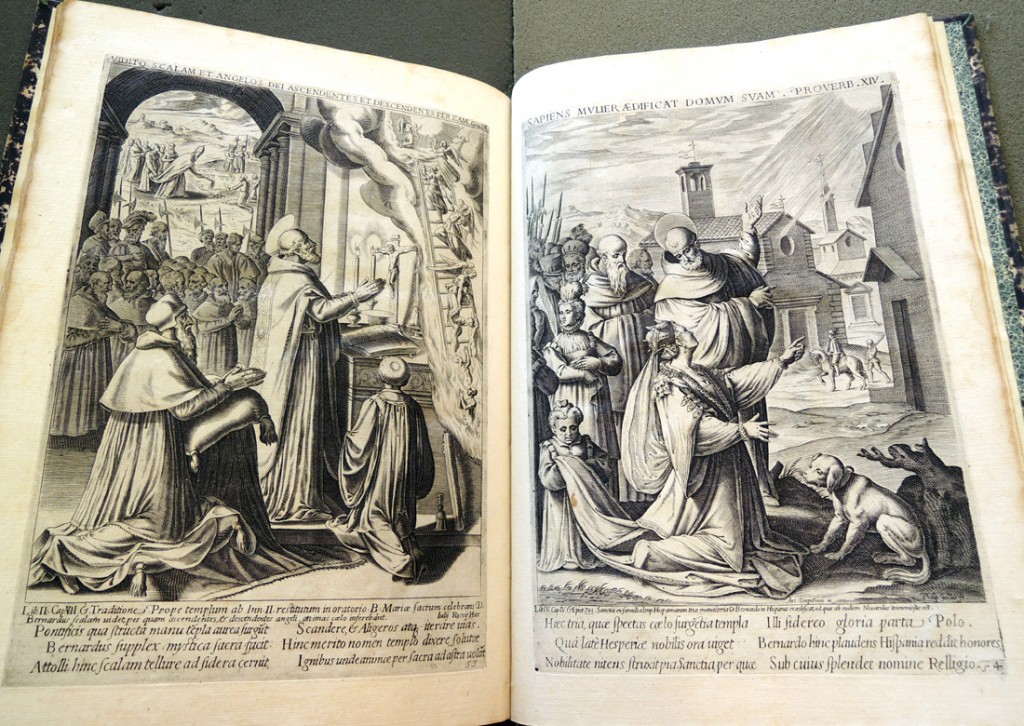
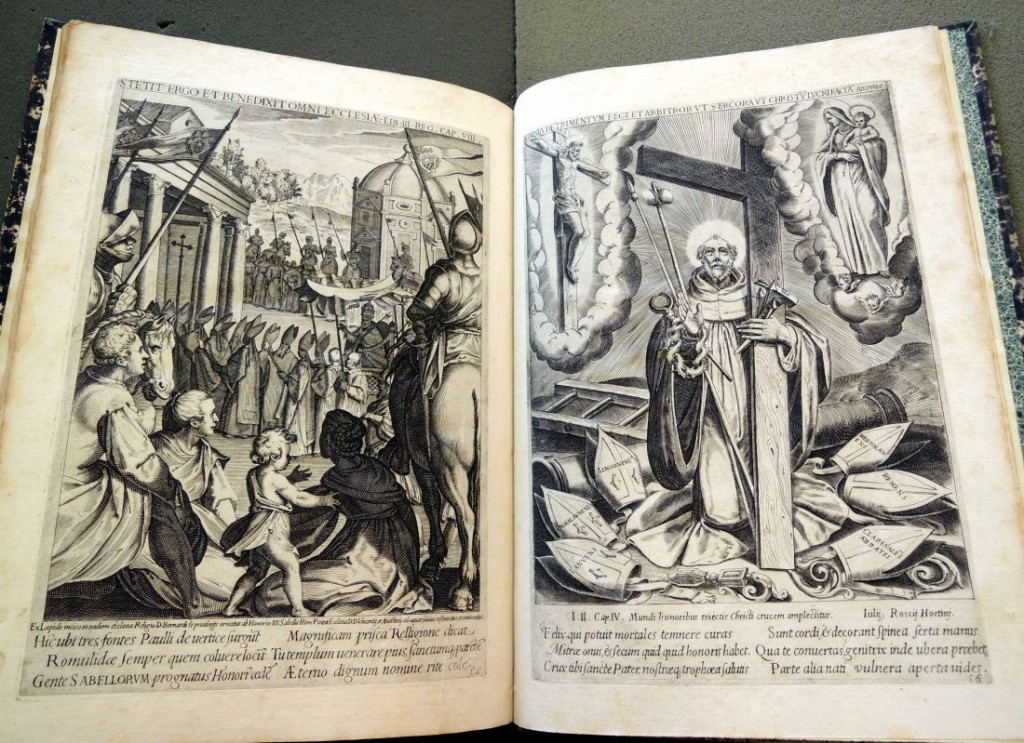
tempesta vita2Antonio Tempesta (1555-1530), Vita et miracula D. Bernardi Clarevallensis abbatis. Opera & industria Congregationis regularis obseruantiae eiusdem Hispaniarum ad alendam pietatem Vniuersi Ordinis Cisterciensis. Aeneis formis expressa. Pars prior. Cum priuilegio, & superiorum permissu. = The Life and Miracles of Lord Bernard, Abbot of Clairvaux. The Works and Diligence of His Regular Observant Congregation of Spaniards for the Spiritually Nourishing Piety of the Whole Cistercian Order. Printed with copper plates. Part one. With the privilege and permission of the superiors (Rome, 1587). 56 engravings depicting the life of Saint Bernard of Clairvaux (1090 or 1091-1153), 11 with monograms identifying various printmakers.

Bound with: Les Portraits de quelques personnes signalées en piété … de l’ordre des minimes (S.l., 1668) and Les figures et l’abrégé de la vie, de la mort et des miracles de S. François de Paule (Paris, 1664). More about these two in other posts.
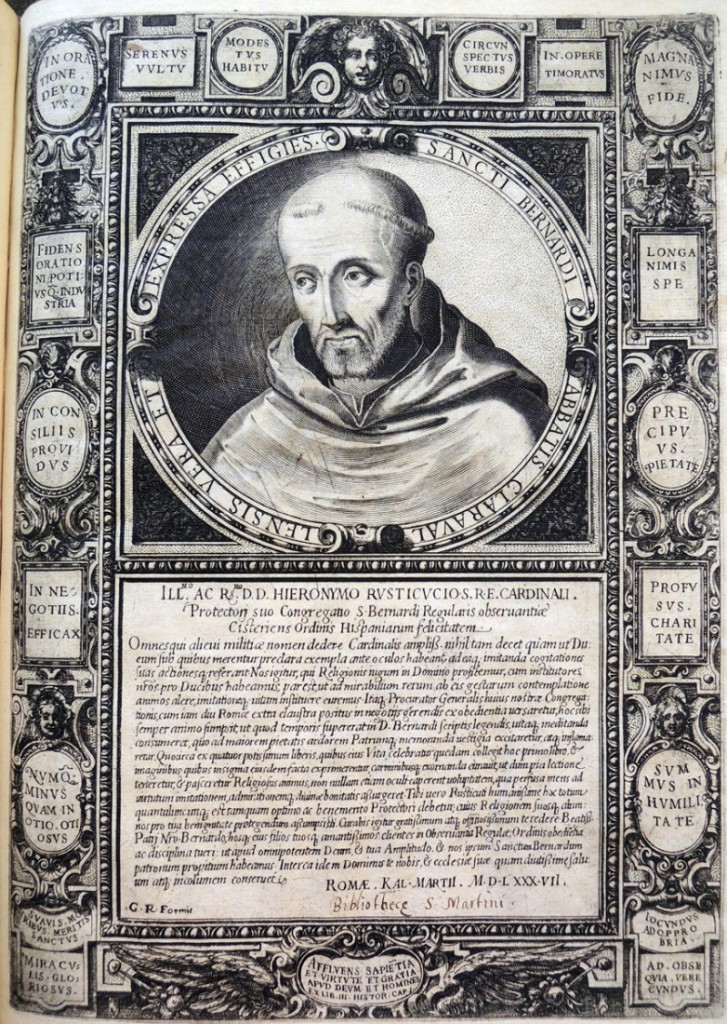
tempesta vita1

Antonio Tempesta (1555-1630) was a multifaceted Baroque artist who worked both large and small, in color and in black & white, designing enormous wall frescos as well as modest, albeit complex, book illustrations. In Rome, he was one of the artists Pope Gregory XIII selected to decorate the Loggia Gallery of the Vatican Palace, among many other projects. At the same time, he produced over 1,500 engraving, released in portfolios and as bound plates.

For his first published book, Tempesta was commissioned by the Cistercian Order to tell the story of the French abbot Bernard of Clairvaux, (1090-1153) who founded a monastery known as Claire Callée or Clairvaux. According to the Catholic Encyclopedia, Bernard “began that active life, which has rendered him the most conspicuous figure in the history of the 12th century. He founded numerous other monasteries, composed a number of works, and undertook many journeys for the honor of God.”
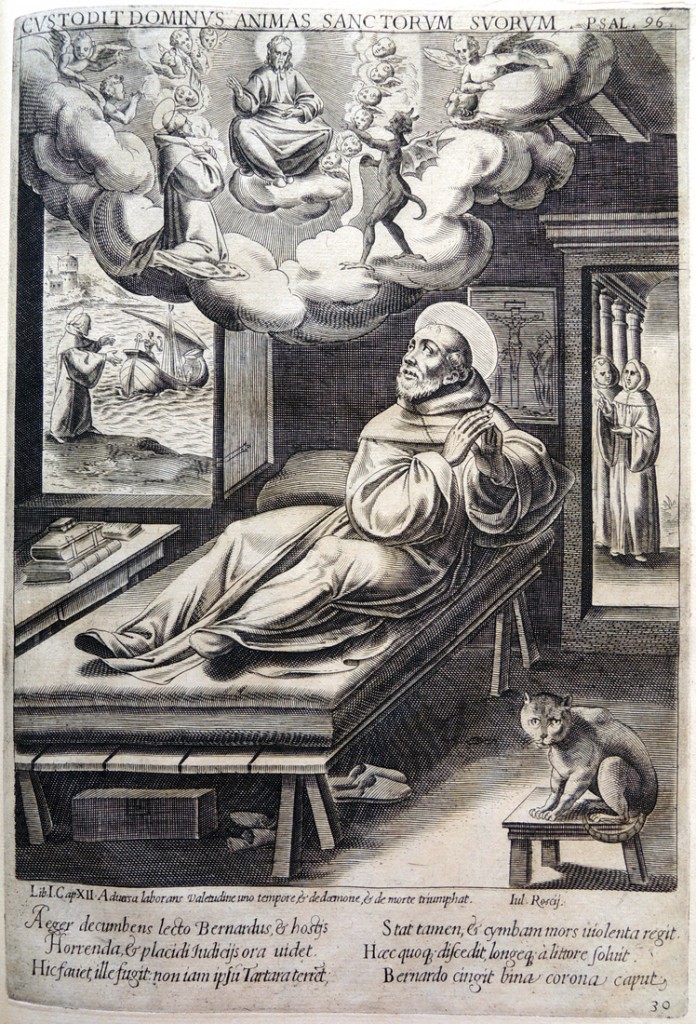
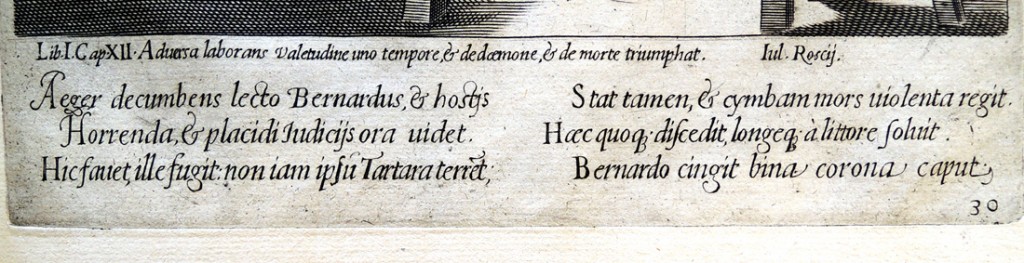
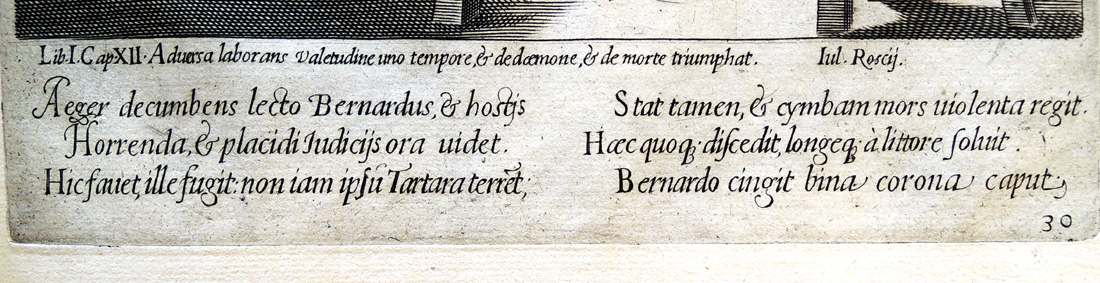
tempesta vita9tempesta vita10Custodit Dominus animas sanctorum suorum. Psal. 96. Lib. I. Cap. XII. Aduersa laborans valetudine uno tempore, & de daemone, & de morte triumphat. = [The Lord] preserveth the souls of his saints. Psalms 97:10. Book 1, ch. 12. Struggling simultaneously against disease, the devil, and death, he triumphs.

For the text, the Jesuit, humanist and polygraph Giulio Roscio (1550-1591) was selected, a specialist in religious poetry. He wrote six lines of verse at the bottom of each of Tempesta’s plates. This one translates:

Lying sick in bed, Bernard sees both the horrors of the enemy, and the face of the one who is gentle in judging. /  This one befriends, that one flees; now the nether regions themselves hold no terrors; he, however, stands; and raging death steers the boat. / The boat also departs, and sets sail far from shore. A double crown encircles Bernard’s head.
tempesta vita4

tempesta vita3See more of Tempesta’s work:

Antonio Tempesta, Metamorphoseon, siue, Transformationum Ouidianarum libri quindecim, æeneis formis ab Antonio Tempesta Florentino incise… (Amsterodami, Wilhelmus Ianssonius excudit [1606?]) Rare Books (Ex) NE662.T45 O94 1606

Antonio Tempesta, Septem orbis admiranda ex antiqvitatis monimentis collecta, et oblectationi pvblicae in aereas tabvlas ab Antonio Tempesta Florentino relata (Antuerpiae, Venduntur apud I.B. Vrintium [1608]) Marquand Library (SAX): Rare Books NE662.T24 A3

Otto van Veen, Batavorum cum Romanis bellum, engraved by Antonio Tempesta (Antuerpiae: Apud auctorem vaeneunt, 1612) Rare Books (Ex) Oversize 2009-0462Q


The Elysium of Animals: A Dream

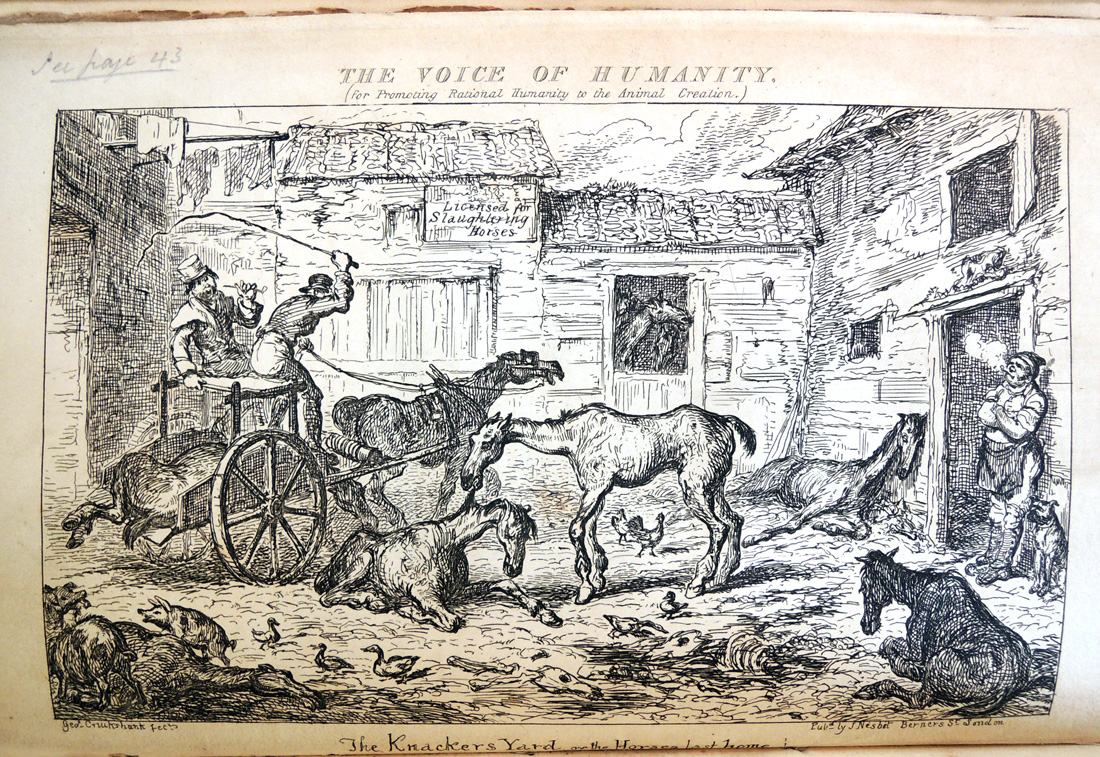
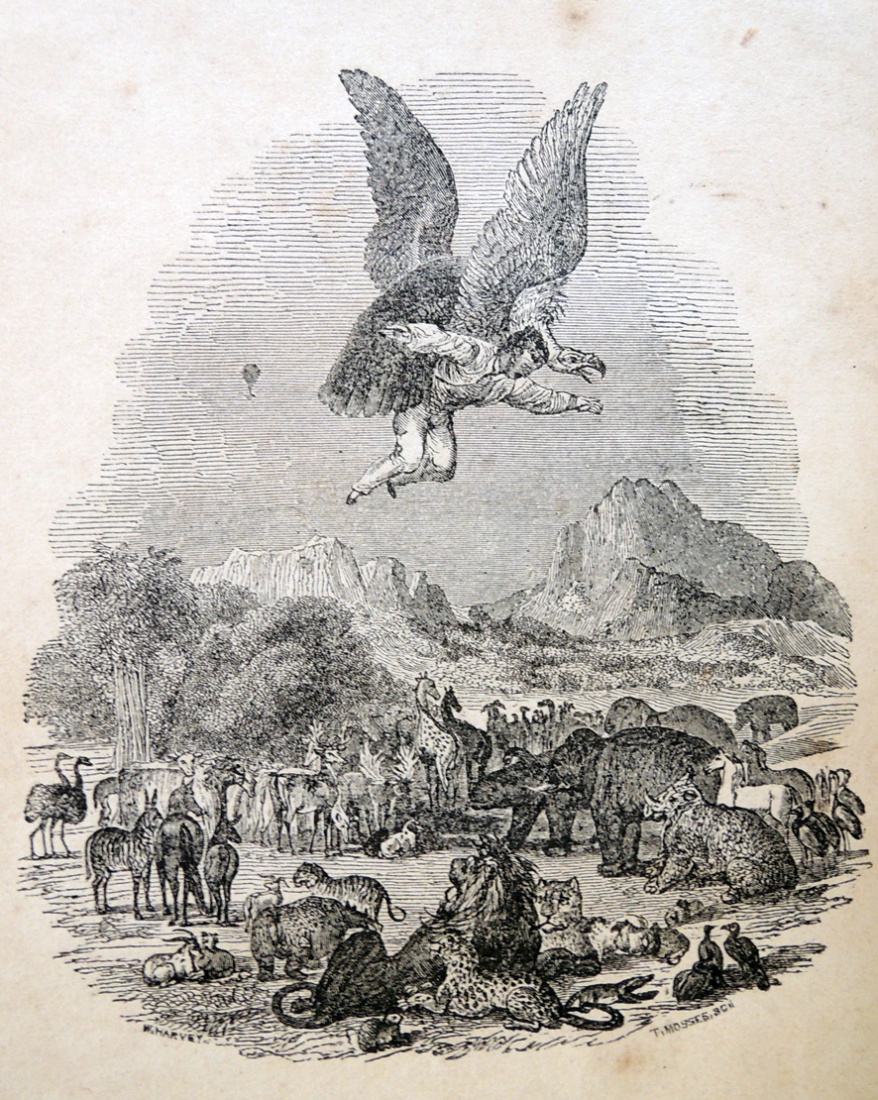
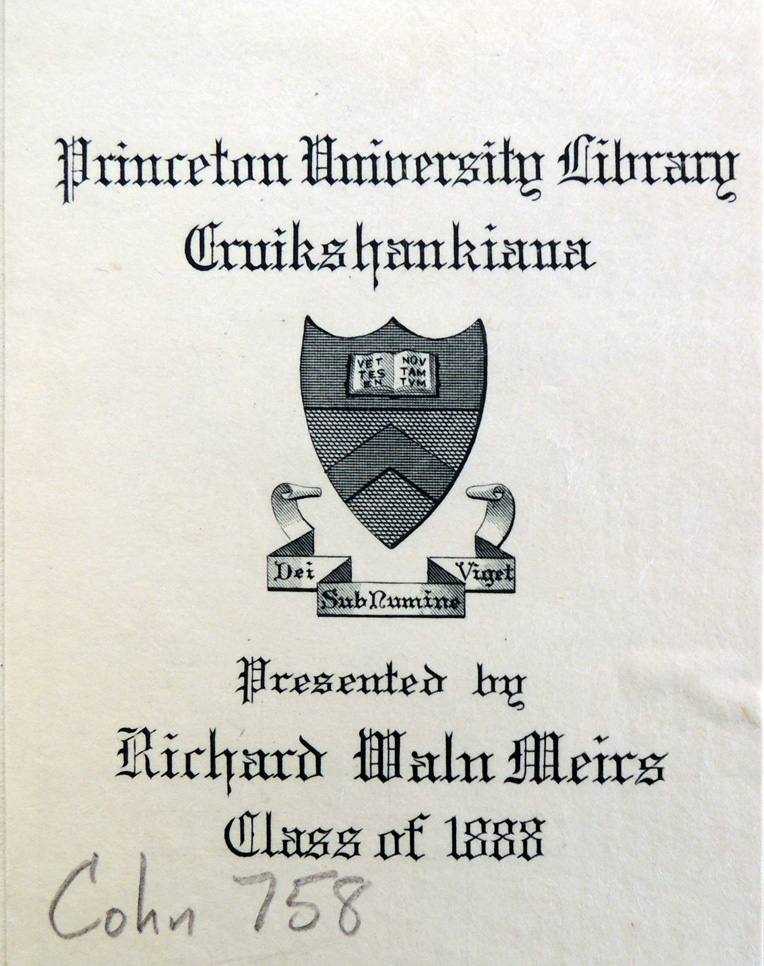
cruikshank voice of“The Knacker’s Yard,” by George Cruikshank (1792-1878), second state, in Egerton Smith, The Elysium of Animals: a Dream (London: J. Nisbet … 1836). Frontispiece by W. Harvey, the other illustration by Cruikshank. Originally published in The Melange. Prospectus of the Late Association for Promoting Rational Humanity towards the Animal Creation, and of its quarterly periodical, The Voice of Humanity, issued together.  Arts Collection (GA) Cruik 1836.9. Gift of Richard Waln Meirs, Class of 1888.
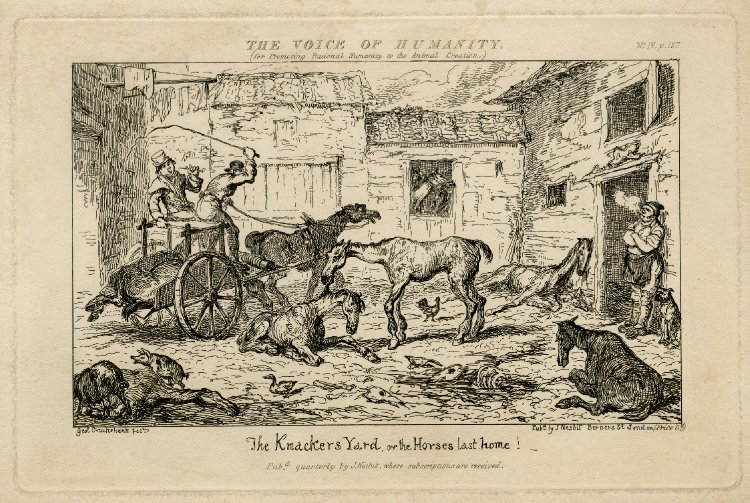
AN01442122_001_lThe Knacker’s Yard, First state. (c) British Museum

cruikshank voice of3

The Monthly Review for 1836 commented on the book,

“That the author has succeeded in his endeavour to exhibit to the reader the odious character of wanton severity towards the lower animals, in a more forcible light than the common observer would discover for himself we admit. He has also put the subject upon such a ground, and treated it in such a shape as will naturally arouse the attention of the young, and the unreflecting. At the same time, we feel that he sometimes pitches his appeals too high, and that thereby he has run the risk of defeating the very object he had in view. For instance – and we care not by what human authority he backs his conjecture – it seems to us quite unnecessary, in pleading in behalf of the inferior animals, to suppose that they may enjoy a future state of existence.”

cruikshank voice of2
cruikshank voice of4

Cohn 758: Egerton Smith, The Elysium of Animals. A Dream. 8vo. London: J.Nisbet, Berners Street. 1836. Etched plate at p.83 of “The Knacker’s Yard” in second state (see note to no. 825). There is a frontispiece by W. Harvey.

Cohn 825: The Voice of Humanity: For the Communication and Discussion of all Subjects Relative to the Conduct of Man towards the Inferior Animal Creation. 3 Vols. 8vo. London: J. Nisbet, Berners Street. 1830-1833. The first volume was issued in four quarterly parts, the second and third volumes in white-grey printed cloth boards. The title of the second and third volume was changed to The Voice of Humanity: for The Association for Promoting Ratinal Humanity toward the Animal Creation. In the second volume the publishers’ name upon the title is spelt “Nisbett” instead of Nisbet as in the first and third volumes.

Part 4 of Vol. 1 contains the famous etching of “The Knacker’s Yard” in its first state before its alteration; and the same plate, in the second state, with the addition of more chickens, the notice, and writing above the window, in the centre of the plate, is at p.134 of Vol. 4. Douglas states that there is a still earlier state of the plate with the date at the bottom of the plate in the right-hand corner, and this state should be in Part 4 of Vol. 1. I am very doubtful of this, however, especially as he gives the date 1931, instead of 1830. Certainly it is not so in my copy of the parts, which belonged to Mr. Truman, and in which he has placed an autograph note, stating it to be first state, while the etching in Vol. 3 he designates second state. I have never seen copies with the date as mentioned by Doubglas. The plate appears int he second state in ‘The Melange,’ ‘The Elysium of Animals,’ and ‘Address of Earl Stanhope,’ . . .”

4 Japanese Rhythms

hartmann 4 japanese4In 1933, while most Greenwich Village residents were struggling to pay their rent and feed their families, Lew Ney (Luther Widen, 1886-1963) divided his time between fund raising and typesetting fine press poetry.

The sale of his latest newssheet, The Sunday Bruncheon: Another wee magazine done by Lew Ney (1932-1933) funded his Sunday Breakfast Club, where free meals were offered throughout the day to the neighborhood writers and artists.

hartmann 4 japanese     hartmann 4 japanese2

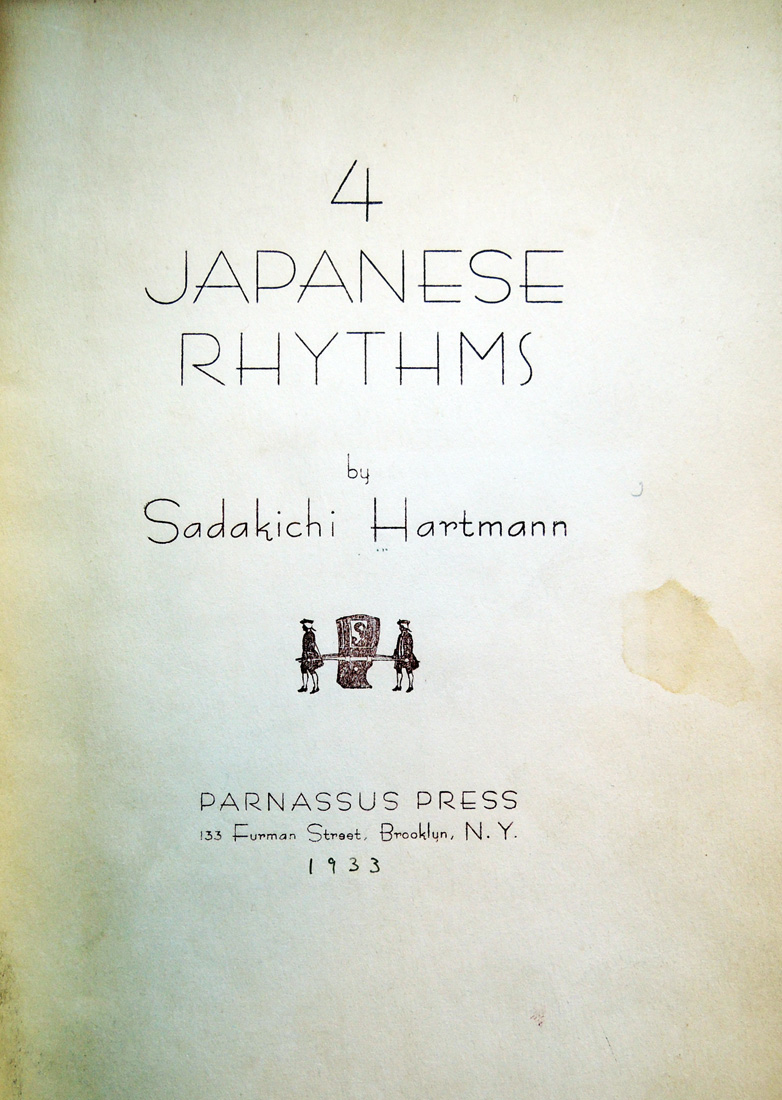
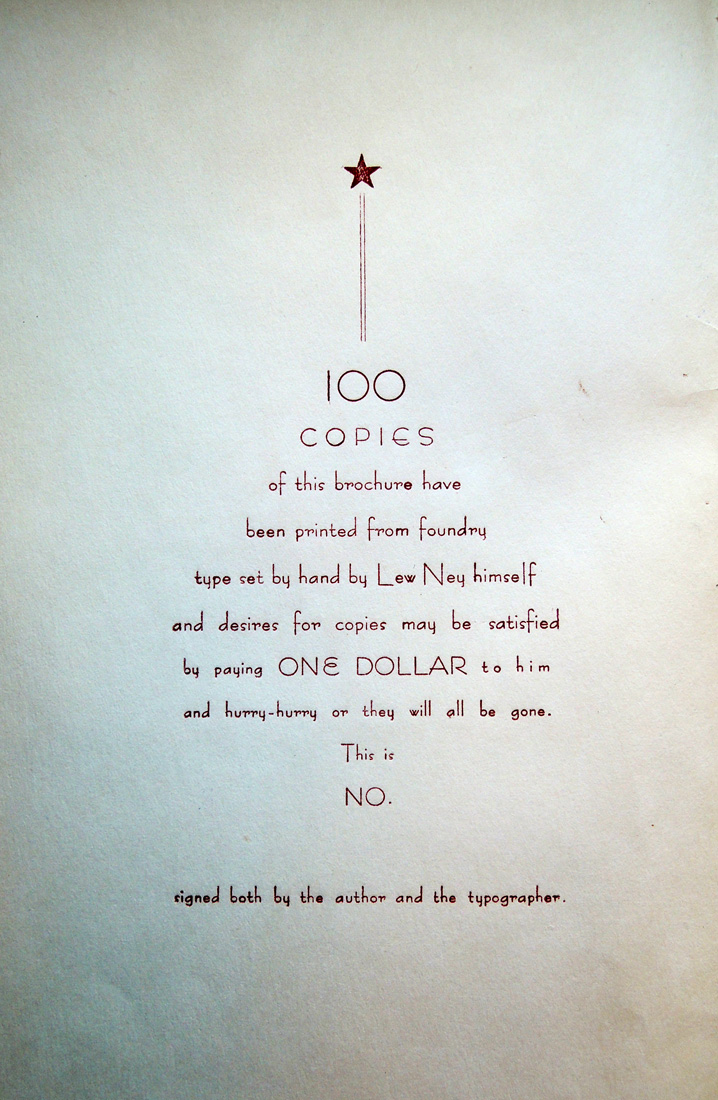
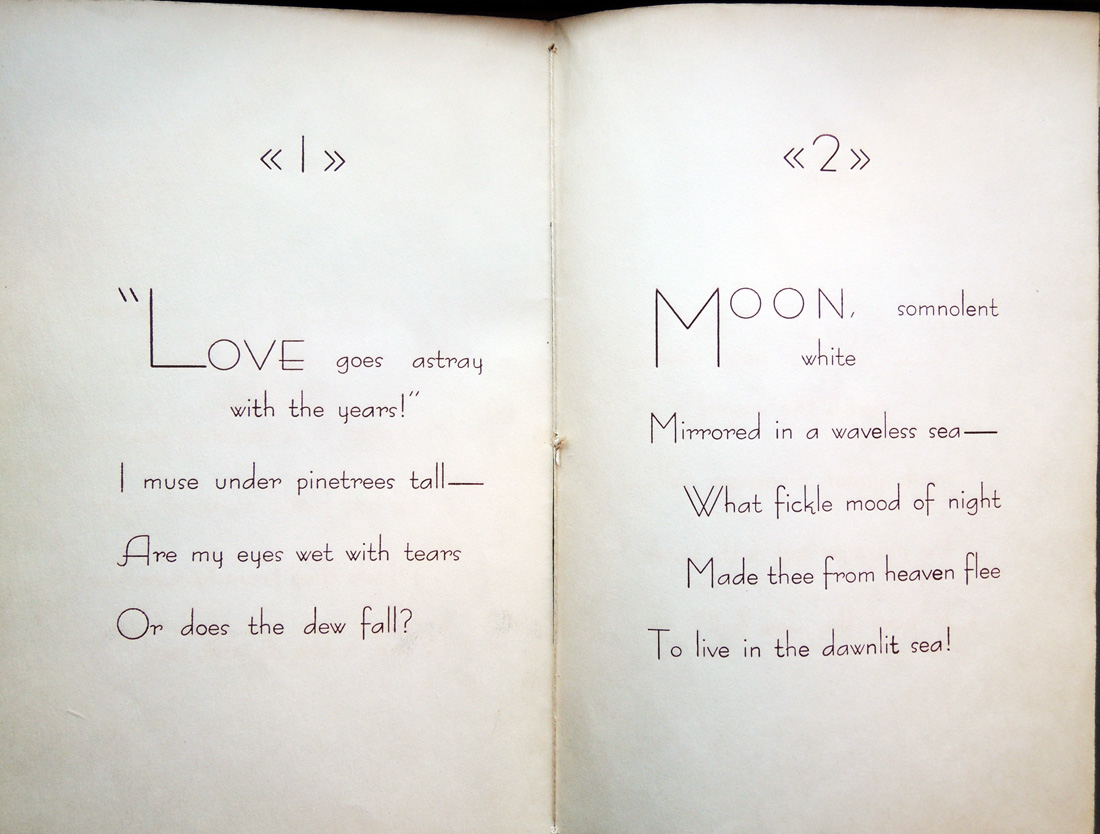
Around once a month, Lew Ney designed, printed, and published a letterpress edition commissioned by a local poet, under the imprint Parnassus Press. One of the most lyrical and visually appealing was 4 Japanese Rhythms by Sadakichi Hartmann (1867-1944), typeset in a coldwater studio on Furman Street, along the Brooklyn waterfront. The edition of 100 copies was advertised at the inexpensive cost of $1, with the overly optimistic comment “and hurry-hurry or they will all be gone.” Today, only Princeton University Library holds a copy of this book by a noted art historian and poet (donated by Lew Ney), leaving the actual print run in doubt.

Hartmann’s book was followed by 8 Bells by John Cabbage, one of several volumes Lew Ney published for the New York City sanitation inspector who spent his days among the garbage scows on the East River. Cabbage’s fine press editions are surprisingly well represented in academic libraries across the country, including Princeton.

The New York Herald Tribune failed to review either book, preferring to comment on Lew Ney himself, always a figure of public interest. “Lew Ney and Ruth Willis Thompson have moved their private press over to Brooklyn and set up housekeeping with a ship’s bell, a spinning wheel, shaker chairs, and skis. . . contributions of cash or provisions are invited, to help feed the hungry literati who come in on Sundays… this is not a joke; actual relief is being given.” (“Turns with a Bookworm,” New York Herald Tribune, March 5, 1933).
hartmann 4 japanese3See also: Rudolf Eickemeyer (1862-1932), Winter, introduction by Sadakichi Hartmann (New York: R. H. Russell, 1903). Graphic Arts Collection (GAX) Oversize 2006-1032Q

Sadakichi Hartmann (1867-1944), 4 Japanese rhythms  (Brooklyn: Parnassus Press [1933]). Graphic Arts collection in process

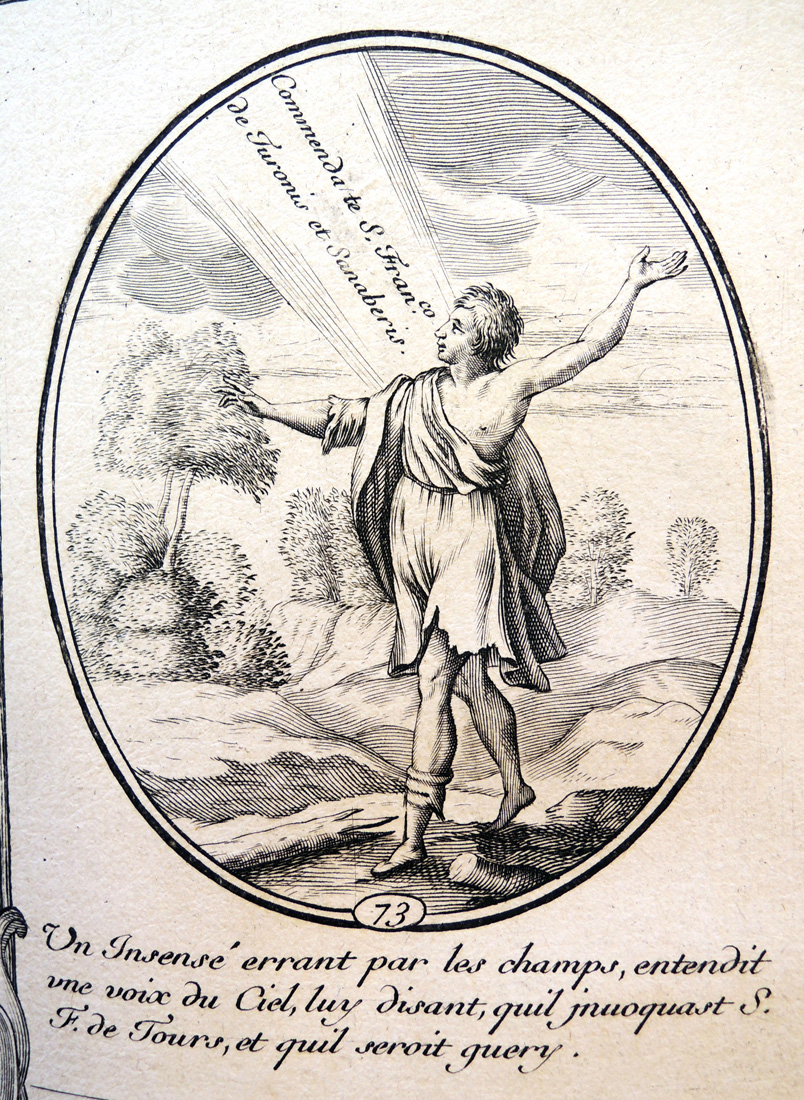
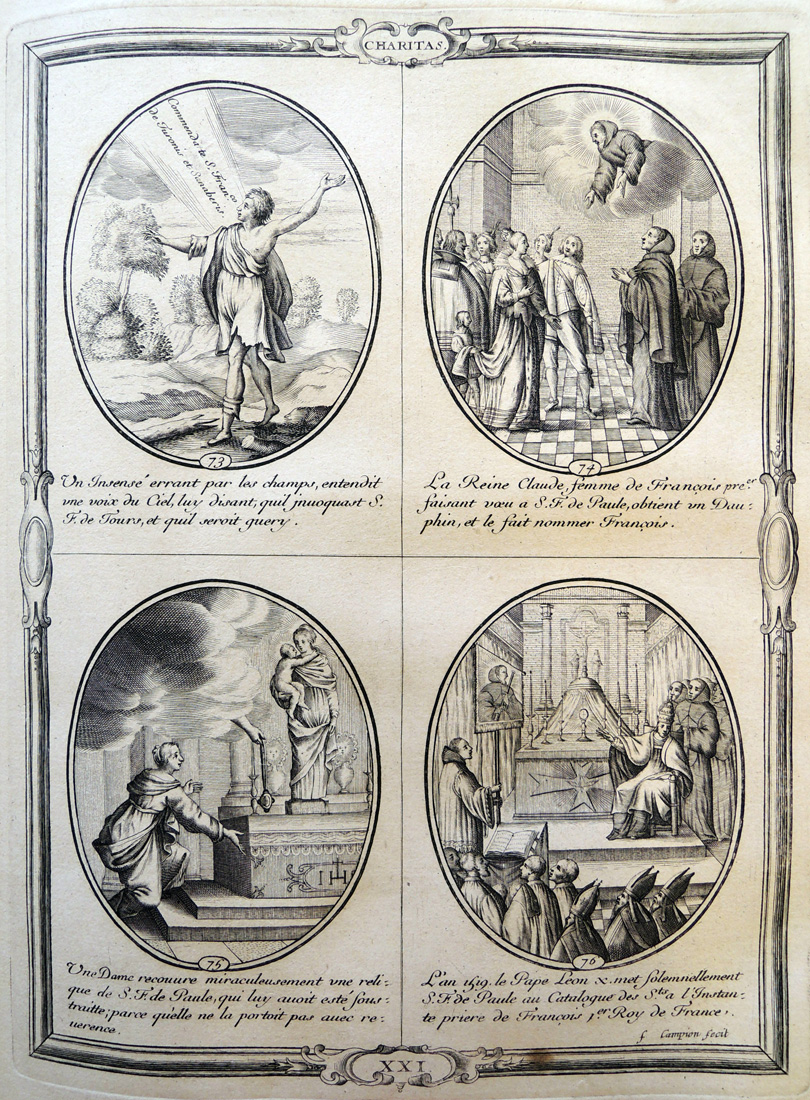
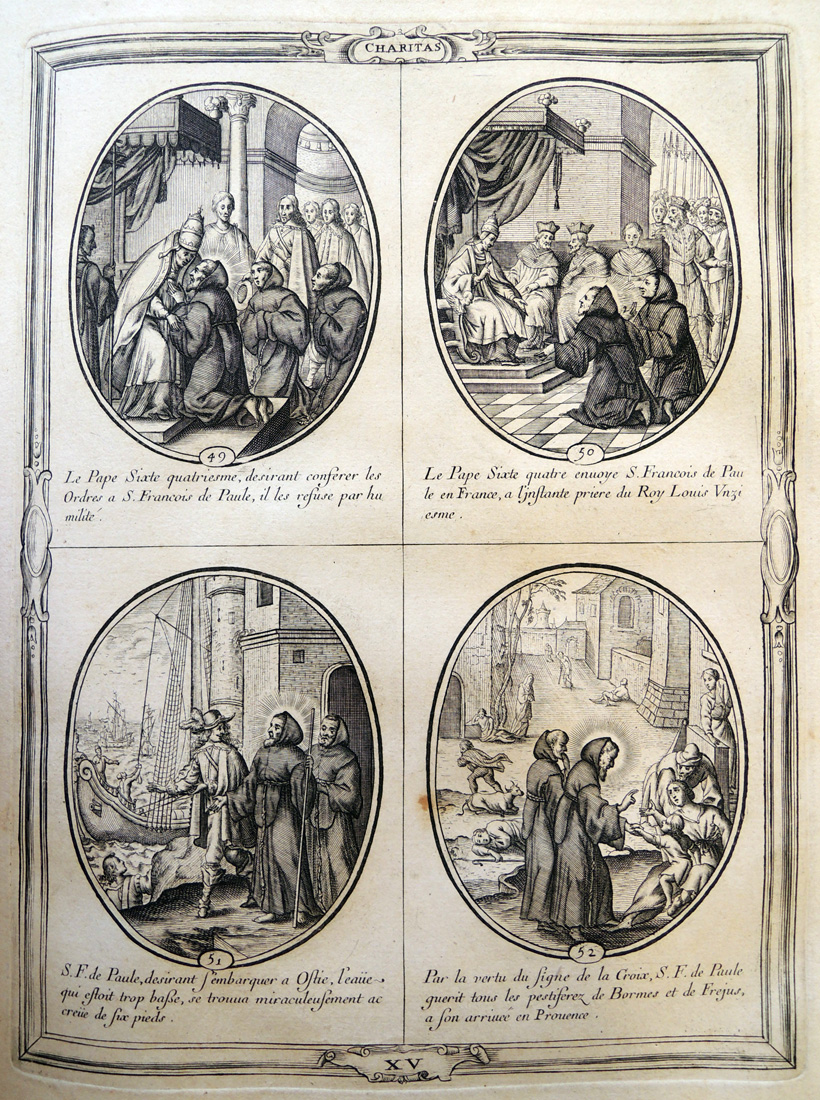
The Life, Death, and Miracles of Saint Francis of Paula

tempesta unidentified4

Les figures et l’abrégé de la vie, de la mort et des miracles de S. François de Paule instituteur et fondateur de l’ordre des minimes recueillies de la Bulle de Léon X et des enquestes faites pour procéder à sa canonization. Text by Antoine Dondé (Paris: François Muguet, 1664). Engraved vignettes by Adriaen Lommelin (1637?-1673), Nicolas de Poilly (1627-1696), F. Campion, Abraham Bosse (1602-1676) Jean Bollanger (1607-16??); Michael Noël Natalis (1610-1668); Etienne Picart (1632-1721); Nicolas Pitau (1632-1671); Pierre Petit; Gérard Scotin (1643-1716); and Antony van der Does (1606-1680). Graphic Arts Collection GAX 2014- in process

Bound with: Antonio Tempesta (1555-1530), Vita et miracula D. Bernardi Clarevallensis abbatis (1587) and Les Portraits de quelques personnes signalées en piété … (1668). More about these in other posts.

The Graphic Arts Collection recently acquired three books bound as one, each book presenting a set of engraved plates depicting the life of one or more saints. This post shows the second book with an incomplete life of Saint Francis of Paula (1416-1507). Our volume holds only 8 plates with 4 scenes each offering a total of 32 scenes. The complete copy in the Bibliothèque nationale shows 20 plates with a total of 80 scenes, along with preparatory material. http://gallica.bnf.fr/ark:/12148/btv1b8452395k

tempesta unidentified3   tempesta vita6   tempesta unidentified1

The project is closely related to Jacques Callot’s Les images de tous les saincts et saintes de l’année completed almost thirty years earlier. The Fine Art Museums of San Francisco have a nice set of these: http://art.famsf.org/jacques-callot/st-phocas-martyr-march-5-st-theophilus-bishop-march-5-st-conon-martyr-march-6-sts

At the age of fourteen, Francis returned to Paula. “…he selected a retired spot on his father’s estate, and there lived in solitude…. Here he remained alone for about six years giving himself to prayer and mortification. In 1435 two companions joined him in his retreat, and to accommodate them Francis caused three cells and a chapel to be built: in this way the new order was begun. The number of his disciples gradually increased, and about 1454, with the permission of Pyrrhus, Archbishop of Cosenza, Francis built a large monastery and church.

…The rule of life adopted by Francis and his religious was one of extraordinary severity. They observed perpetual abstinence and lived in great poverty, but the distinguishing mark of the order was humility. …In 1474 Sixtus IV gave him permission to write a rule for his community, and to assume the title of Hermits of St. Francis: this rule was formally approved by Alexander VI, who, however, changed their title into that of Minims. After the approbation of the order, Francis founded several new monasteries in Calabria and Sicily. He also established convents of nuns, and a third order for people living in the world, after the example of St. Francis of Assisi.
–Hess, Lawrence. “St. Francis of Paula.” The Catholic Encyclopedia. Vol. 6. New York: Robert Appleton Company, 1909.

Printed in Hopewell, New Jersey

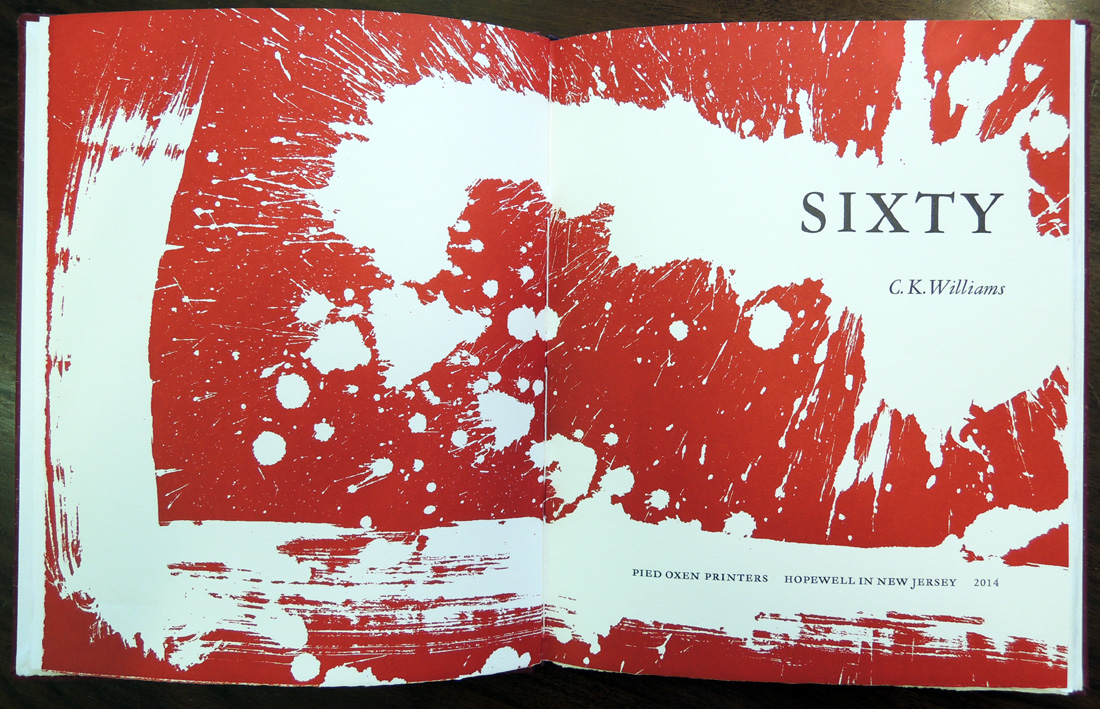
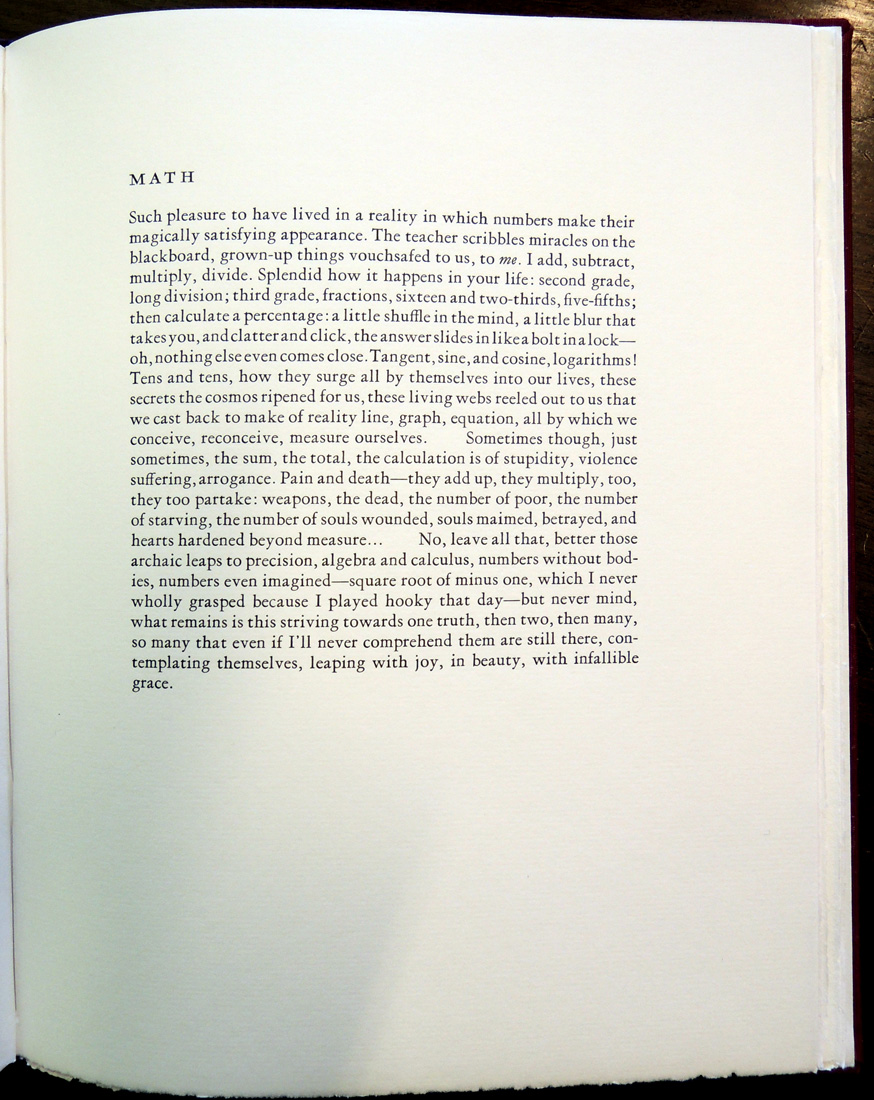
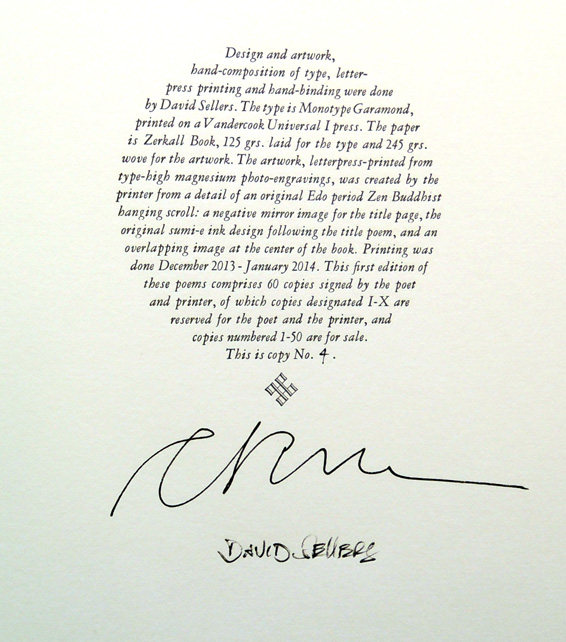
williams, sixtyC.K. Williams, Sixty ([Hopewell, New Jersey]: Pied Oxen Printers, 2014). Printed by David Sellers. Copy 4 of 60. Graphic Arts Collection 2014- in process


williams sixty3On the afternoon of 9 March 2014, pianist Richard Goode and poet C.K. Williams took the stage of the Richardson Auditorium in Princeton University’s Alexander Hall. The event, billed as “A recital with poetry,” sold out almost immediately and every seat in the auditorium was filled.

Williams, only recently retired from Princeton University, read his poem “Beethoven Invents the Species Again,” which he wrote for the occasion. In addition, he read from his most recent collection of poems All at Once (New York: Farrar Straus Giroux, 2014), including the series that is shown here, first published as Sixty. Goode played ten pieces, including works by Schumann, Mozart, Chopin, Brahms, Bach, Janácek, and Beethoven.

The Graphic Arts Collection is fortunate to have acquired one of the limited-edition, fine-press copies of Williams’ Sixty, with prints by David Sellers. The artwork, letterpress-printed from type-high magnesium photo-engravings, was created by the printer from a detail of an original Edo period Zen Buddhist hanging scroll: a negative mirror image for the title page, the original sumi-e ink design following the title poem, and an overlapping image at the center of the book.

williams sixty4
williams sixty2

Princeton Magazine published a profile of the Sellers’ press nearby in Hopewell, New Jersey, and you can read the article at:  http://www.princetonmagazine.com/pied-oxen-printers-the-art-of-devotion/


Of Typography and the Harmony of the Printed Page

ricketts5

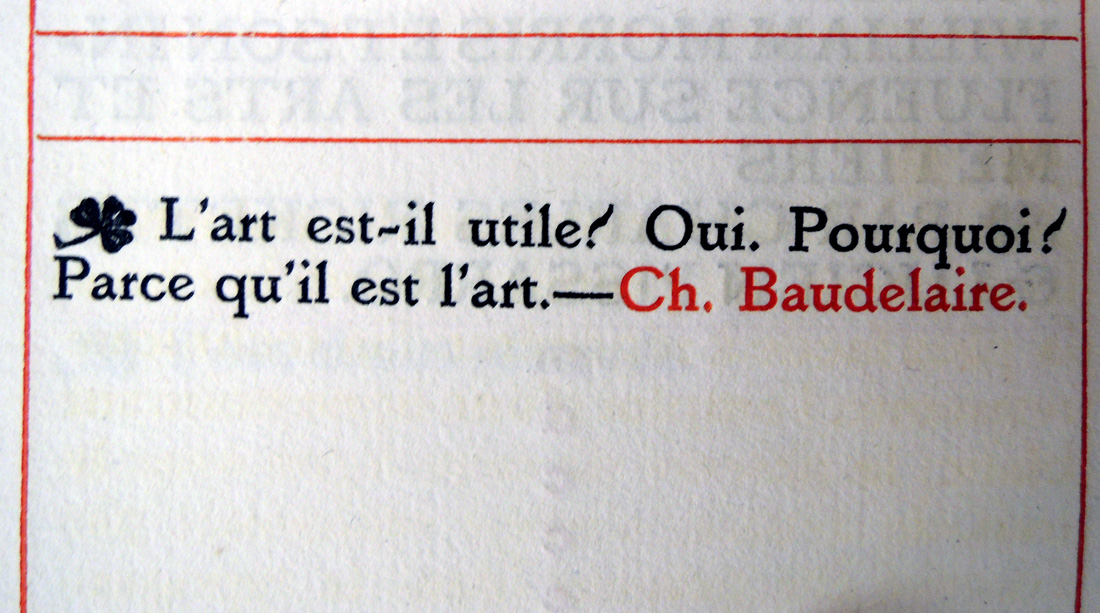
L’art est-il utile? Oui. Pourquoi? Parce qu’il est l’art. -Charles Baudelaire
Is art useful? Yes. Why? Because it is art. -Charles Baudelaire.

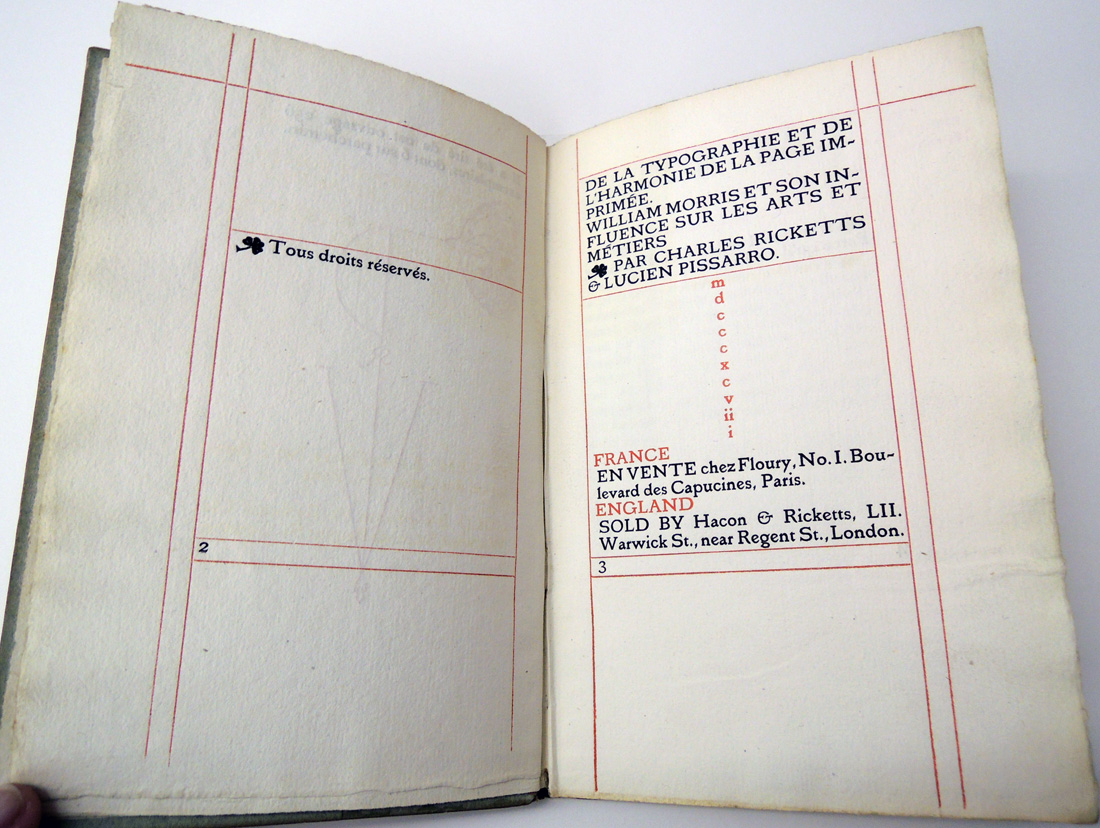
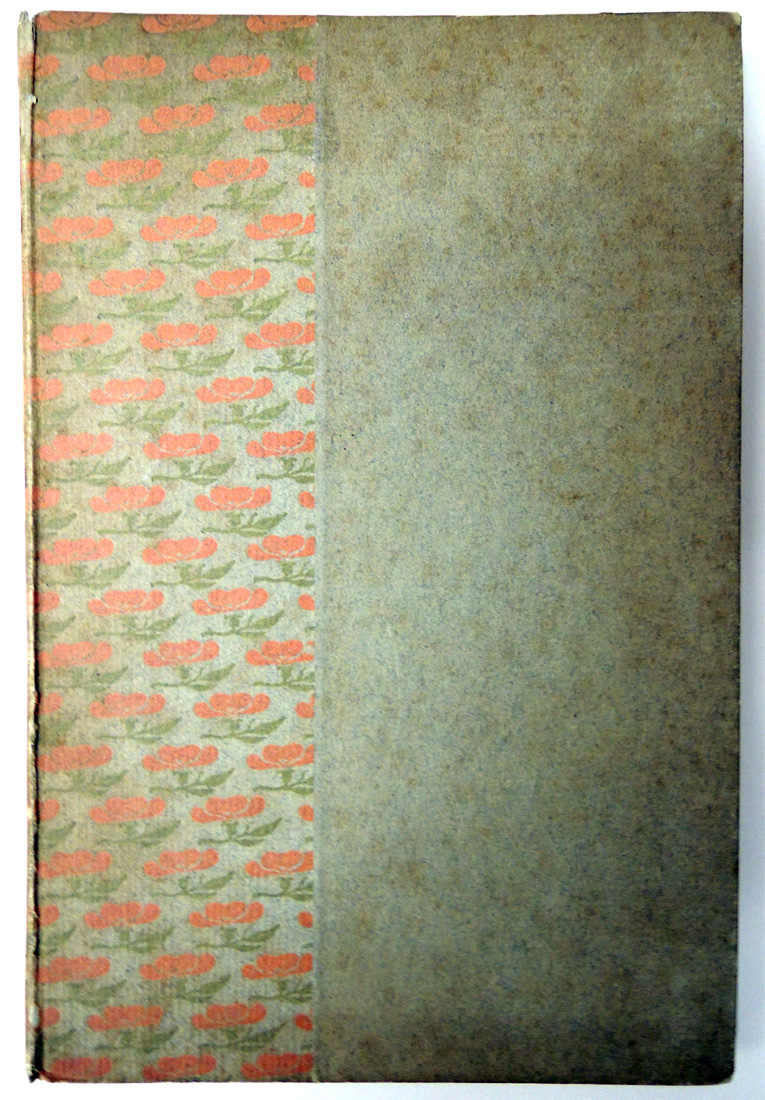
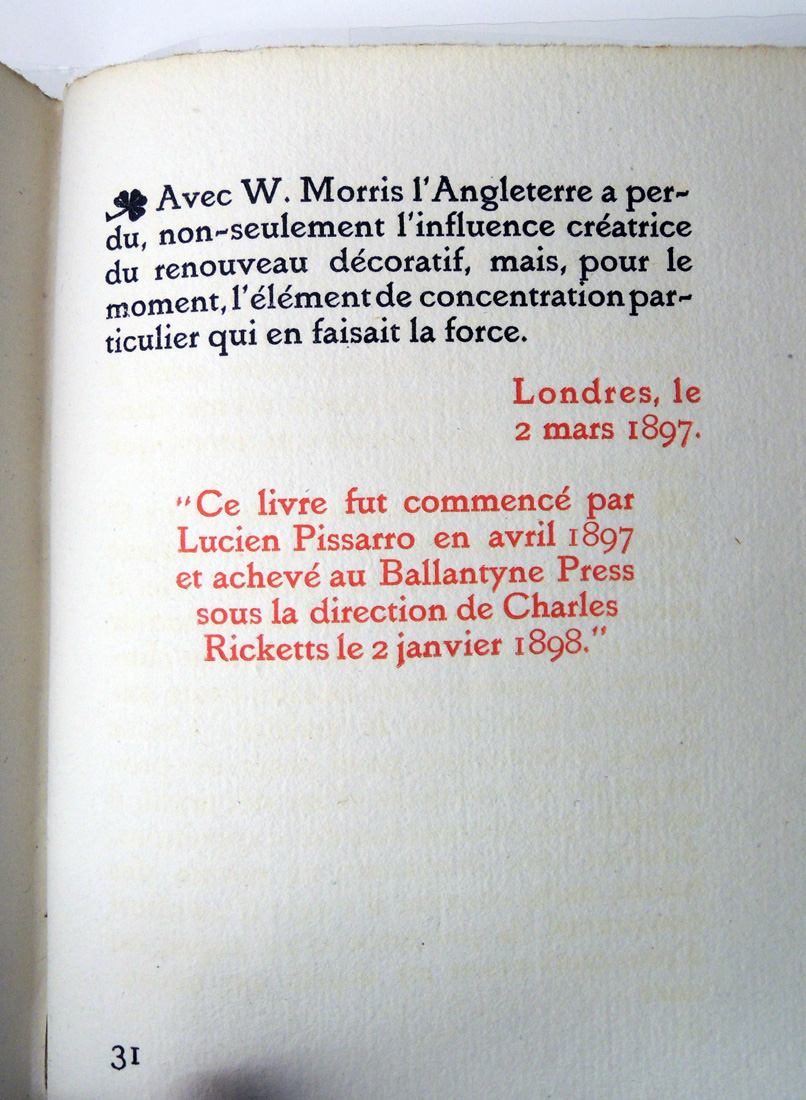
ricketts3Charles S. Ricketts (1866-1931) and Lucien Pissarro (1863-1944), De la typographie et de l’harmonie de la page imprimée: Wiliam Morris et son influence sur les arts et métiers (Paris: Floury; London: Hacon & Ricketts, Ballantyne Press, 1898). Colophon: Ce livre fut commencé par Lucien Pissarro en avril 1897 et achevé au Ballantyne press sous la direction de Charles Ricketts le 2 janvier 1898./ “Il a été tiré de cet ouvrage 256 exemplaires, dont 6 sur parchemin”–P. [1].
Graphic Arts Collection 2014- in process

ricketts2     ricketts

In 1889, the artisan publishers Charles Ricketts and Charles Shannon invited the artist Lucien Pissarro to submit images for their magazine The Dial. Within five years, Lucien and his wife Esther Pissarro established The Eragny Press and began printing books of their own, completing thirty-one titles in all. Princeton University Library only holds around a dozen of their books and surprisingly, not the collaboration between Ricketts and Pissarro De la typographie de l’harmonie de la page imprimée.

The Graphic Arts Collection recently acquired one of the 216 copies of this important book, bound in the original grey/green boards decorated in floral motif and a printed paper spine label (256 in the book is a misprint). The text pages are beautifully printed in red and black with the Vale type that Pissarro used until 1903.

ricketts4

We are all fortunate that Ricketts’ essay was translated into English by Richard K. Kellenberger in 1953 [http://digitalcommons.colby.edu/cgi/viewcontent.cgi?article=1345&context=cq]. Of Typography and the Harmony of the Printed Page begins:

“In a renewal of interest in handicrafts, the art of book-making would, at first sight, appear to be the easiest to revitalize. Its limited technique, the placing a black line on white paper, the relationship of this line to the stroke of a pen, adjusted merely to the work of the en- graver (both in printing and in wood-engraving), this does not involve the difficulties which are presented by more complicated or recalcitrant materials – difficulties such as are presented by the technique of weaving brocades or rugs, or of fitting together the pieces of a stained glass window. And yet, throughout the thirty years during which there has been, in handicraft circles in England, an intense preoccupation with the arts, the art of book-making is the last one to come on the scene.”