Category Archives: Books

books

King Lear

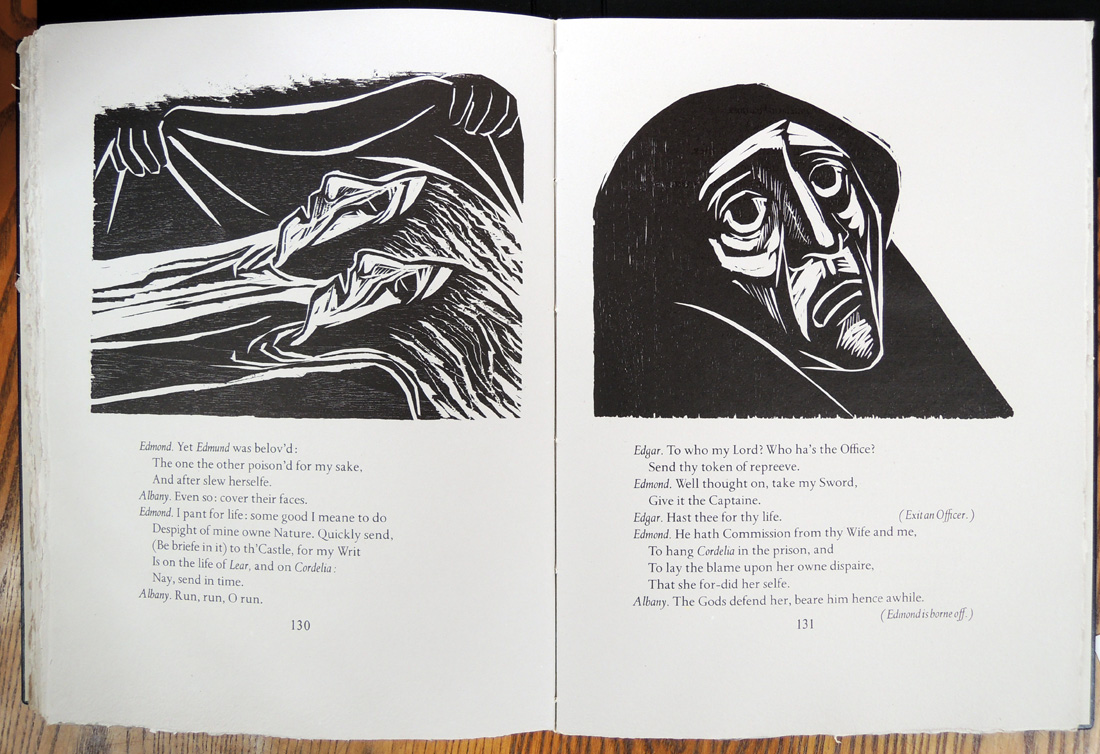
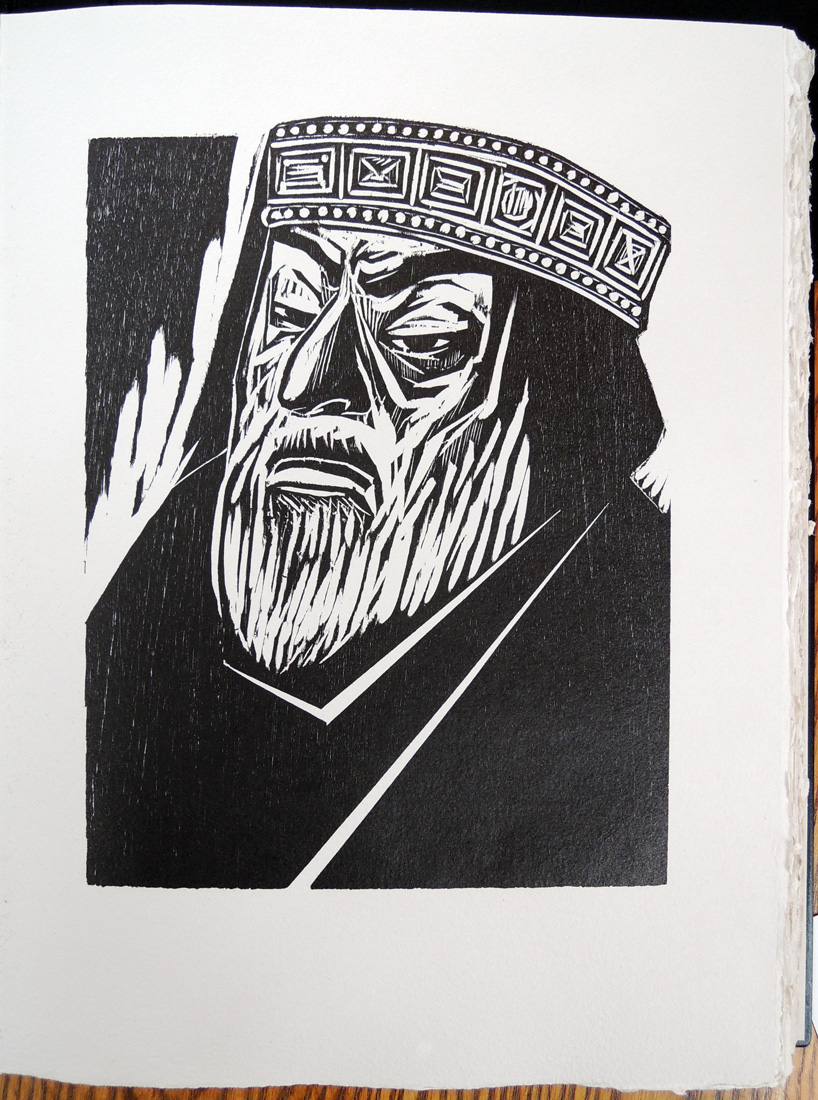
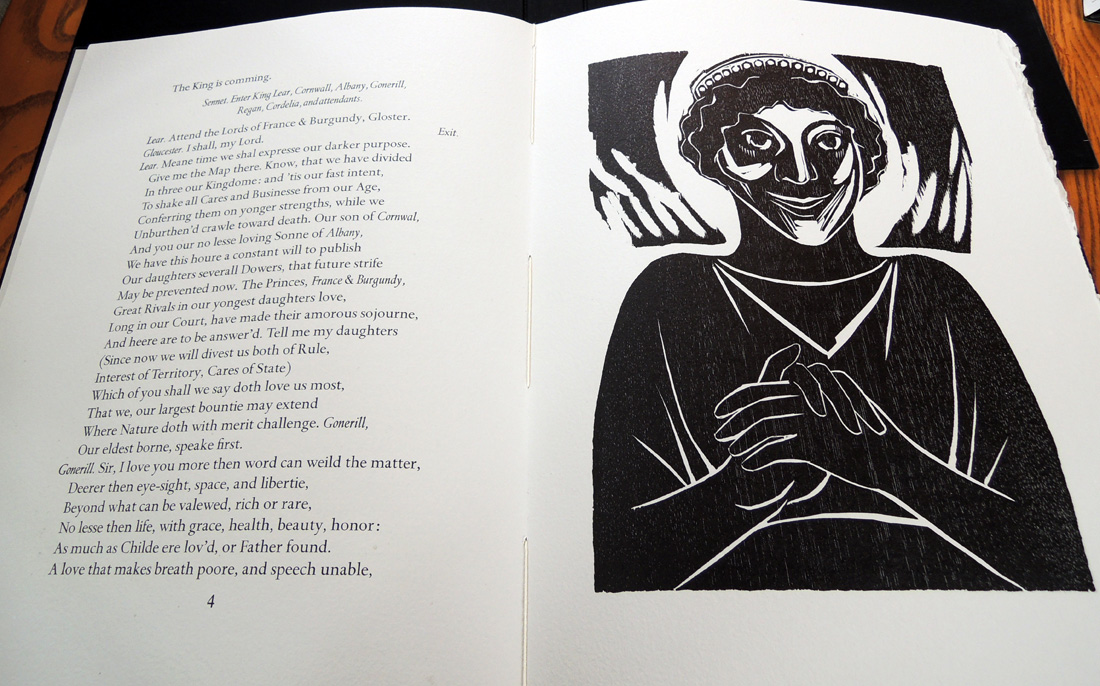
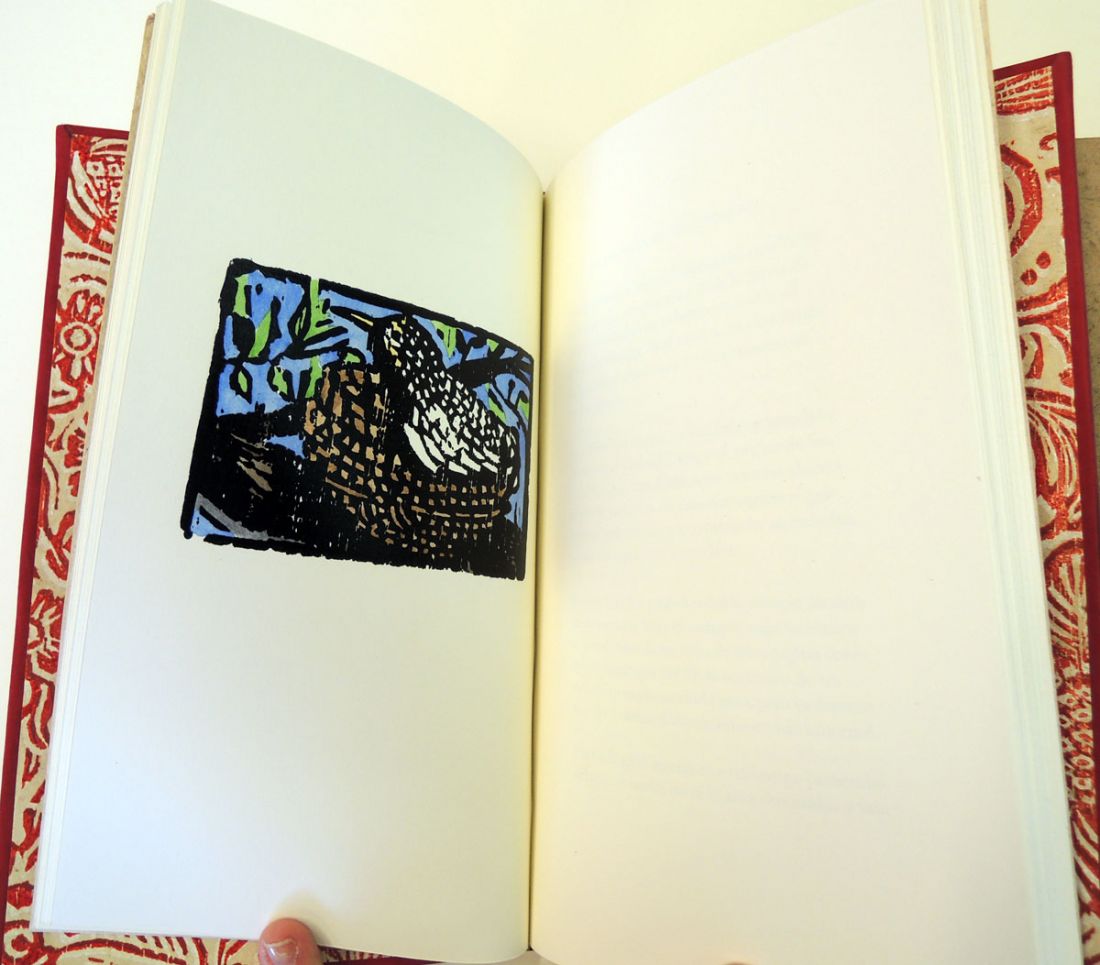
king lear6king lear2William Shakespeare (1564-1616), The Tragedie of King Lear; with woodcuts by Claire Van Vliet (Bangor: Theodore Press, 1986). Copy 94 or 160. Graphic Arts Collection (GAX) Oversize NE1112.V36 S52 1986q

king lear1

One of the fine press editions that is requested on a regular basis is this 1986 edition of King Lear. The entire colophon is reproduced below but note, in particular, the integration of text and image, which is central to this edition. The text preparation, typographical design, setting and presswork were done by Michael Alpert at the Theodore Press in Bangor, Maine.

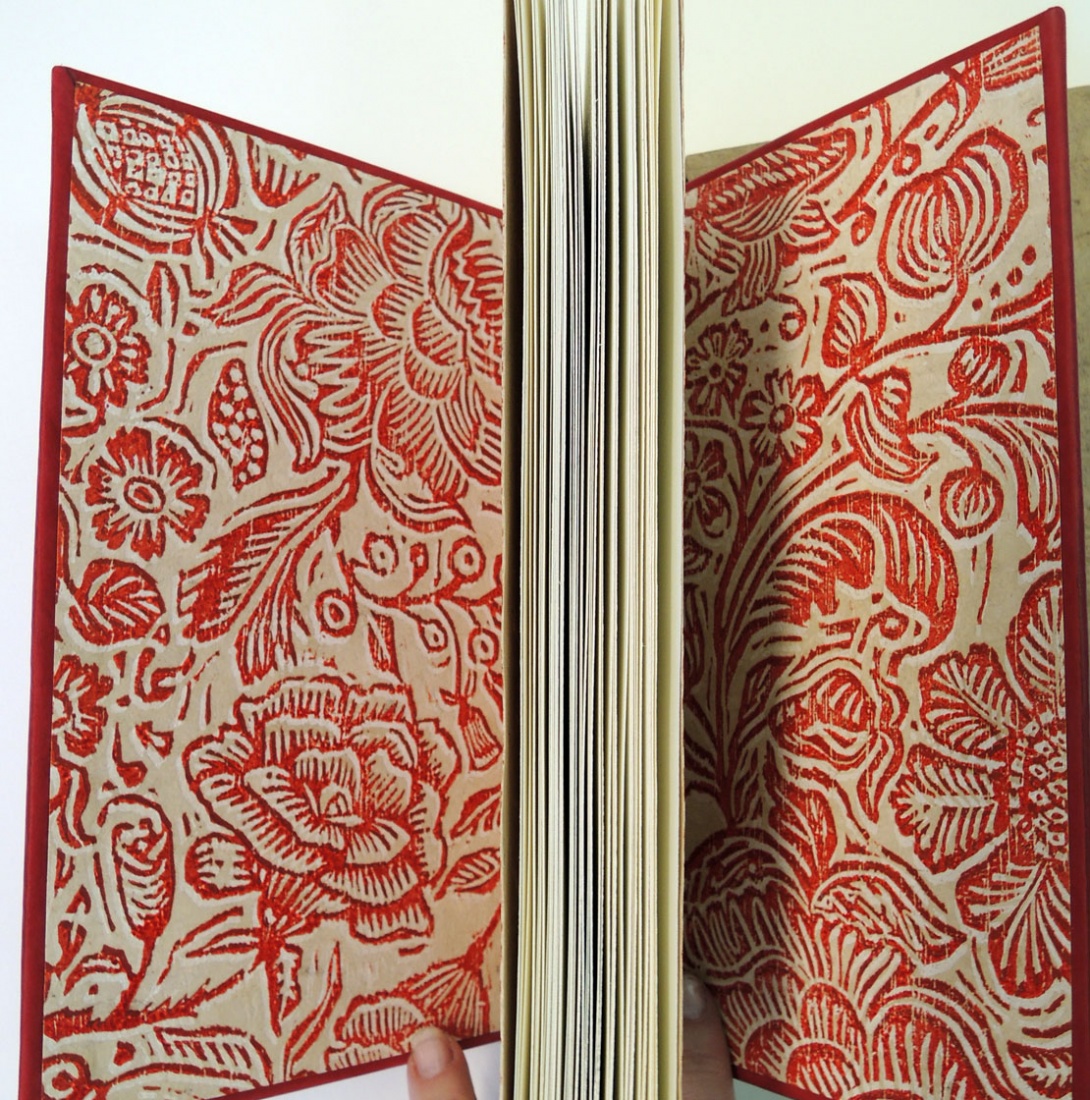
I’m also showing the birch covers, which were individually decorated by Claire Van Vliet who designed the binding with Nancy Southworth of Lancaster, New Hampshire. After spending most of the day at the fine press fair in New York City yesterday, I was reminded of the importance of all the elements that go into the making of a book. This is a perfect example of a successful collaboration between many artists.
king lear5      king lear4
king lear3

Edgar Allen Poe and Alice Neel

poe with alice neel 1

poe with alice neel 5

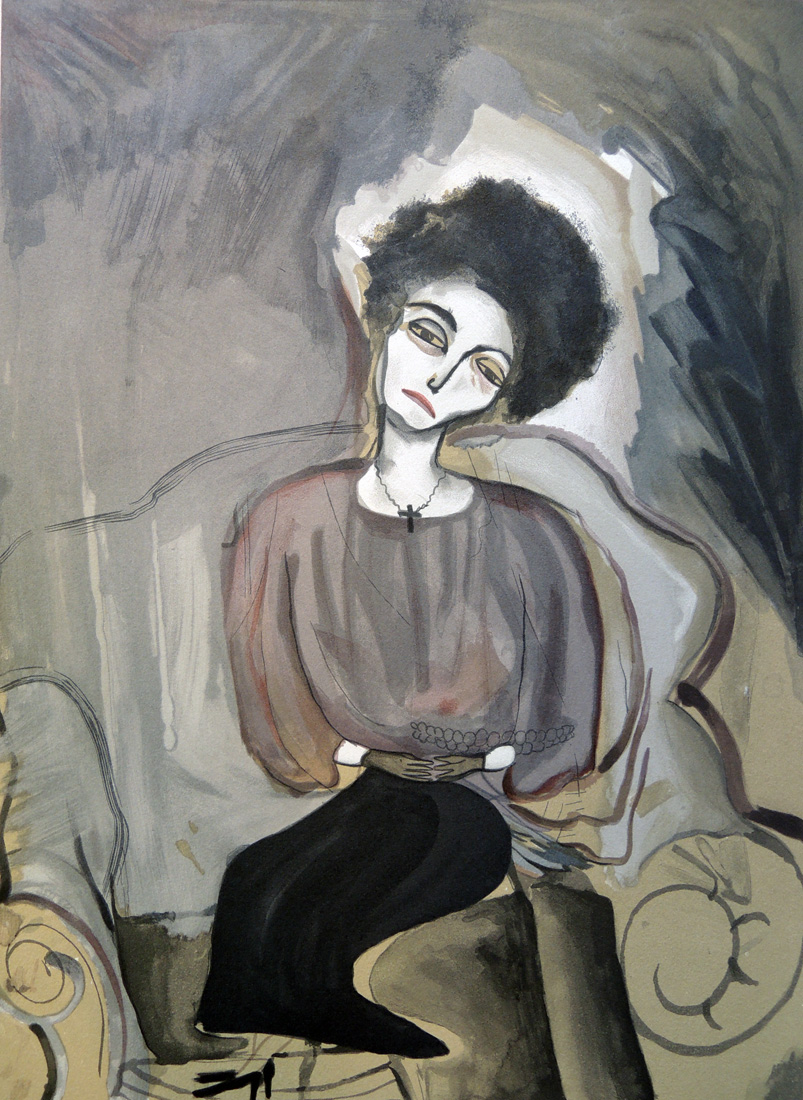
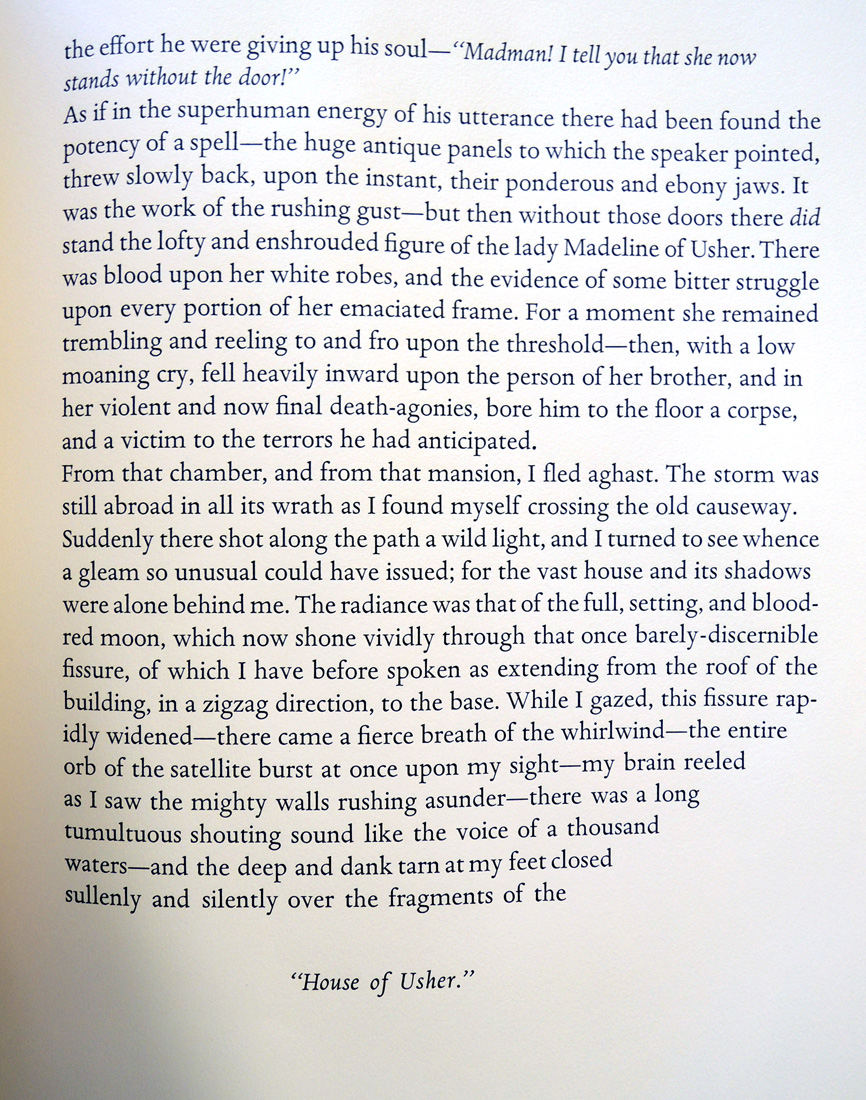
The artist Alice Neel (1900-1984) never lived to see the publication of her fine press book prepared with the Limited Editions Club. She died from cancer in October 1984, early in production stages. Our copy, like most, is only signed by her friend and fellow artist Raphael Soyer (1899-1987) who wrote a short tribute to her, included at the end of this volume.

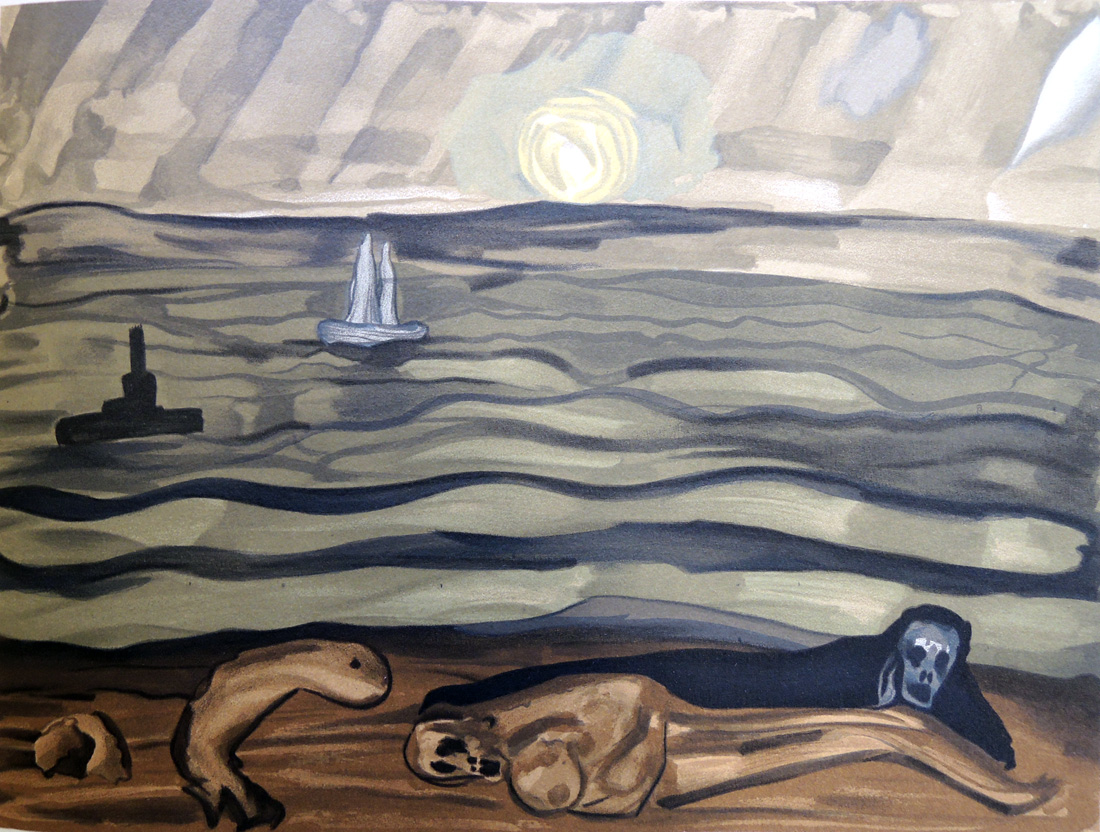
Neel selected two of her earlier paintings to accompany Poe’s text, along with several black and white etchings. According to the prospectus, “The first illustration, Alice Neel’s ‘Nadja’ and our Madeline Usher [sister of Roderick], is a reproduction of a gouache painting from 1929. The reproduction of this image required eighteen plates/colours, with several plates run more than once for a total of twenty-five printings. The second illustration, entitled ‘Requiem,’ printed in 1927, incorporates seventeen plates and a total of twenty-six press runs. The extraordinary separations on both lithographs were performed by Gena Maxwell, and the printing by Frank Martinez.”


poe with alice neel 4

poe with alice neel 3      poe with alice neel 2

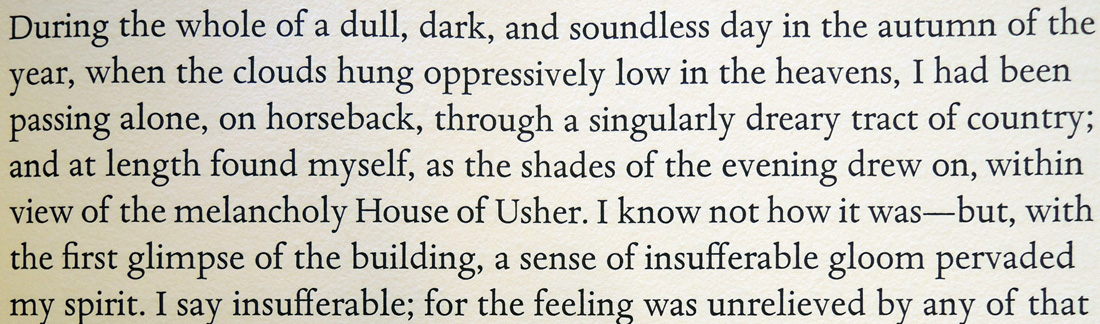
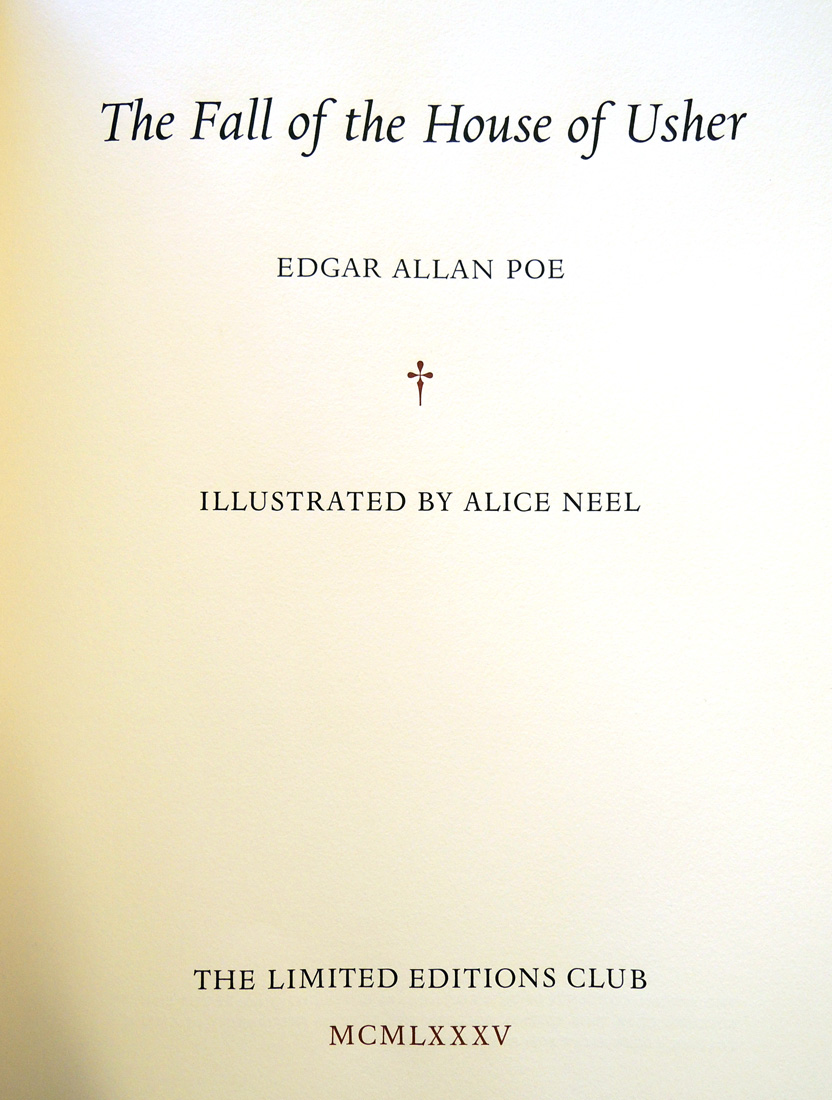
Edgar Allan Poe (1809-1849), The Fall of the House of Usher, illustrated by Alice Neel ([New York]: Limited Editions Club; printed by Anthoensen Press, 1985). Copy 528 of 1500. Graphic Arts Collection (GAX) Oversize 2006-0040F

A 1975 interview with the artist can be found here:  http://www.vdb.org/titles/alice-neel-interview


Alexeieff

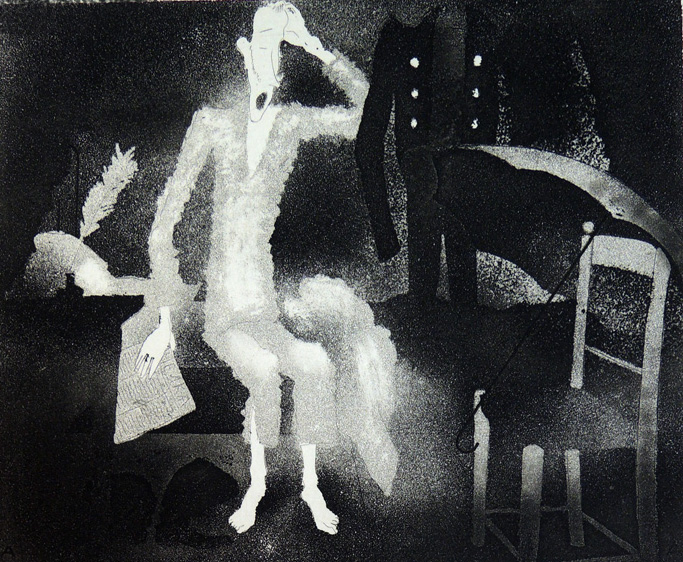
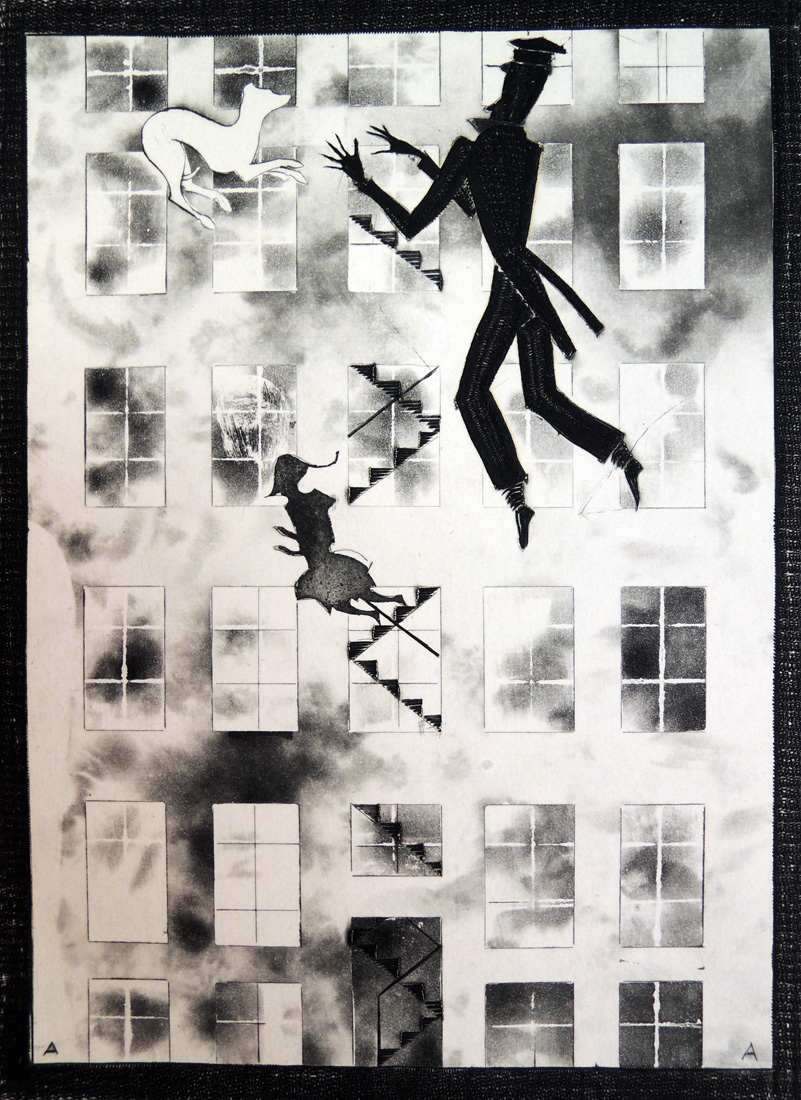
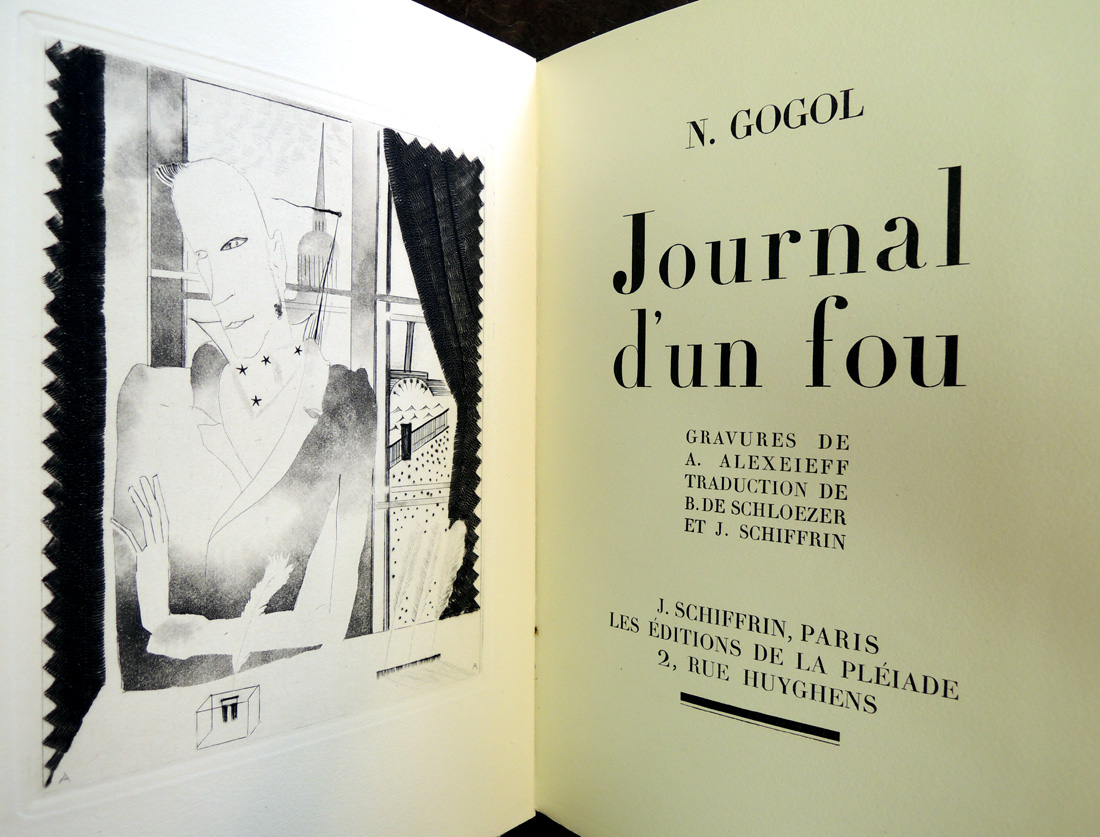
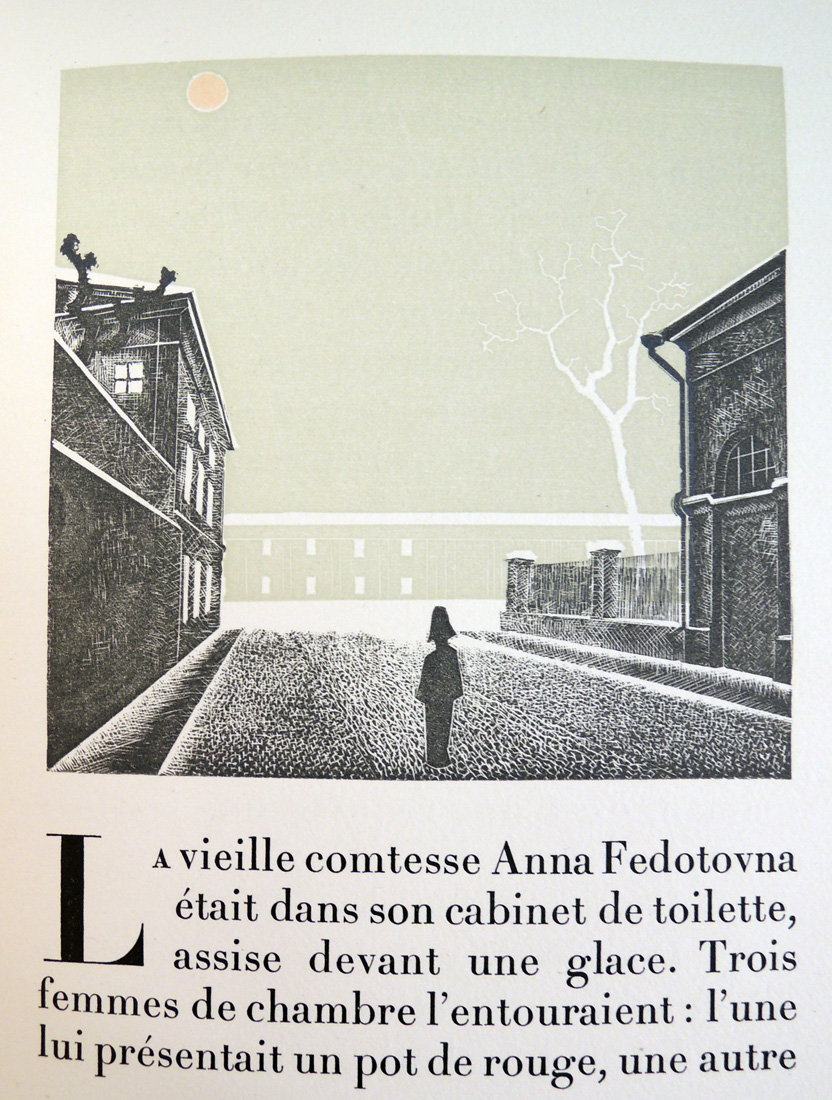
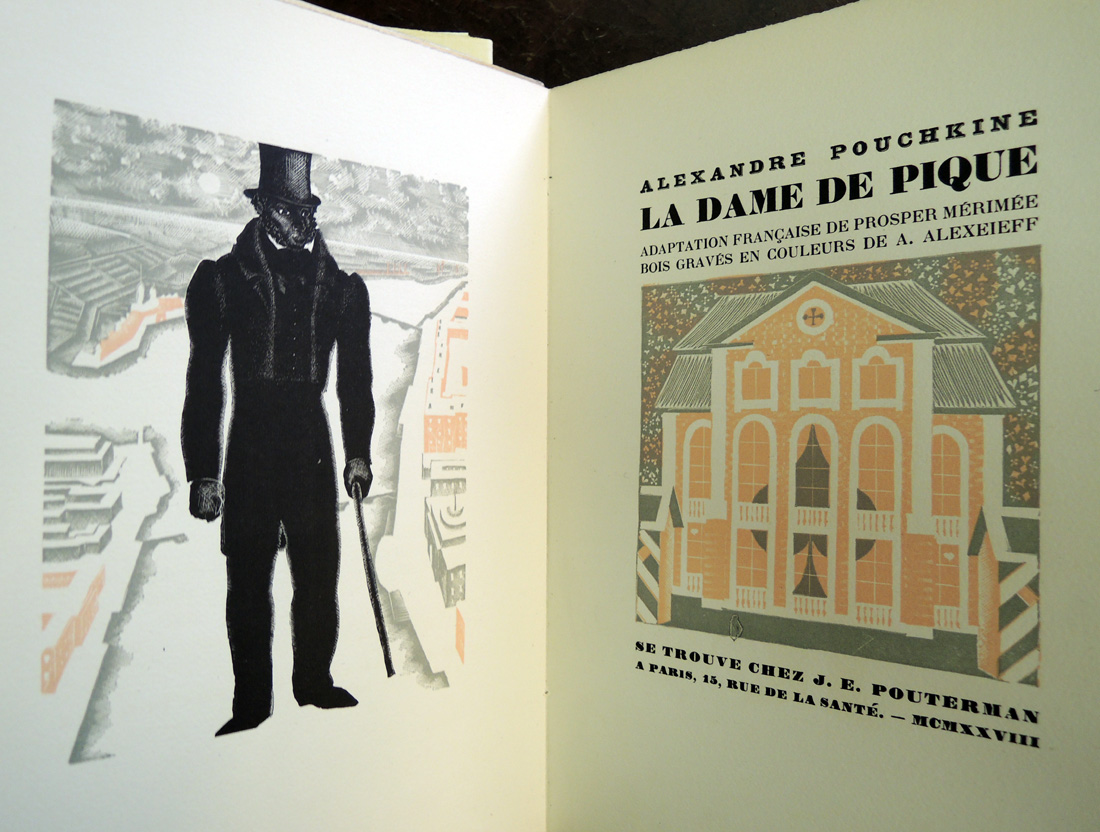
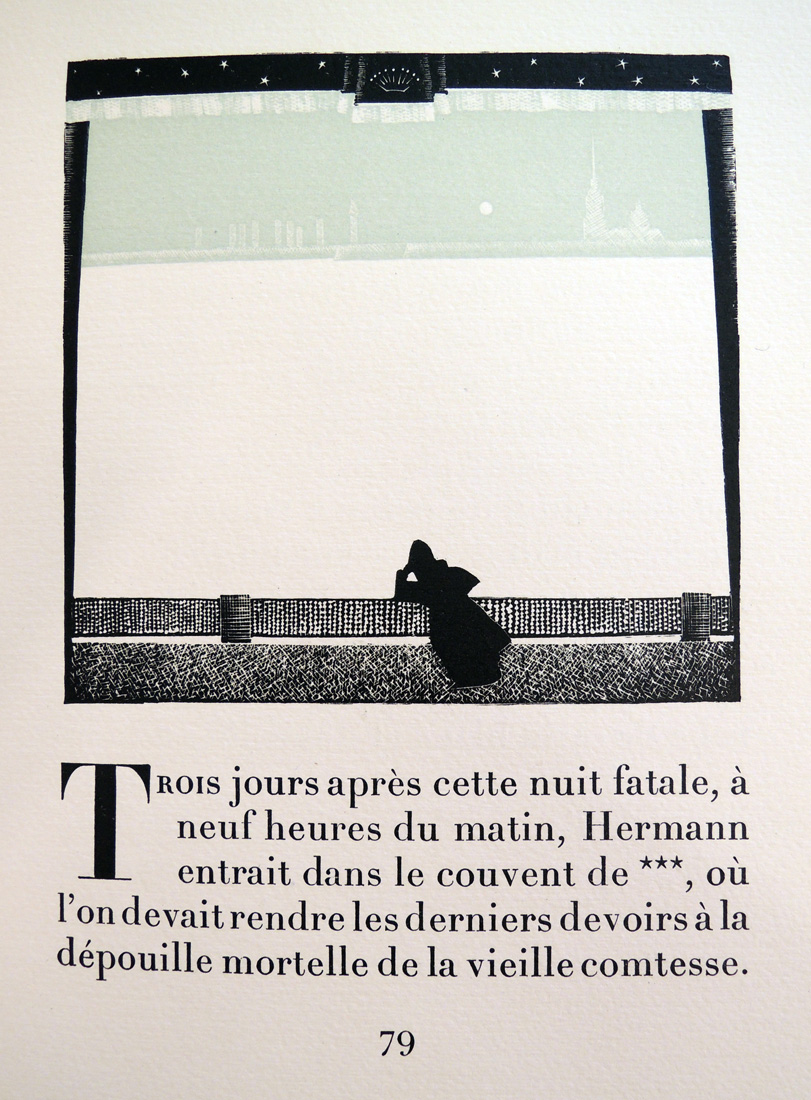
gogol journal 5Russian émigré Alexandre Alexeieff (1901-1982) moved to Paris in the early 1920s, where he designed and painted sets for the Ballets Russes and other productions. When theater jobs dried up, Alexeieff took up printmaking and found work as an illustrator, creating plates for books by Poe, Baudelaire, Pushkin, Dostoyevsky, Tolstoy, Flaubert, Hoffman, and his friends Andre Malraux and Philippe Soupault. One of the most beautiful is his 1927 Journal d’un fou (Diary of a Madman) by Gogol, illustrated with aquatints, seen above and below.

gogol journal 4    gogol journal 3

When the American poet Wallace Stevens was given a copy of one of Alexeieff’s books, he wrote, “I went over some of [the poems] again in the edition illustrated by Alexieff [sic]. I was very much pleased with this big Alexieff book because I love large pages for poetry. On the other hand, I cannot say that I think that Alexieff’s designs are truthful illustrations of the text; they are too individual. The eccentricity of Fargue should be delineated in its own right and not doubled by an additional eccentricity on the part of an illustrator.” –written to Paula Vidal 1950.

gogol journal 1Nikolai Vasilʹevich Gogol (1809-1852), Journal d’un fou, gravures de A. Alexeieff; traduction de B. de Schloezer et J. Schiffrin (Paris: J. Schiffrin, les Editions de la Pléiade, 1927). Graphic Arts Collection (GAX) PG3334.F5 Z3 1927

Alexeieff went on to make animated films using his own invention, the écran d’épingles (pinscreen) together with his second, American wife Claire Parker (1906-1981). The texture of these movies is surprisingly similar to the grainy quality of his earlier aquatints. Take a look.

Night on Bald Mountain by Alexandre Alexeieff, 1933

Gogol’s Le Nez, 1963.

pouchkine la dame 5    pouchkine la dame 4
pouchkine la dame 1Aleksandr Sergeevich Pushkin (1799-1837), La dame de pique; adaptation française de Prosper Mérimée; bois gravés en couleurs de A. Alexeieff (Paris: Pouterman, 1928). Graphic Arts Collection (GAX) PG3348.F5 P5 1928

pouchkine la dame 2

The Diary of George Templeton Strong

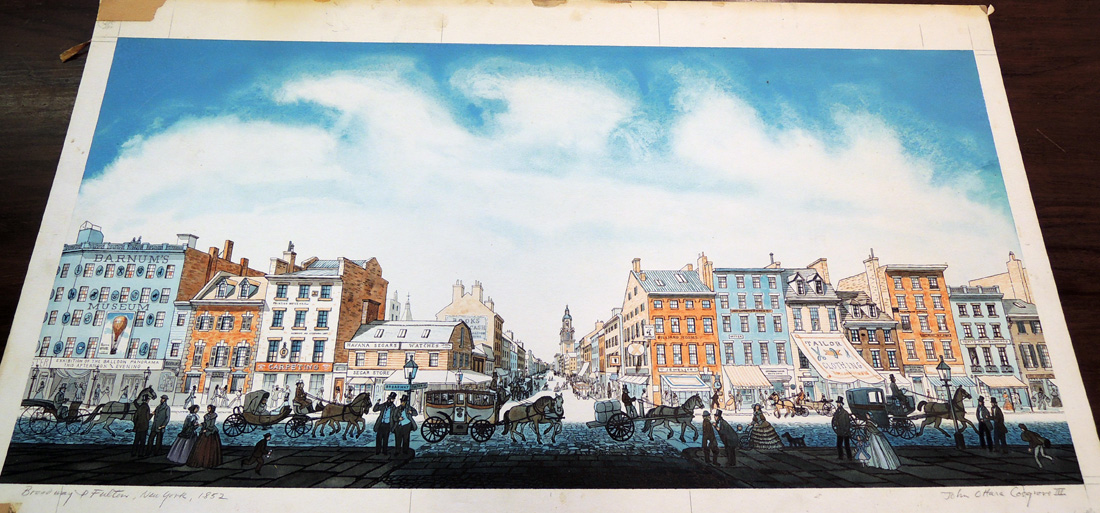
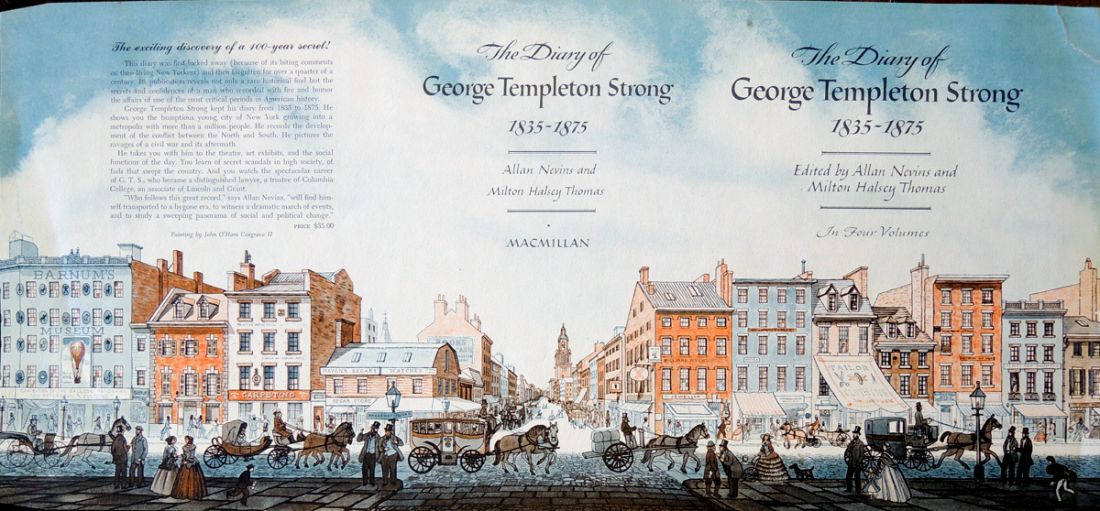
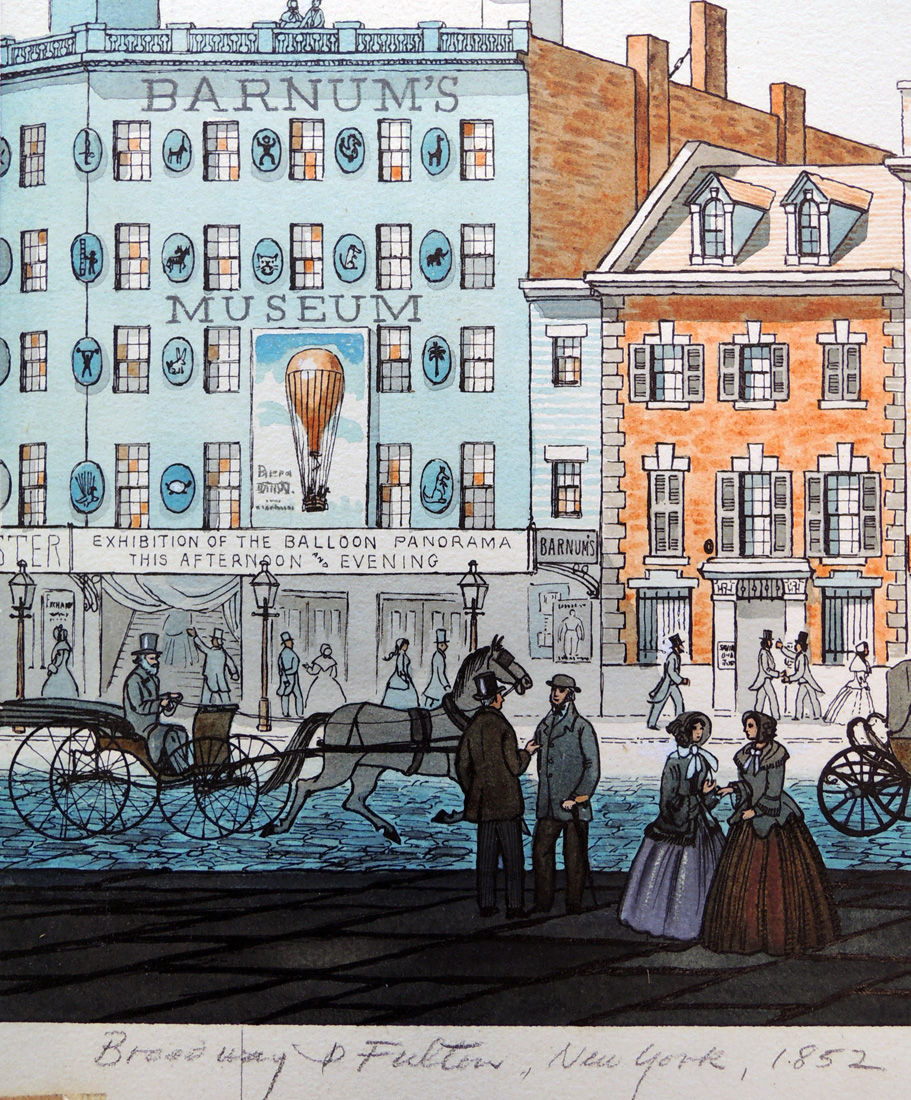
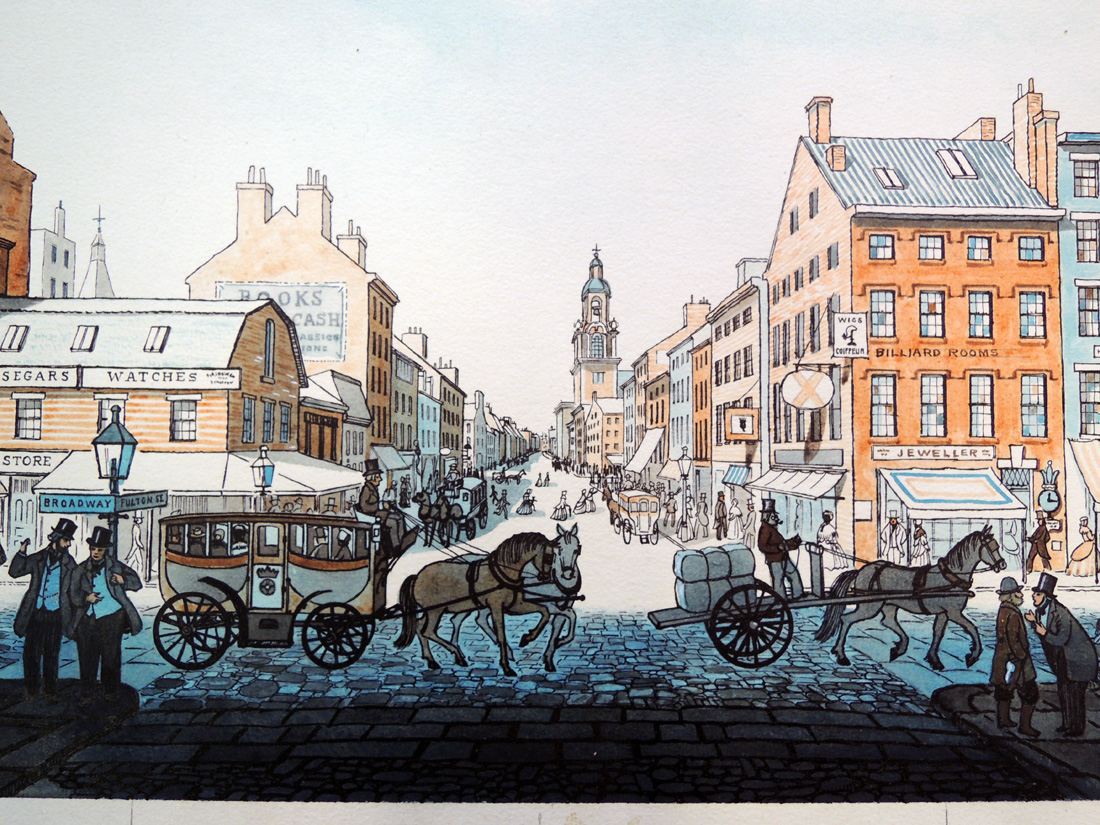
diary of george templeton strong2John O’Hara Cosgrave II (1908-1968), Original watercolor for the dust jacket of The Diary of George Templeton Strong edited by Allan Nevins and Milton Halsey Thomas (New York: Macmillan, 1952). Graphic Arts Collection
diary of george templeton strong1The New York lawyer George Templeton Strong (1820-1875) began keeping a diary at the age of fifteen and continued until his death in 1875. The original, held by the New York Historical Society, was featured recently in Ken Burn’s PBS documentary on the American Civil War. A firm abolitionist, Strong’s diary offers a first-hand account of his efforts in support of the Union Army and the end of slavery in the United States.

diary of george templeton strong5In 1952, when Macmillan began preparing Strong’s diary for publication, the artist John O’Hara Cosgrave II (1908-1968) was commissioned to design the dust jacket. The Graphic Arts Collection is fortunate to hold the original watercolor, along with the final printed cover. Fortunate because the Princeton University Library, like many libraries, removes all the dust jackets from the books as soon as they are purchased.

Illustrations by the California-born watercolorist can be found in over 100 books, including Pardon My Harvard Accent (1941) by William G. Morse; Gnomobile (1936) by Upton Sinclair, Wind, Sand, and Stars (1939) by Antoine de Saint Exupéry; Come In and Other Poems (1943) by Robert Frost; Carry On, Mr. Bowditch (1955) by Jean Lee Latham; among many others.
diary of george templeton strong4

To read selections, see: The Diary of George Templeton Strong edited by Allan Nevins and Milton Halsey Thomas (New York: Macmillan, 1952). Firestone Library (F) E415.9.S86 A3 1952


B is for Beckett

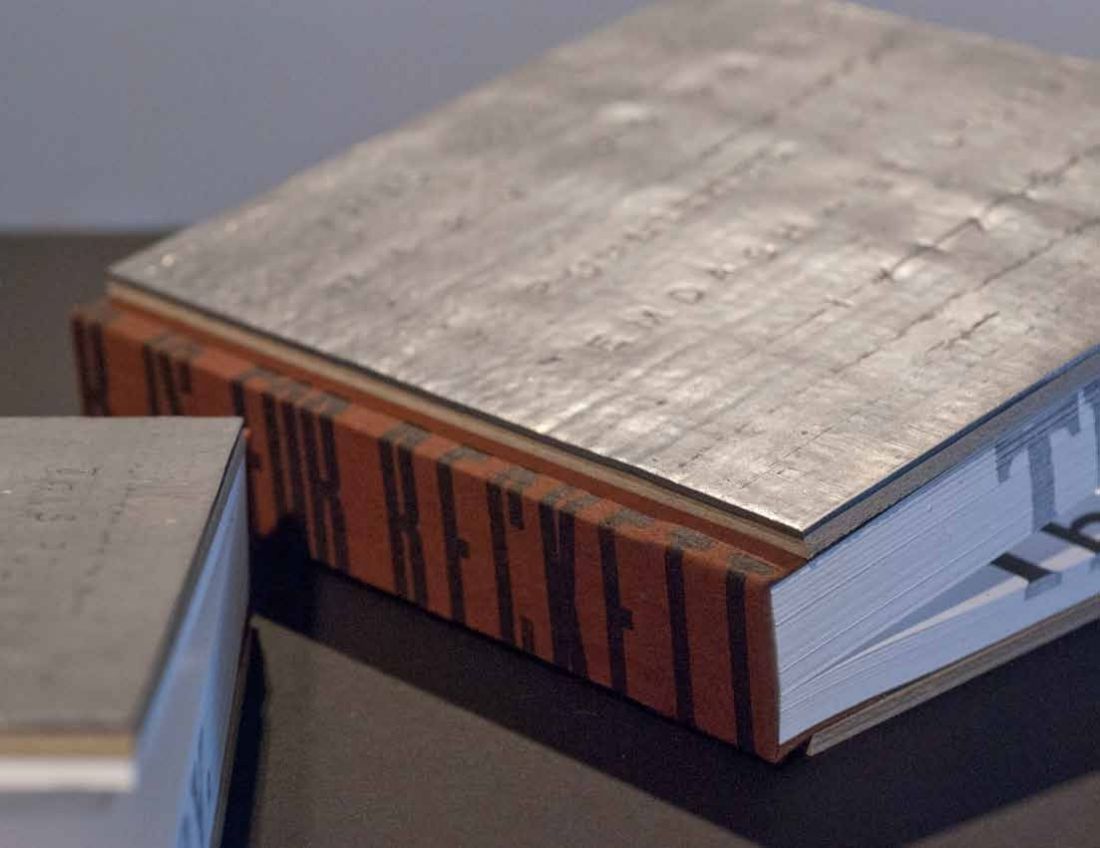
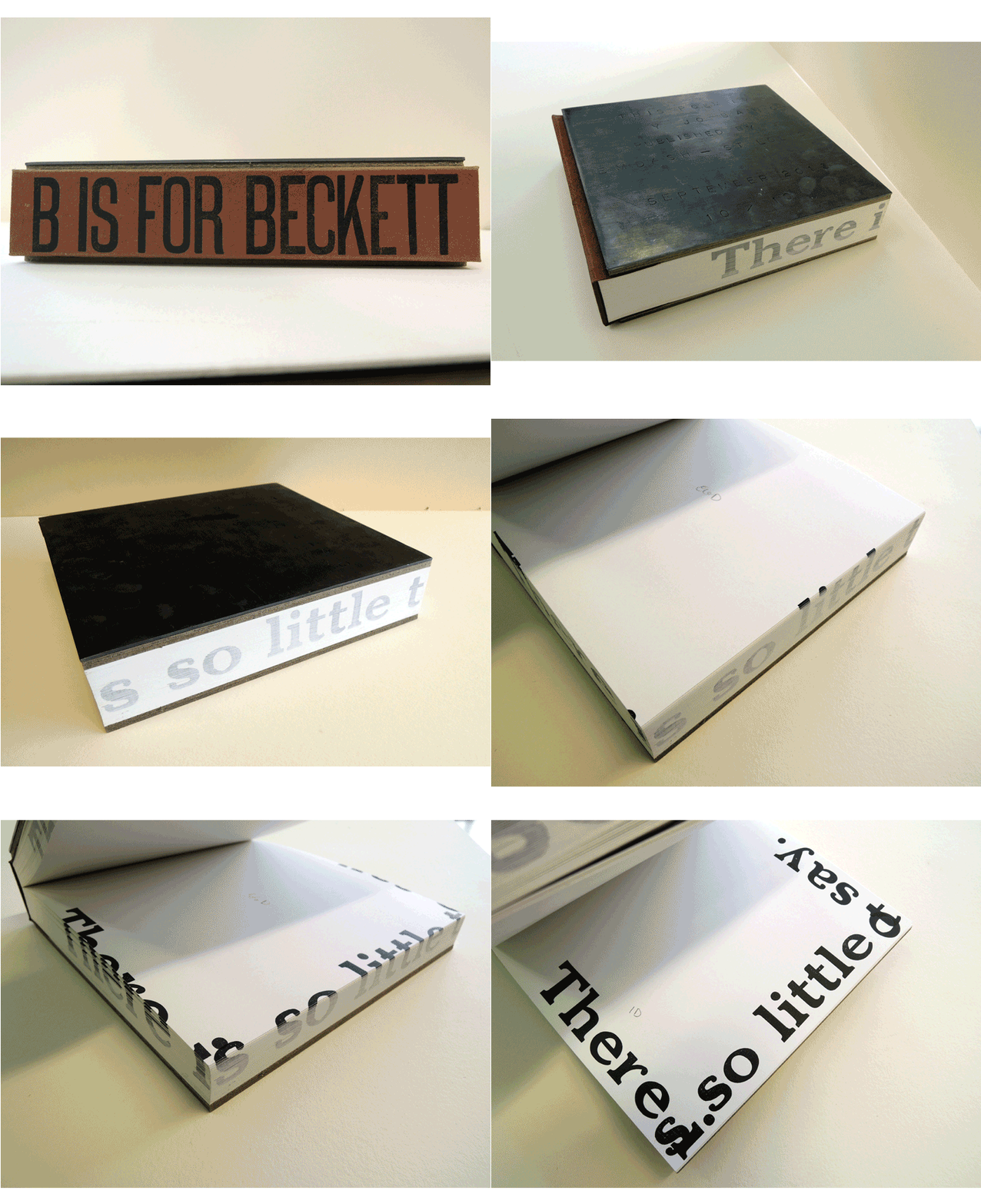
Two Titles from emdash web view_Page_10Mary Jo Bang and Ken Botnick, B is for Beckett (St. Louis, Mo.: Emdash, 2012). Letterpress printed artist book, bound in the notched perfect method with hand-stamped lead front cover and spine of handmade, hand-dyed flax by Cave Paper in Minneapolis. 89 p. Copy 10 of 10. Graphic Arts Collection GAX 2014- in process.

“This is the second collaboration between poet Mary Jo Bang and book artist Ken Botnick, this time publishing a one-line poem by Bang originally published in her collection, Elegy for E. Both projects have employed an unusual and complex printing method which involves moving the type in the bed of the press after each impression, in effect, the type “walks” off the page. When the book is closed the type reads clearly on the edge surfaces of the book as if printed direcctly on the edges themselves. The book is meant to be shown, and stored, on its side.”—prospectus.

b-is-for

Isaac Cruikshank Frontispiece

cruikshank life of the late2

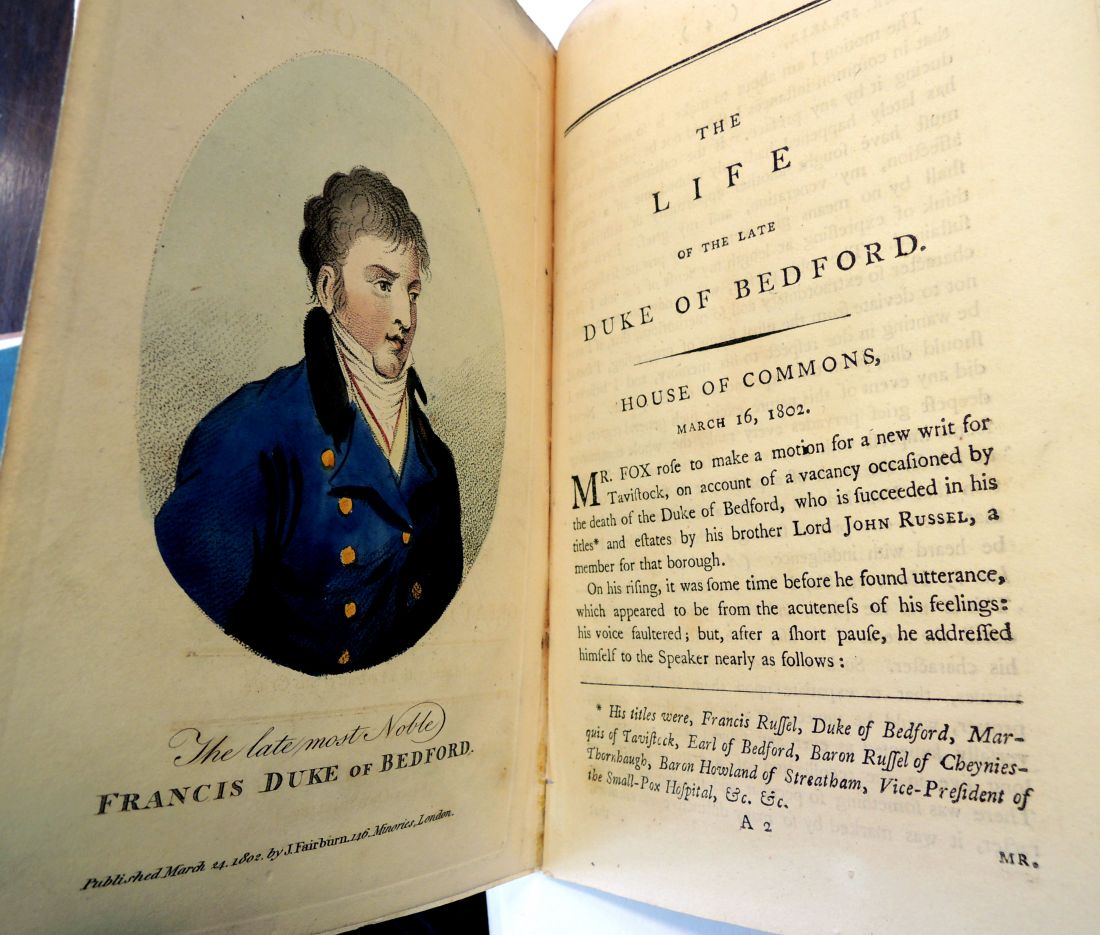
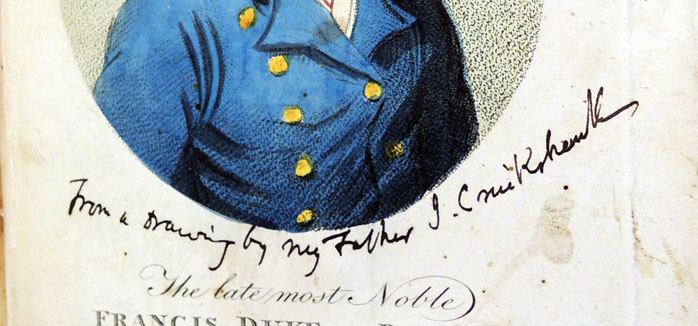
cruikshank life of the lateThe Graphic Arts Collection was recently offered the gift of Isaac Cruikshank’s frontispiece for The Life of the Late Most Noble Francis Duke of Bedford, completed March 16,1802. We already have the book, with its frontispiece in place, However, we were thrilled to acquire the duplicate print.

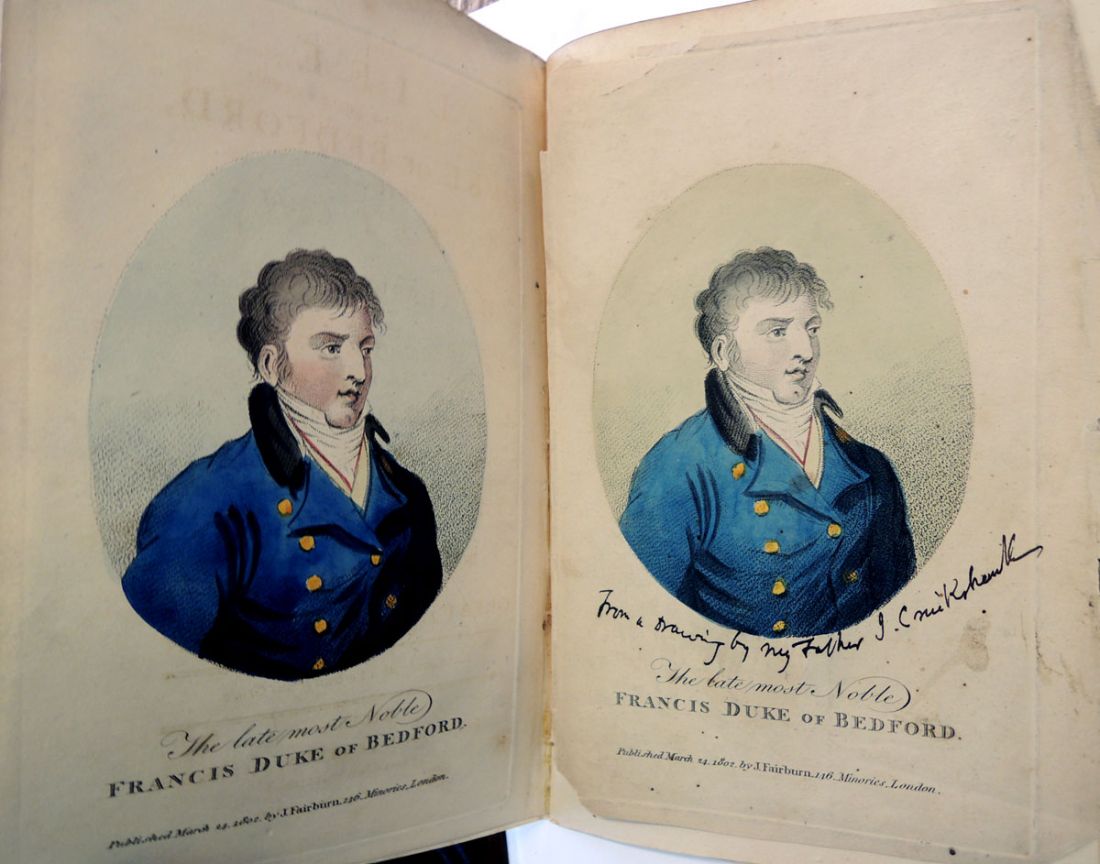
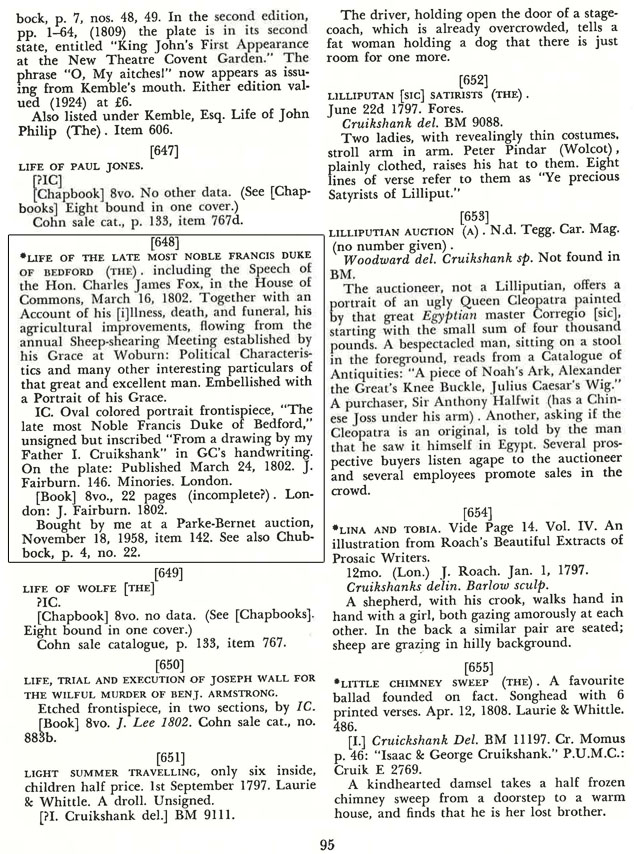
Why? In the Krumbhaar Catalogue Raisonné from 1966, this particular print is described in entry 648: “IC. Oval colored portrait frontispiece, ‘The Late most Nable Francis Duke of Bedford,’ unsigned but inscribed ‘From a drawing by my Father I. Cruikshank’ in GC’s [George Cruikshank’s] handwriting.”

Krumbhaar goes on to say the print was “Bought by me at a Parke-Bernet auction, November 18, 1958, item 142. See also Chubbock, p. 4, no. 22”


cruikshank life of the late3The bound-in frontispiece on the left with the inscribed print laid next to it on the right. Thanks to Thomas V. Lange for his watchful eye to catch this treasure for Princeton’s collection.

cruikshank life of the late4Isaac Cruikshank (1764-1811), Frontispiece etching for The Late most Noble Francis Duke of Bedford… (London: J. Fairburn, 1802). Inscribed by George Cruikshank. Graphic Arts Collection 2014- in process. Gift of Thomas V. Lange.

cruikshank life of the late5 Krumbhaar number 648_Page_1


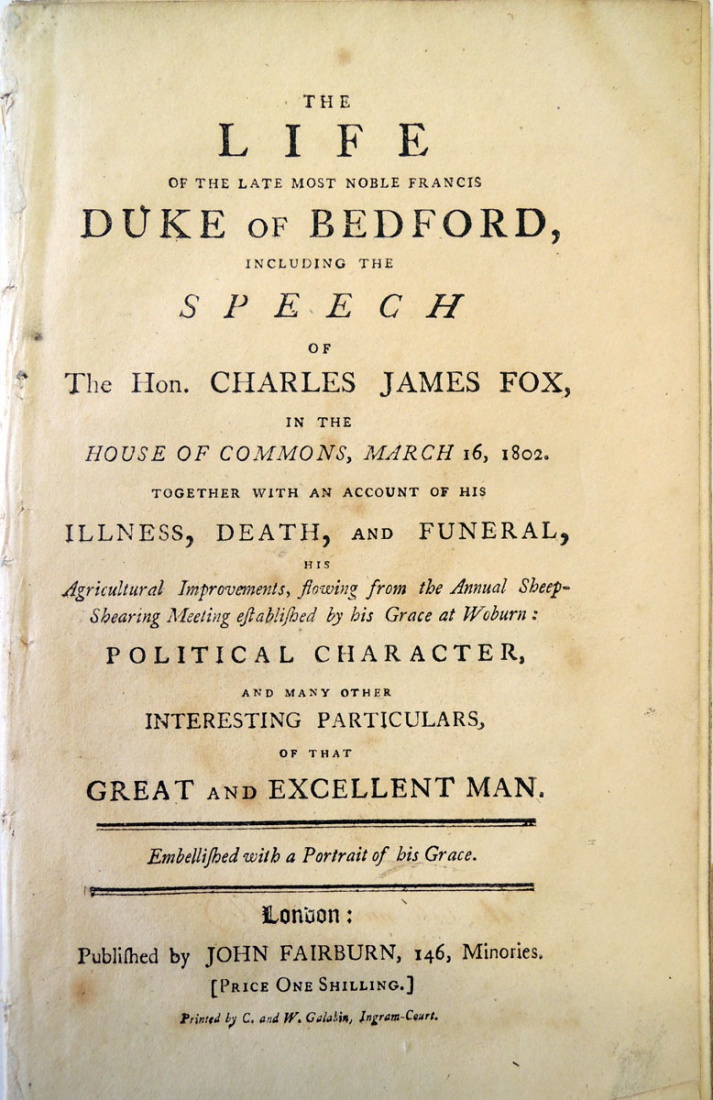
The Life of the late most noble Francis, Duke of Bedford : including the speech of the Hon. Charles James Fox in the House of Commons, March 16, 1802 …(London: John Fairburn, [1802]). Rare Books (Ex) 3580.161

Edward Bell Krumbhaar (1882-1966), Isaac Cruikshank; a catalogue raisonné, with a sketch of his life and work (Philadelphia: University of Pennsylvania Press [1966]). Rare Books: Reference Collection in Dulles Reading Rm. (ExB) NE642.C82 K7

Stories from Antigua

prosa de antigua5

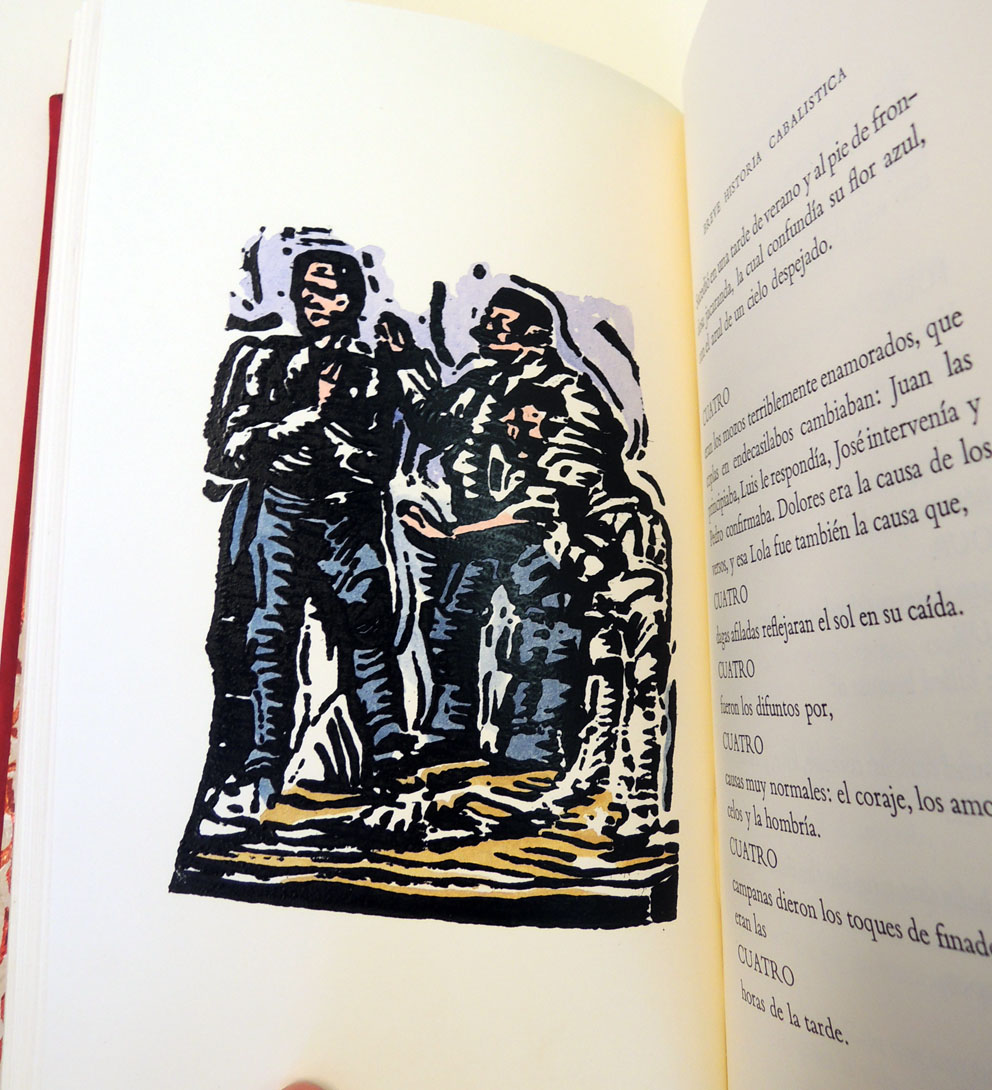
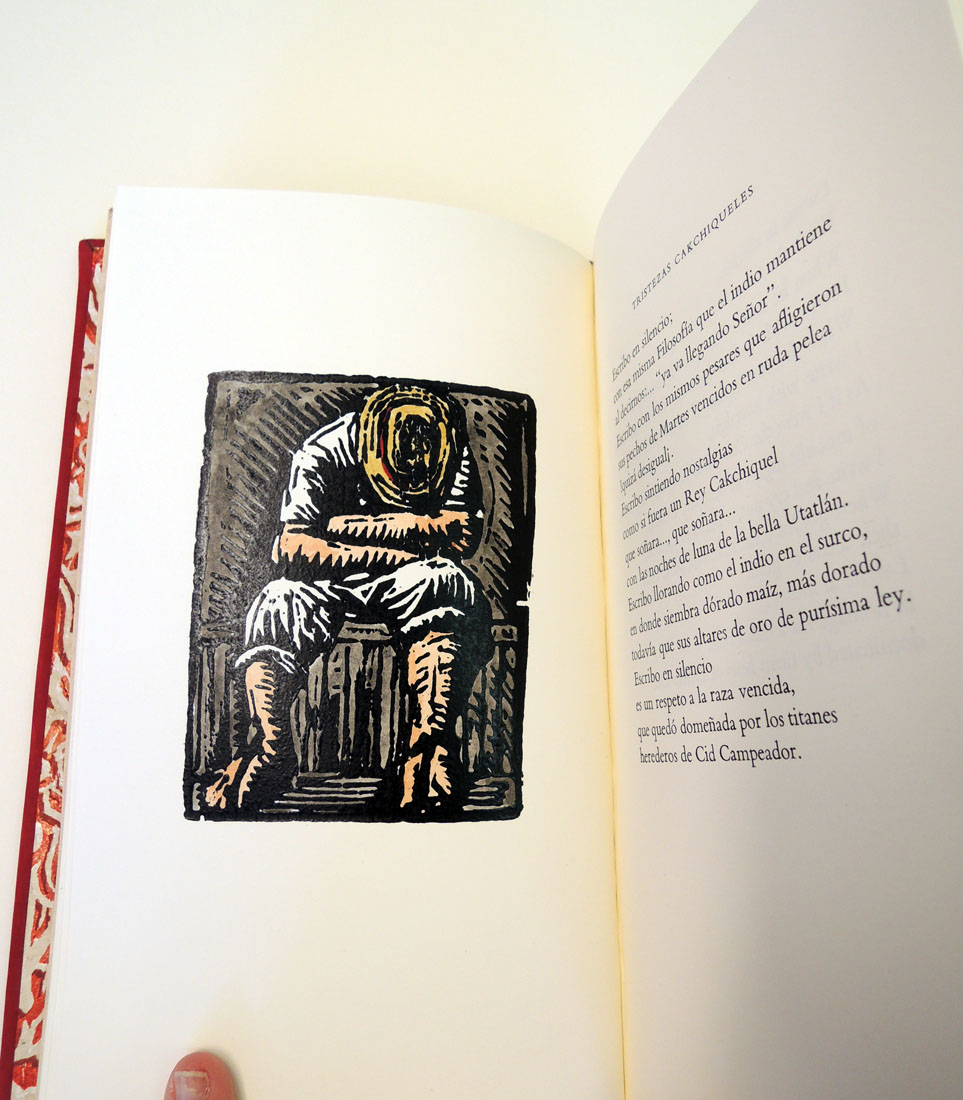
Founded in 1990, Libros San Cristobal La Antigua is a small hand bindery and press located in the Aldea Santiago Zamora, Sacatepequez, Guatemala in Central America. The directors, Christopher Beisel and Grove Oholendt, are “dedicated to the elaboration and publication of small hand printed and hand bound limited editions on subjects related to Mesoamerica.”
prosa de antigua7

Over the last two dozen years, they have published books on a wide spectrum of topics related to indigenous and ancient arts of Mayan civilization. Most include woodcuts designed and cut by Guillermo Maldonado including their most recent volume Prosa de Antigua (Stories from Antigua), with text by Rafael Vicente Alvarez Polanco.
prosa de antigua3

Prosa de Antigua contains twelve stories by Alvarez Polanco selected by his daughter Ana Victoria Alvarez Najera and printed in Spanish and English by Felipe Bucú Miché at Libros San Cristóbal. Maldonado’s woodcuts were printed by E. Rocael López Santos and hand colored by Grove Oholendt and Carlos Bucú Miché. The volume is leather bound by Sergio Bucú Miché and housed in a slipcase made from Libros San Cristóbal’s own amate bark paper.


Rafael Vicente Alvarez Polanco, Prosa de Antigua, with woodcuts by Guillermo Maldonado ([Guatemala]: Libros San Cristobal, 2013). Copy 17 of 125. Graphic Arts Collection GAX 2014- in process. Special thanks to our friend Alfred Bush who helped transport the volume to Princeton.

prosa de antigua2

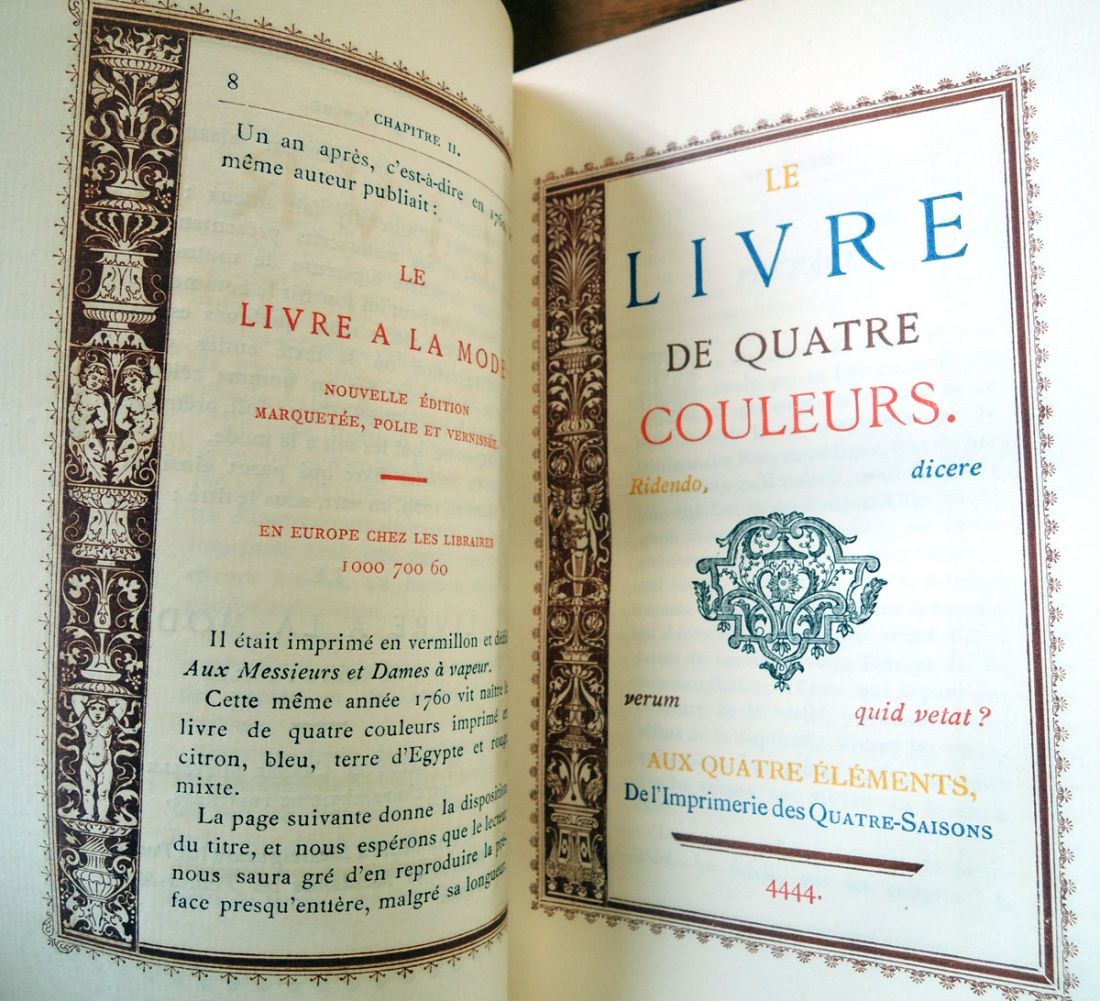
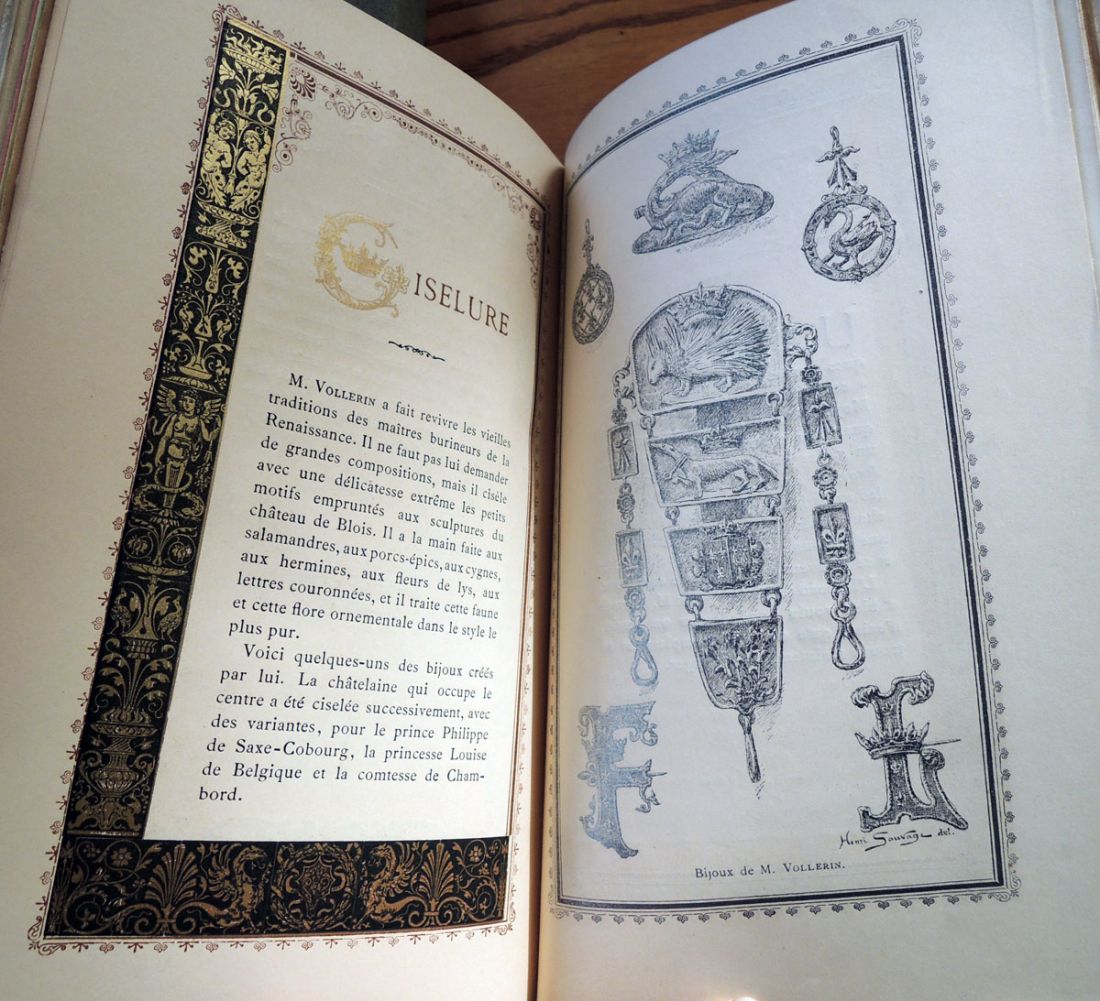
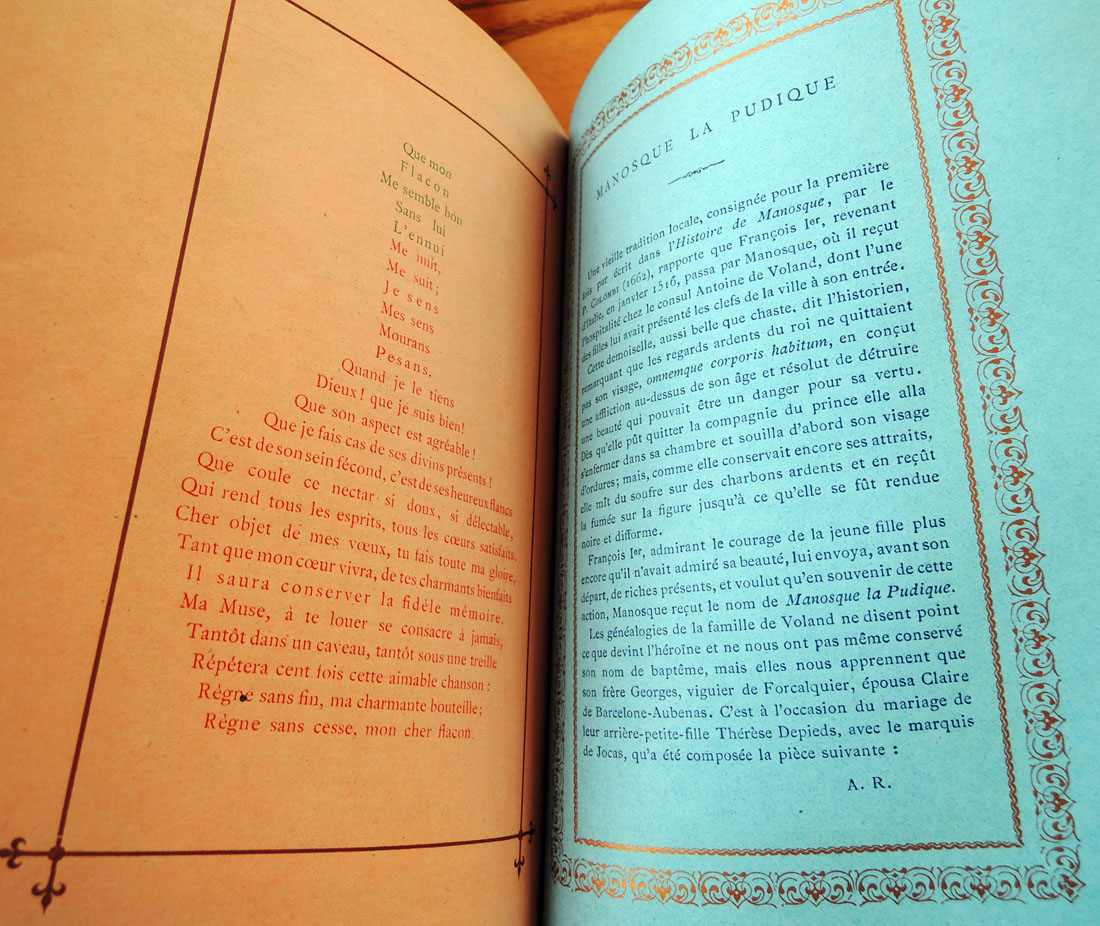
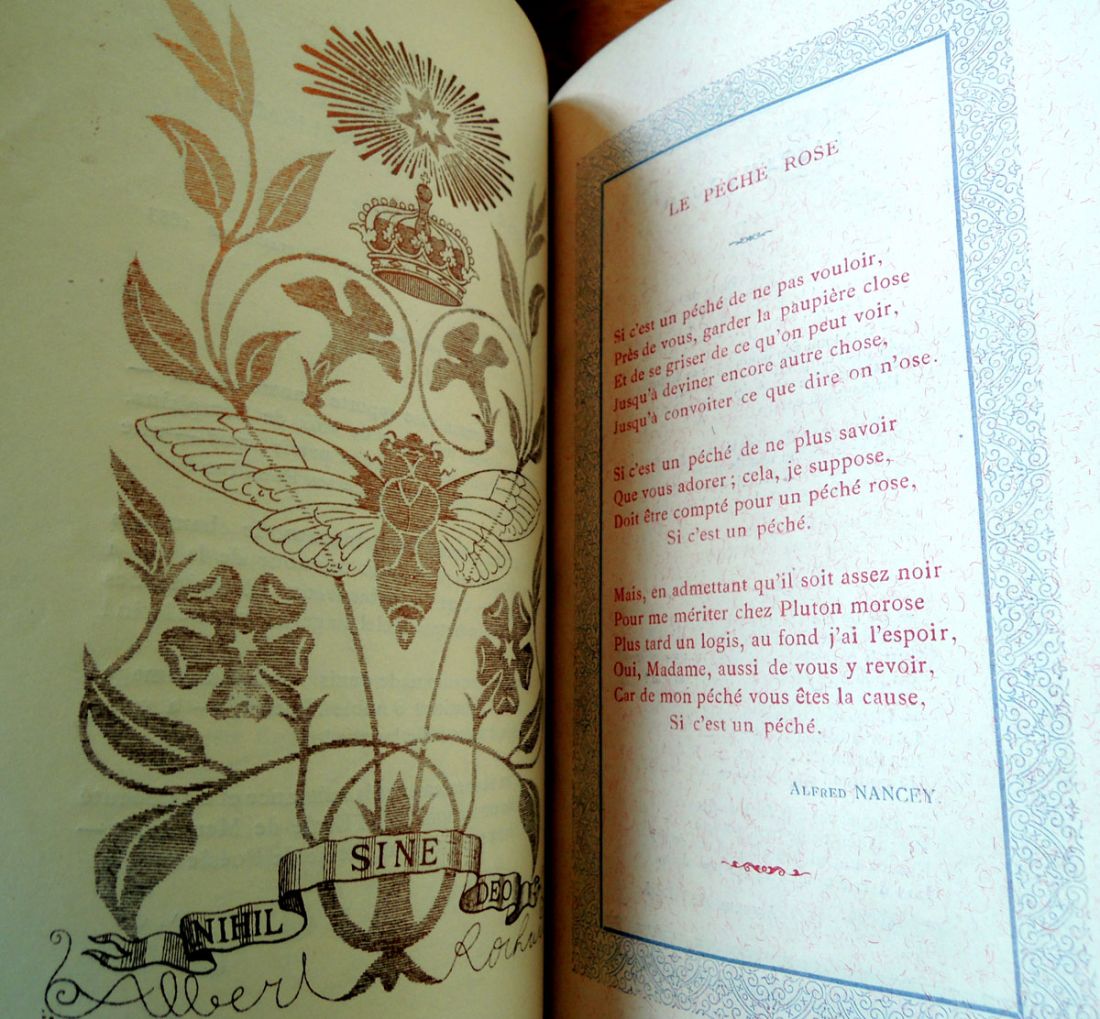
The Book of Tomorrow, in 1884

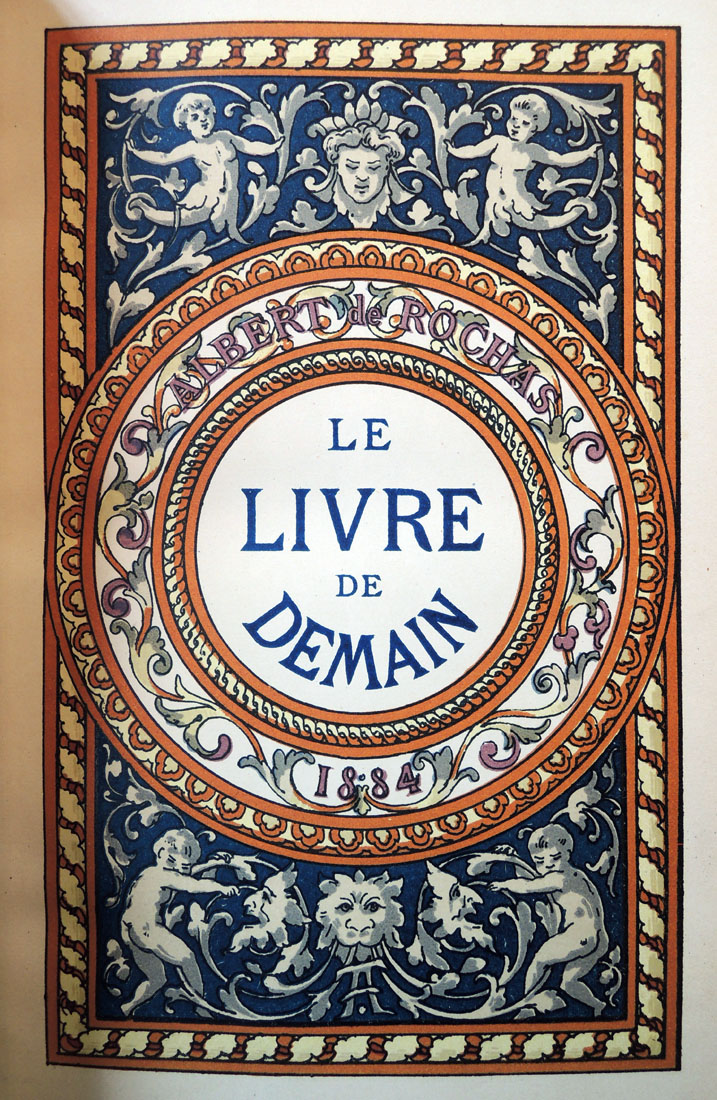
livre de demain4Albert de Rochas d’Aiglun (1837-1914), Le livre de demain (The Book of Tomorrow) ([Blois: Raoul Marchand] 1884). Copy 181 of 250. Graphic Arts Collection (GA) 2008-0772N.

livre de demain2
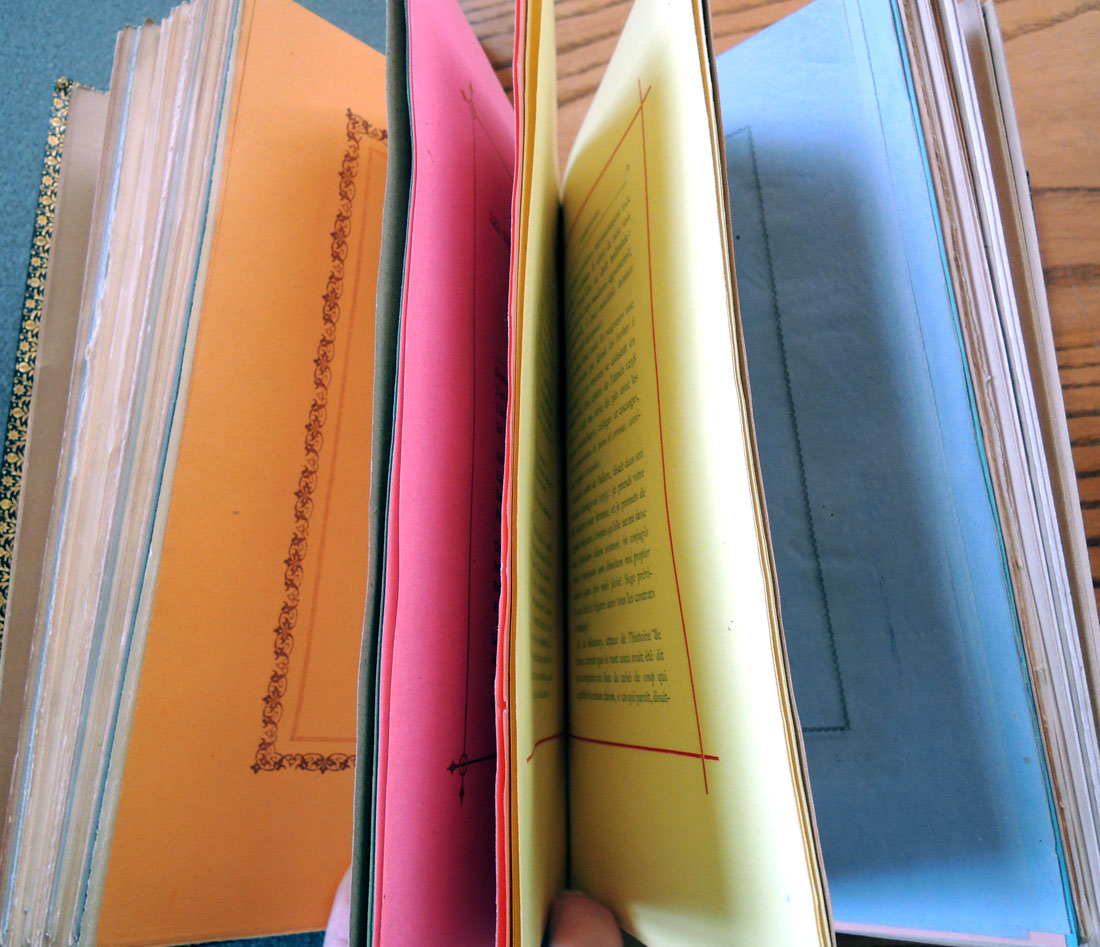
Described as a tour-de-force of bookmaking and papermaking, the printer Rochas d’Aiglun presented the newest techniques of printing in forty-four separate fascicles, which were compiled and published in 1884. Each fascicle was printed on a different kind of paper, using multiple combinations of color and printing techniques, along with essays on the history of paper, ink, and the use of color in printing.

Princeton’s copy takes the imprint from the preliminary leaf. The ornamental title page is printed in color, with the text inside colored ornamental borders. This copy has the “Avis/Tarif” fascicle on pink paper (not called for in contents section), one extra plate in fascicle 3, and a special extra 16 page fascicle on fine heavy blue paper “L’astronomie.” The Jaune de Voiron paper fascicle (28) has the alternate setting “Dissertation . . .”.

An astonishing variety of different papers are shown in a variety of colors, weights, and textures. Almost every page is printed in at least two colors with the text block enclosed in an attractive typographic border of one or two contrasting colors. Several engravings, silhouettes, and photo-lithographs were created for this work and the last principle fascicle contains ten paper samples from papyrus to Chinese and Japanese papers.

livre de demain1
livre de demain6
livre de demain5
livre de demain3

Les Illuminations

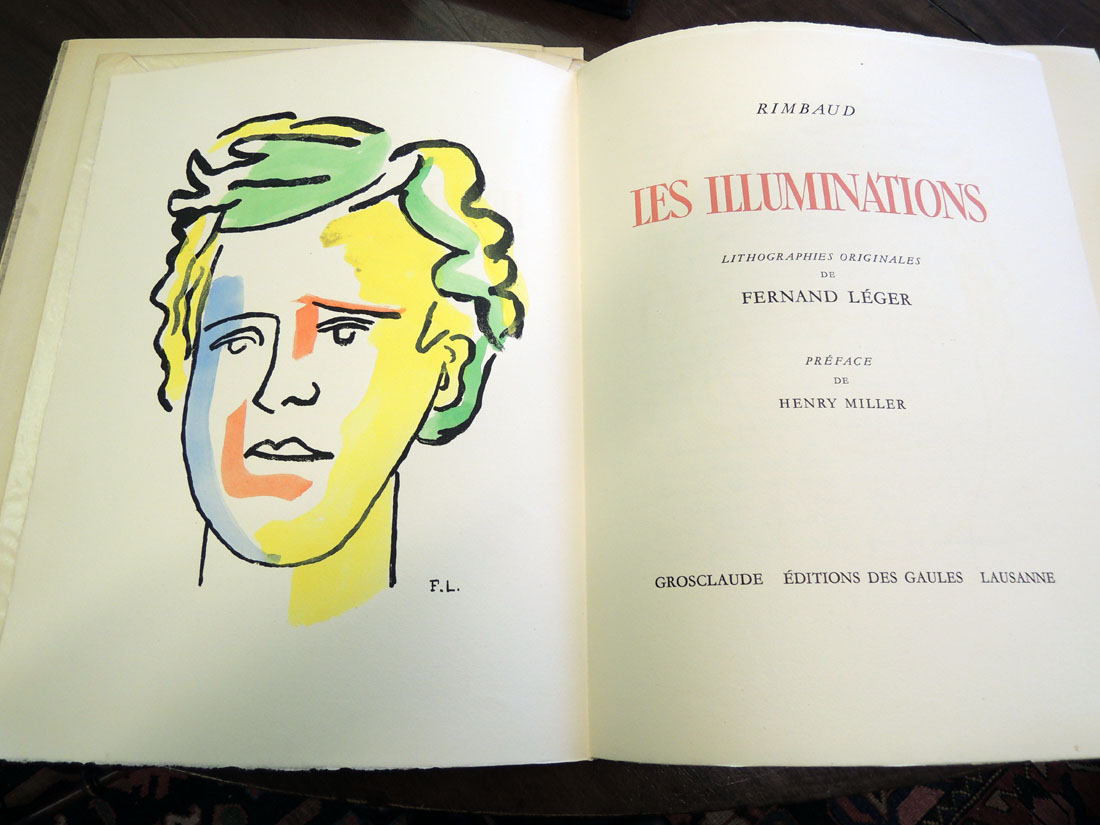
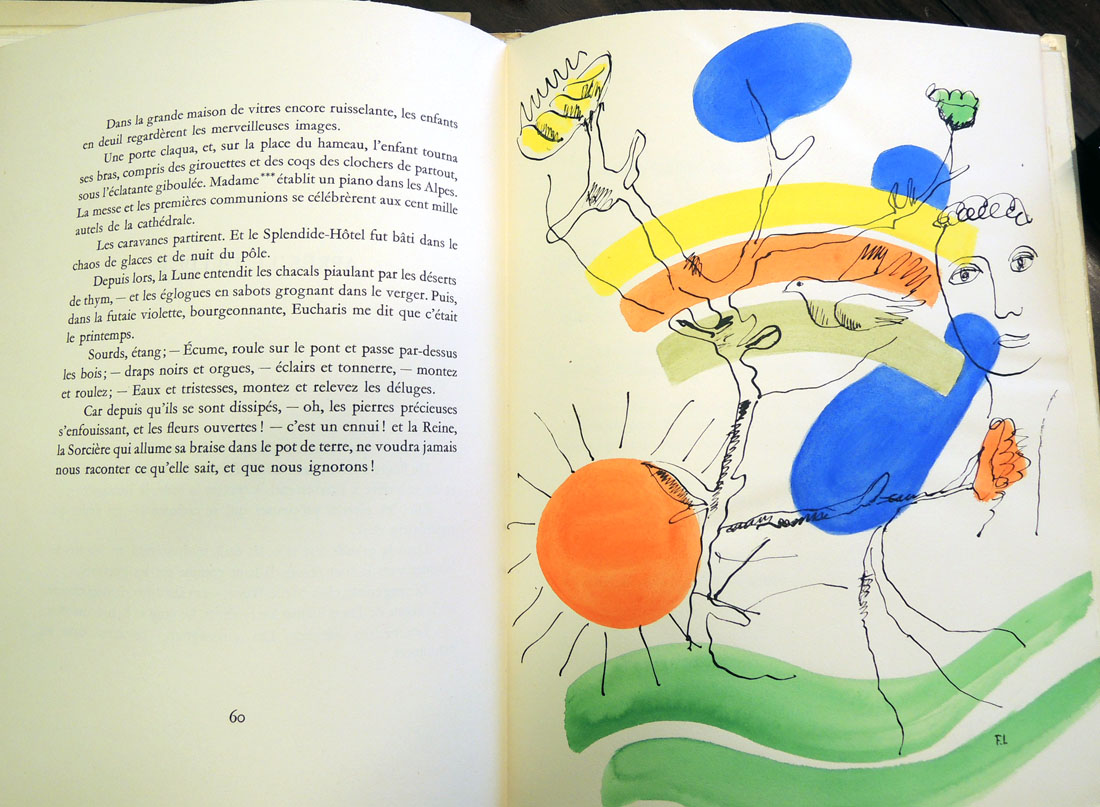
leger illuminationsArthur Rimbaud (1854-1891), Les illuminations. Lithographs by Fernand Léger, preface by Henry Miller. Lausanne: Éditions des Gaules, 1949. One of 395 copies. Graphic Arts Collection 2014- in process

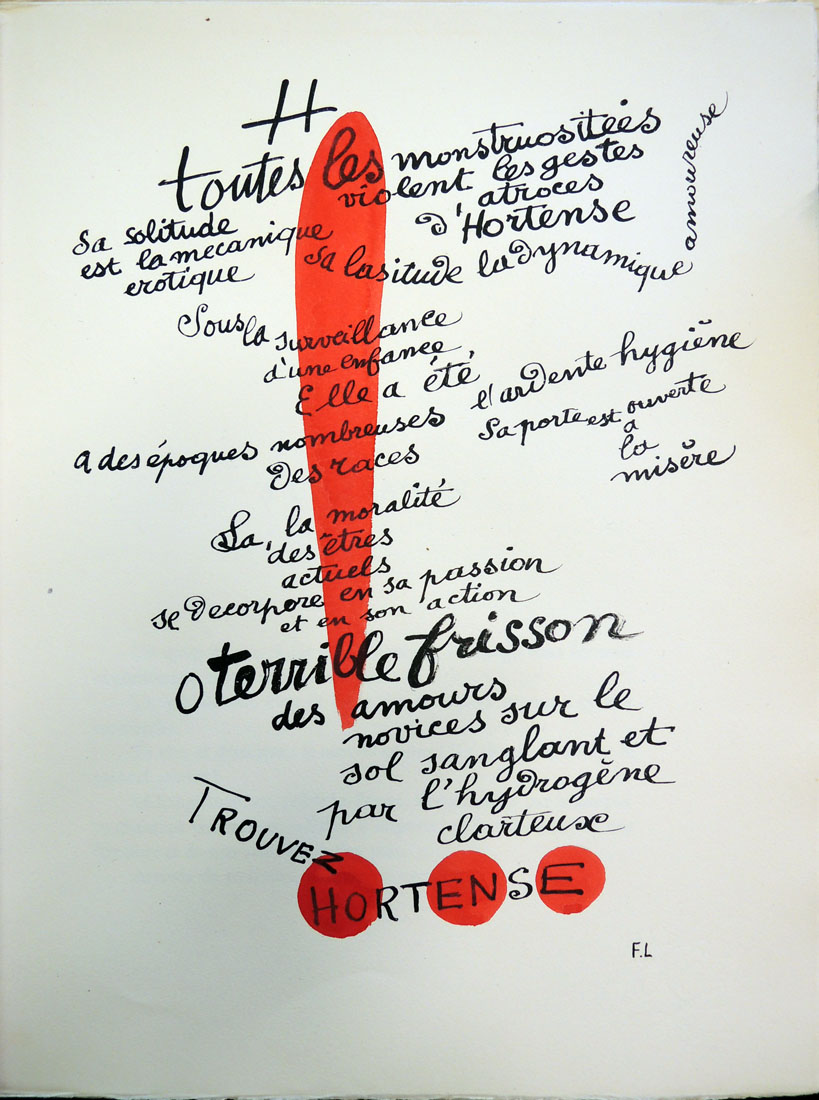
leger illuminations2During the Second World War, the French artist Fernand Léger (1881-1955) lived and worked in the United States, teaching for a brief time at Yale University. He returned to France in 1945 and worked on several livres d’artistes late in his career. In 1948 Léger sent a series of drawings to the American author Henry Miller (1891-1980), who wrote The Smile at the Foot of the Ladder (Ex 3857.19.386) to accompany Léger’s circus imagery.

Although the artist decided not to use this piece, Léger went back to Miller the following year and requested that he write a preface to his next project, Les Illuminations. Miller agreed and his text is reproduced in facsimile of his own handwriting.
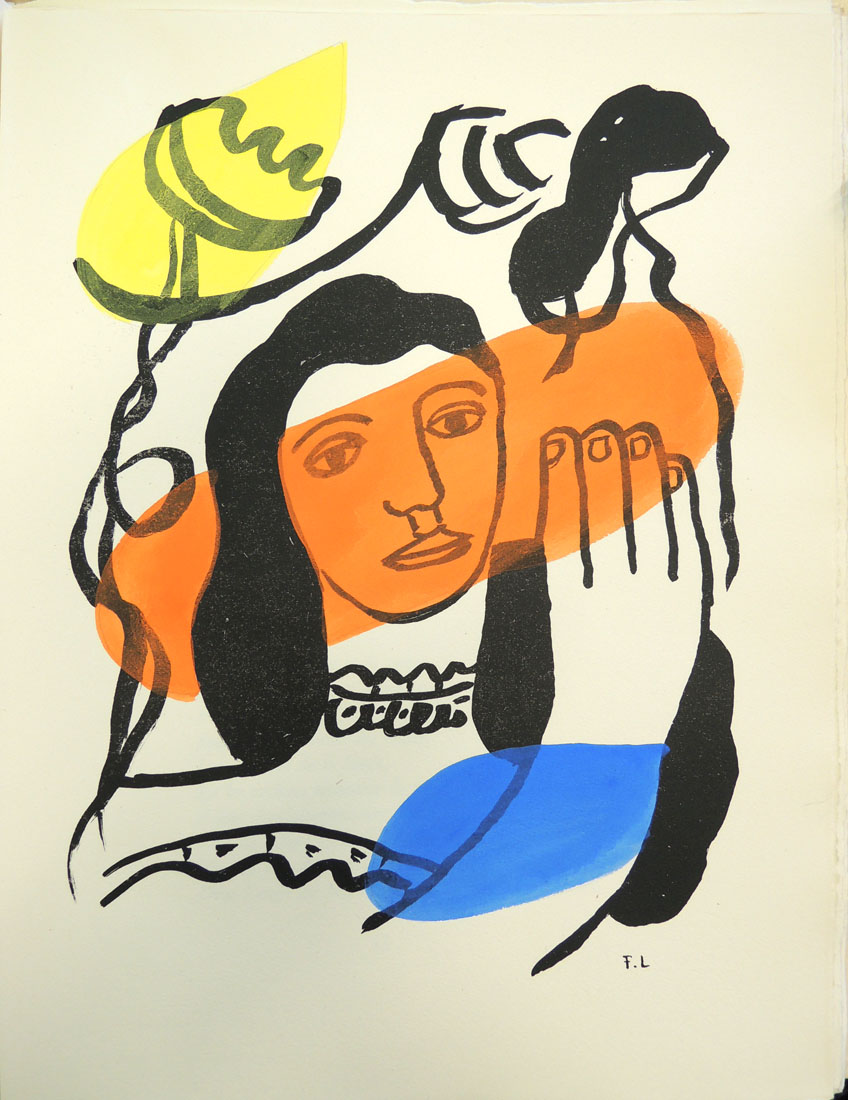
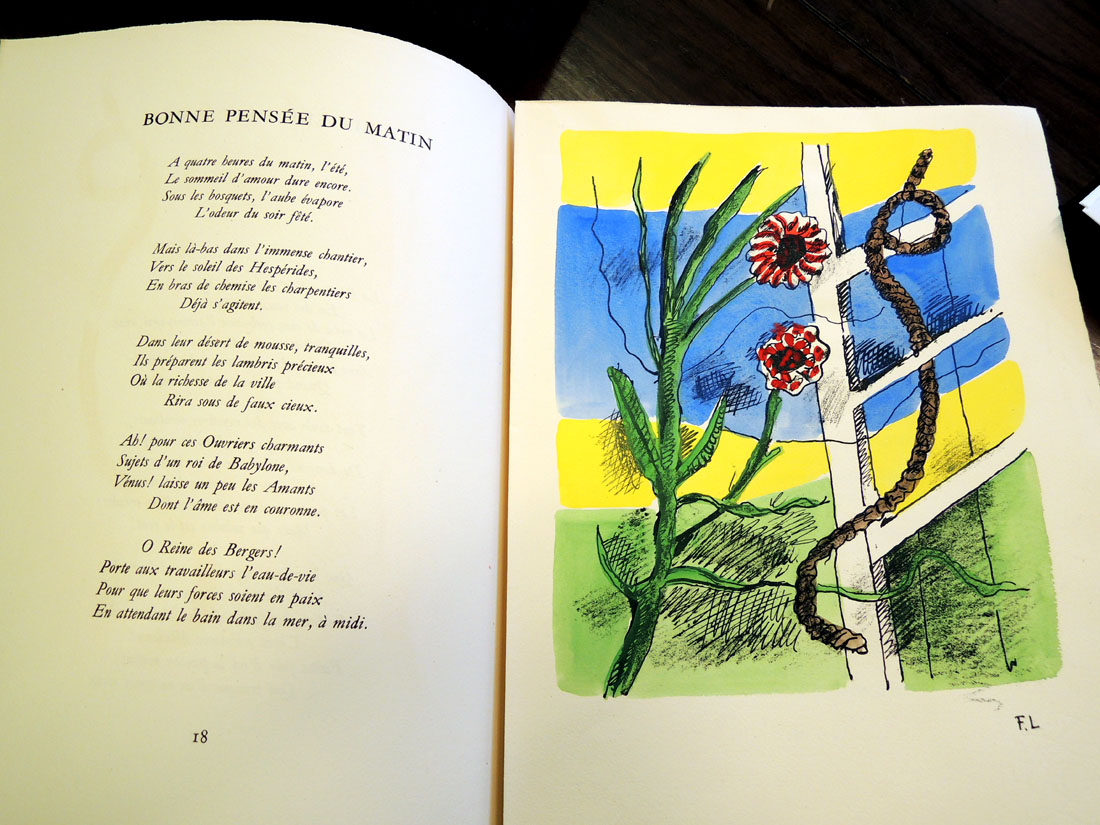
leger illuminations5The prose poems of Les Illuminations were written by Arthur Rimbaud between 1873 and 1875, and partially published in La Vogue in 1886. Léger chose a selection of these poems to include with 15 of his lithographs, 6 of which were stencil colored under the direction of the Swiss publisher Louis Groschaude.

leger illuminations4One of the poems Léger chose to use was Parade, which has been translated as:

“Sturdy enough jesters. Several have exploited your worlds. Devoid of need, in no hurry to make play of their brilliant faculties or their knowledge of your conscience. How ripe they are! Eyes dazed like the summer night, red and black, tricolours, steel pricked with golden stars; features deformed, leaden, pallid, on fire; hoarse-throated frolickers! A cruel swagger of faded finery! – Some are young – how do they view Cherubino? – endowed with frightening voices and dangerous resources. They’re sent out soliciting in city streets, decked out in disgusting luxury.”

Among Léger other book project are J’ai Tué (1918) and La Fin du Monde Filmée par l’Ange Notre-Dame (1919) both by Blaise Cendrars; Lunes en Papier by André Malraux (1921); and Liberté by Paul Éluard (1953). To read more, see Renée Riese Hubert, “The Books of Fernand Léger: Illustration and Inscription,” in Visible Language, 23, no. 2/3 (spring/summer 1989), p. 255-79 (Firestone Library (F) Z119 .J88).
leger illuminations3
leger illuminations6

Sindbad Reaches America 1794

history of sinbad2
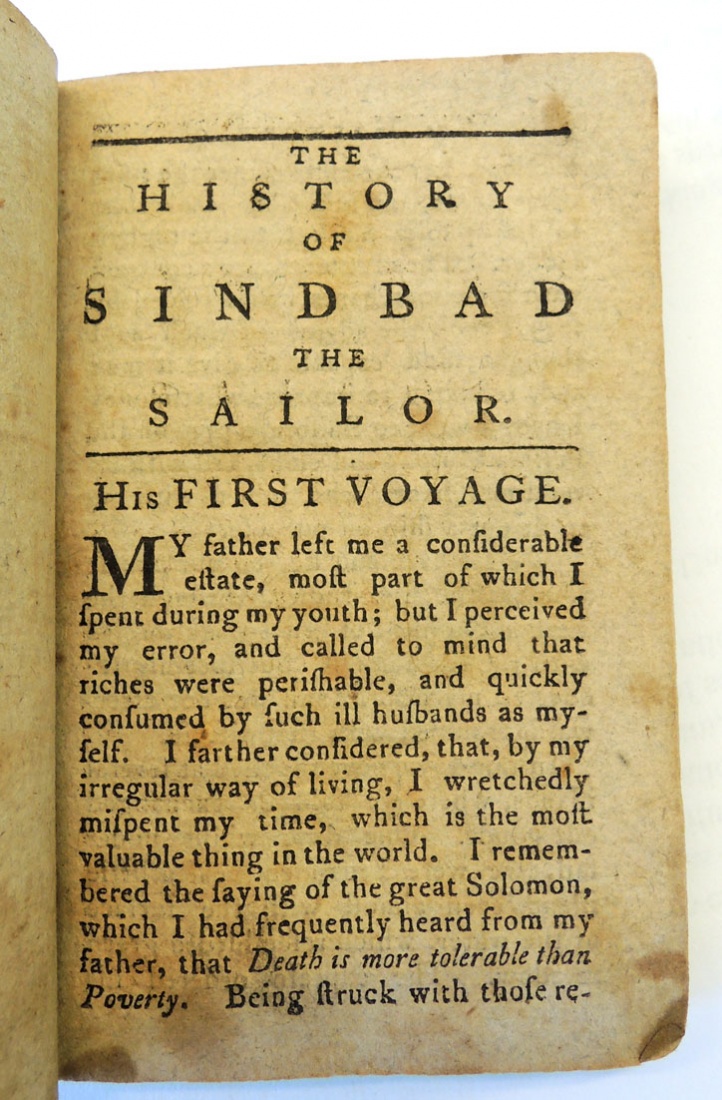
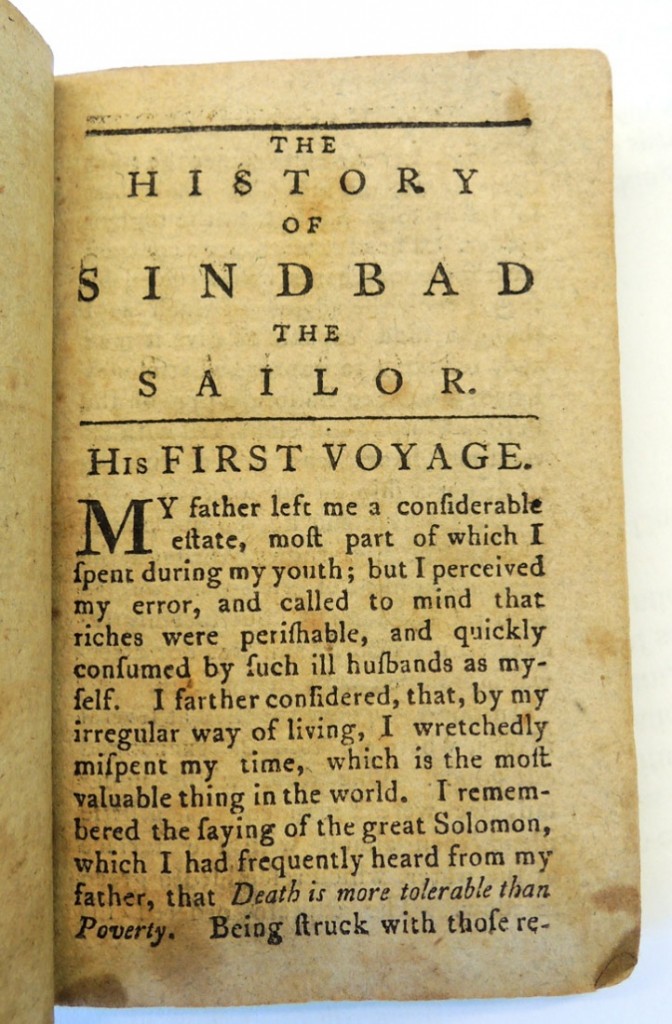
“My father left me a considerable estate, most part of which I spent during my youth,” begins the history of Sindbad the sailor, “but I perceived my error, and called to mind that riches were perishable, and quickly consumed by such ill husbands as myself. I farther considered, that, by my irregular way of living, I wretchedly mispent [sic] my time, which is the most valuable thing in the world.”

This slideshow requires JavaScript.

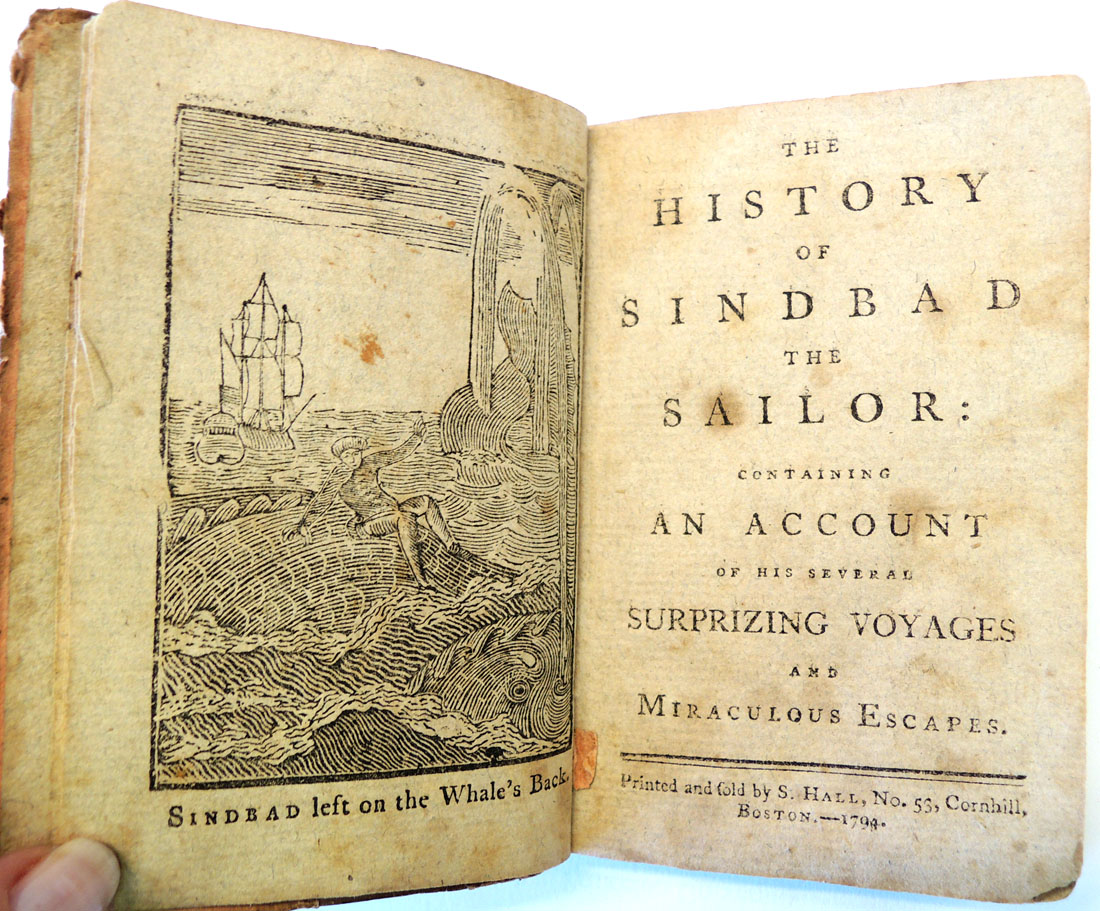
Elizabeth Newbery (1746-1821) first published this account of Sindbad the sailor from her London shop in 1784 (Cotsen Eng 18, Newbery 5017). There is no record of who made the woodcut illustrations to accompany the story. Ten years later, a pirated edition turned up for the first time in Boston, Massachusetts with the same cuts under the publisher Samuel Hall (1740-1807).

The brothers, Samuel and Ebenezer Hall began printing in Salem, Mass. from 1768 to 1775, the third printing press in the colony of Massachusetts. After the death of his brother, Samuel moved the firm to Boston where he published books and newspapers for adult and juvenile audiences. A nice biography of the “printer/patriot” has been posted at: http://tarquintarsbookcase.blogspot.com/2010/05/samuel-hall-printer-patriot-part-1.html and additional information can be found in Isaiah Thomas’s The History of Printing in America (1810):

“In April, 1789, [Hall] began printing, in the French language, a newspaper, entitled Courier de Boston. This was a weekly paper, printed on a sheet of crown in quarto, for J. Nancrede, a Frenchman… a bookseller in Boston; but his name did not appear in the imprint of the paper. Courier de Boston was published only six months. After Hall relinquished the publication of a newspaper, he printed a few octavo and duodecimo volumes, a variety of small books with cuts, for children, and many pamphlets, particularly sermons. He was a correct printer, and judicious editor; industrious, faithful to his engagements, a respectable citizen, and a firm friend to his country. He died October 30, 1807, aged sixty-seven years.”
history of sinbad7

The History of Sindbad the Sailor: Containing an Account of His Several Surprizing Voyages and Miraculous Escapes (Boston: Printed and sold by S. Hall, No. 53, Cornhill, 1794). Woodcut frontispiece and six full-page illustrations, one for each of the seven voyages. Graphic Arts Collection GAX 2014- in process