Category Archives: Books

books

Need paper?

paper allen

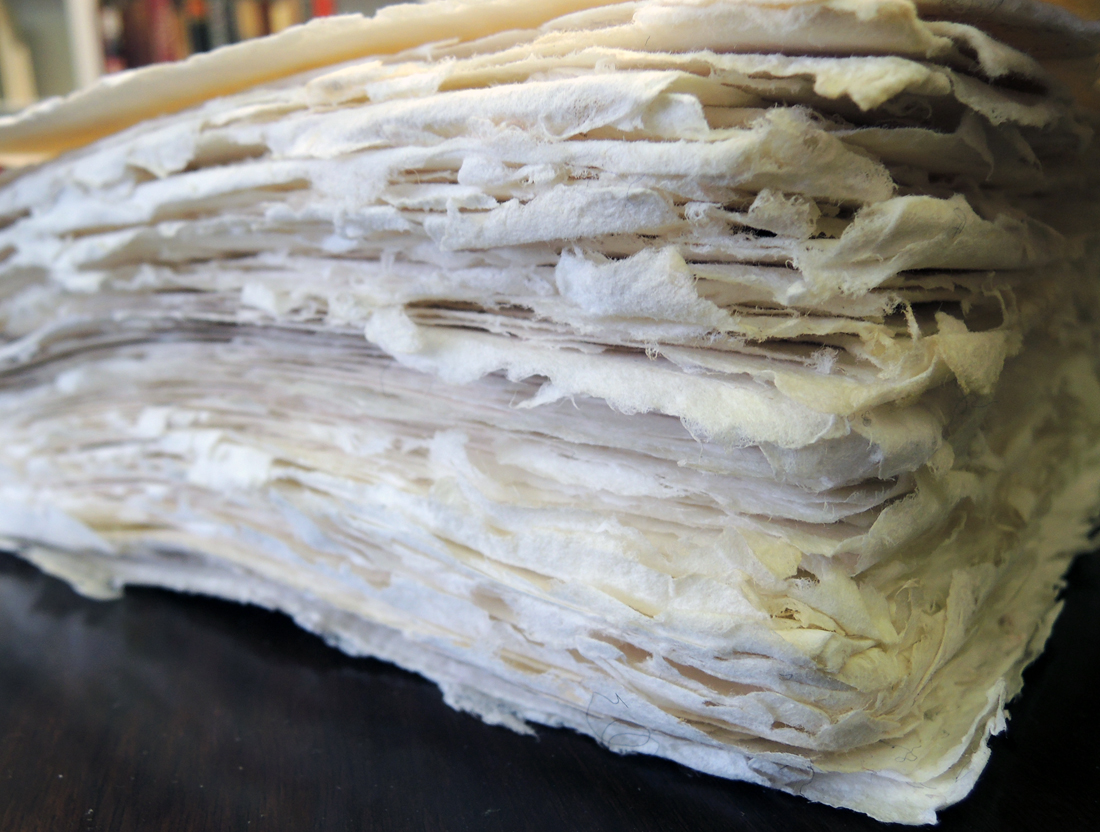
paper allen2paper allen4Need some paper? Why go to Office Depot when you can make it yourself? That’s what our good friend Allen Scheuch, Class of 1976, did.

Two years after he graduated from Princeton University, Scheuch decided to learn to make paper. The class he attended followed Dard Hunter’s book, Papermaking: the History and Technique of an Ancient Craft (New York: Knopf, 1943). Graphic Arts Collection (GAX) TS1090 .H816 1943.

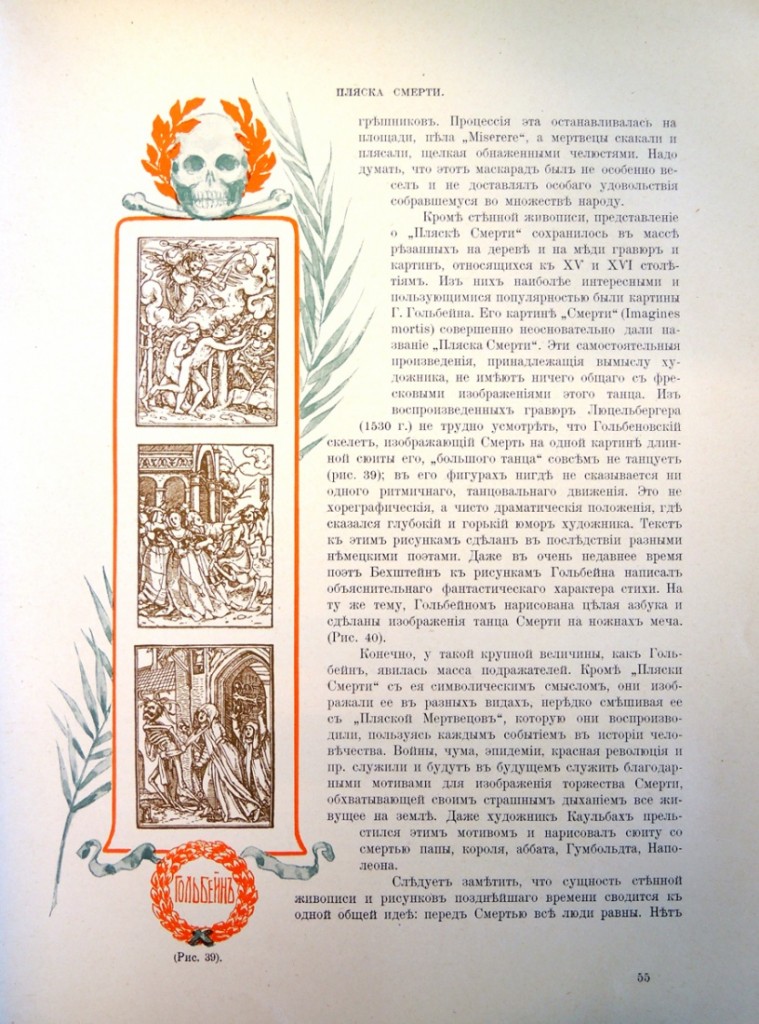
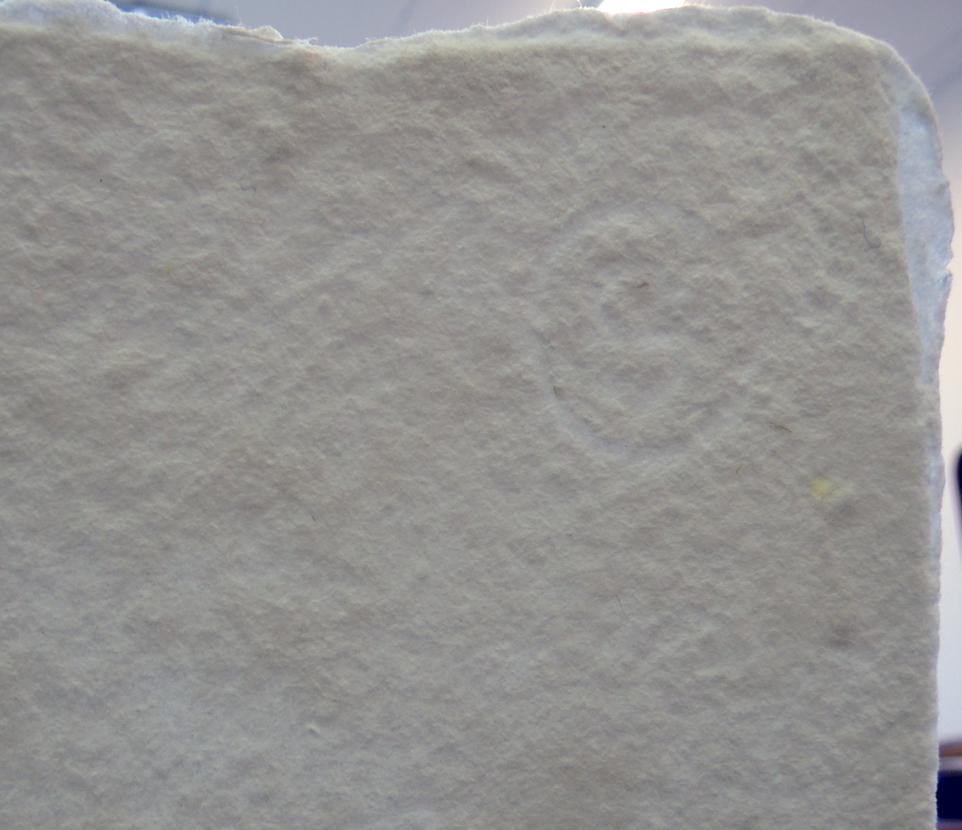
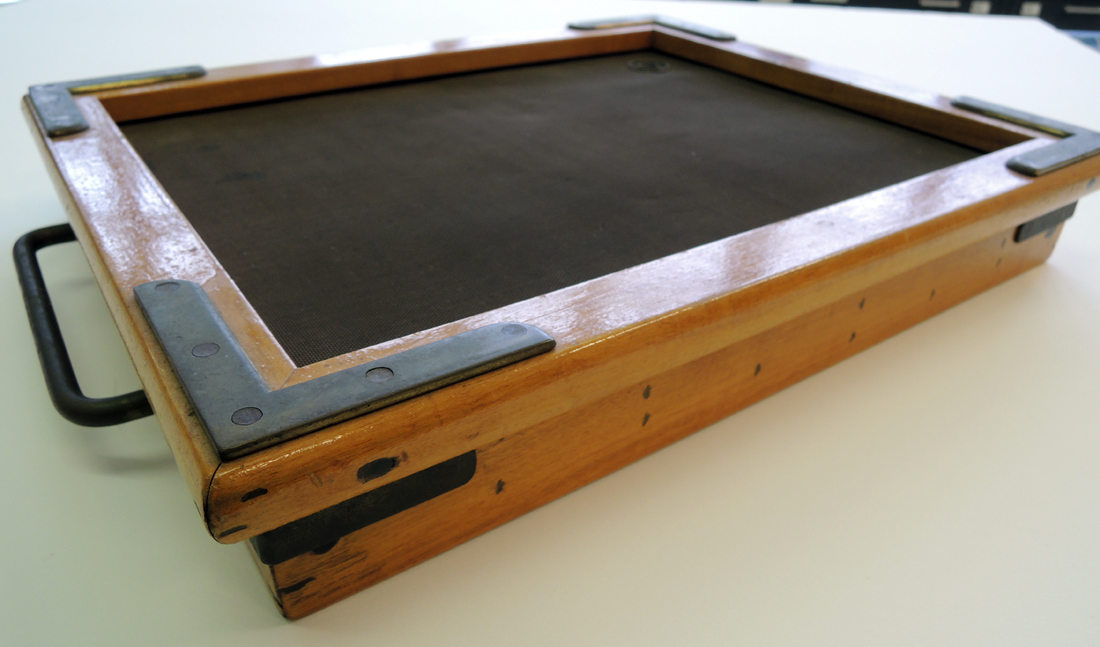
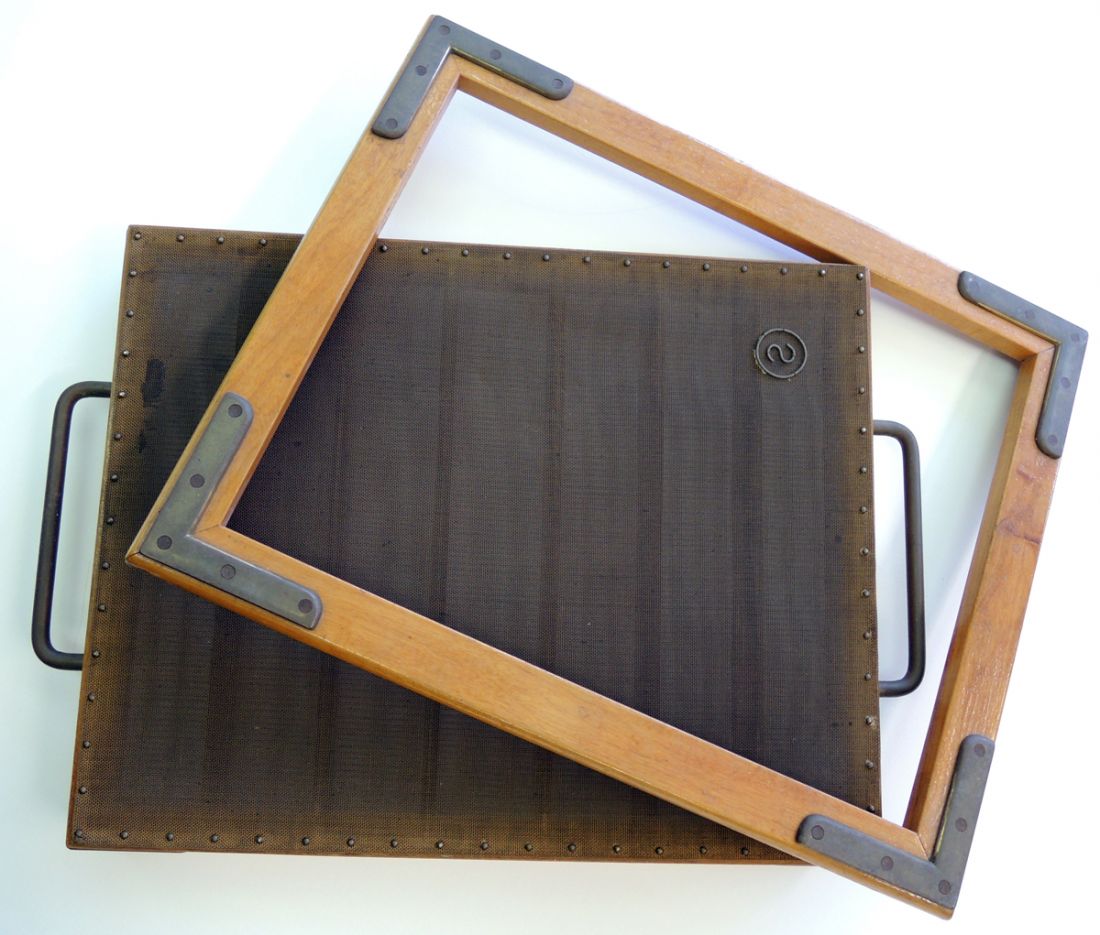
A 24 x 32 inch paper mould was fashioned from varnished mahogany, with a bronze screen, simple brass (kitchen cabinet) handles, an inlaid brass rod on one side for reinforcement, and an “S” (for Scheuch) in a circle for the watermark.

100% linen rag was torn and beaten into a milk-like soup. For each sheet, Scheuch dipped the mould into the mixture and let the water drain. The top “deckle” finished the sides of the paper before the damp sheet was transferred to a felt where it would dry.

“I used one or two pieces but that was all!” Scheuch told me. “I liked the texture and the deckle but could never bring myself to use it casually – it meant too much to me! – and never ended up using it in a special project. So this will be its special project – as a teaching aide in Princeton’s Graphic Arts Department; I can’t imagine a finer one!”

paper allen3Even better, this winter Scheuch’s mould and some of his paper will find their way into the Princeton University Art Museum as an educational element for the upcoming extravaganza: 500 Years of Italian Master Drawings from the Princeton University Art Museum, opening January 25, 2014.

Our sincere thanks to Mr. Scheuch!


Overdue Accounts

morley rubaiyat7
morley rubaiyat6

In 1923, when Frances Steloff (1887-1989), owner of the Gotham Book Mart, moved her bookstore to West Forty-Seventh Street, it was her friend Lew Ney (Luther Widen, 1886-1963) who gave up his Fourth of July weekend to carry the books and shelves to the new shop. When Steloff needed a brochure or keepsake printed, it was her friend Lew Ney who hand-set the type, dampened the paper, and printed the edition for her.

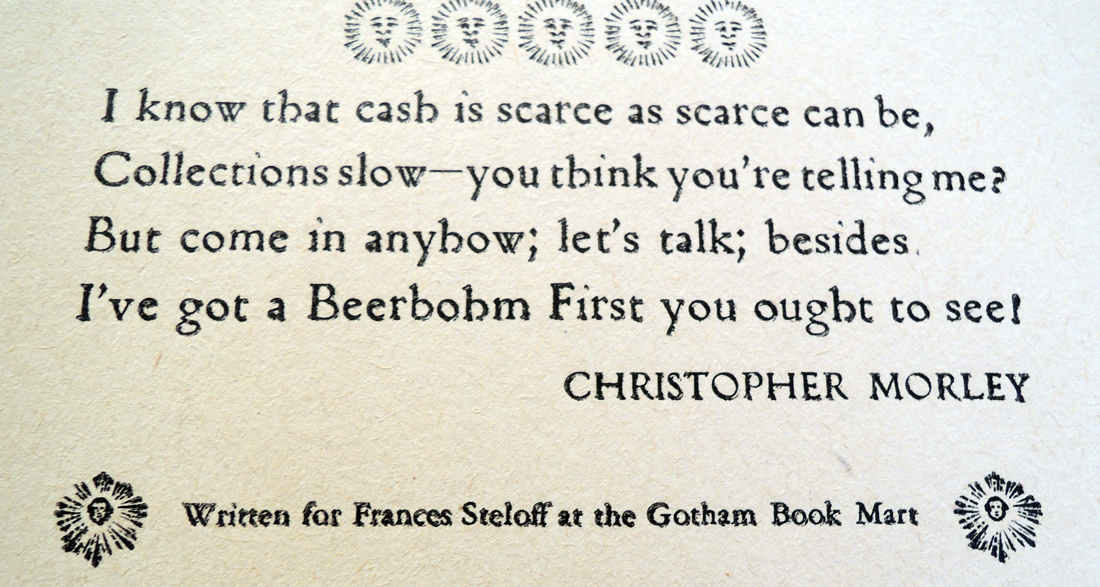
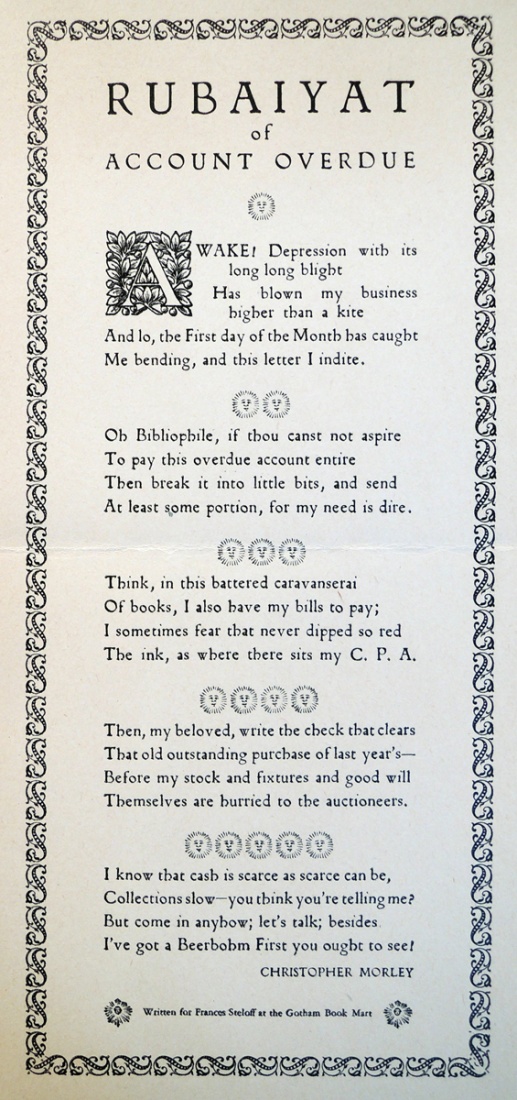
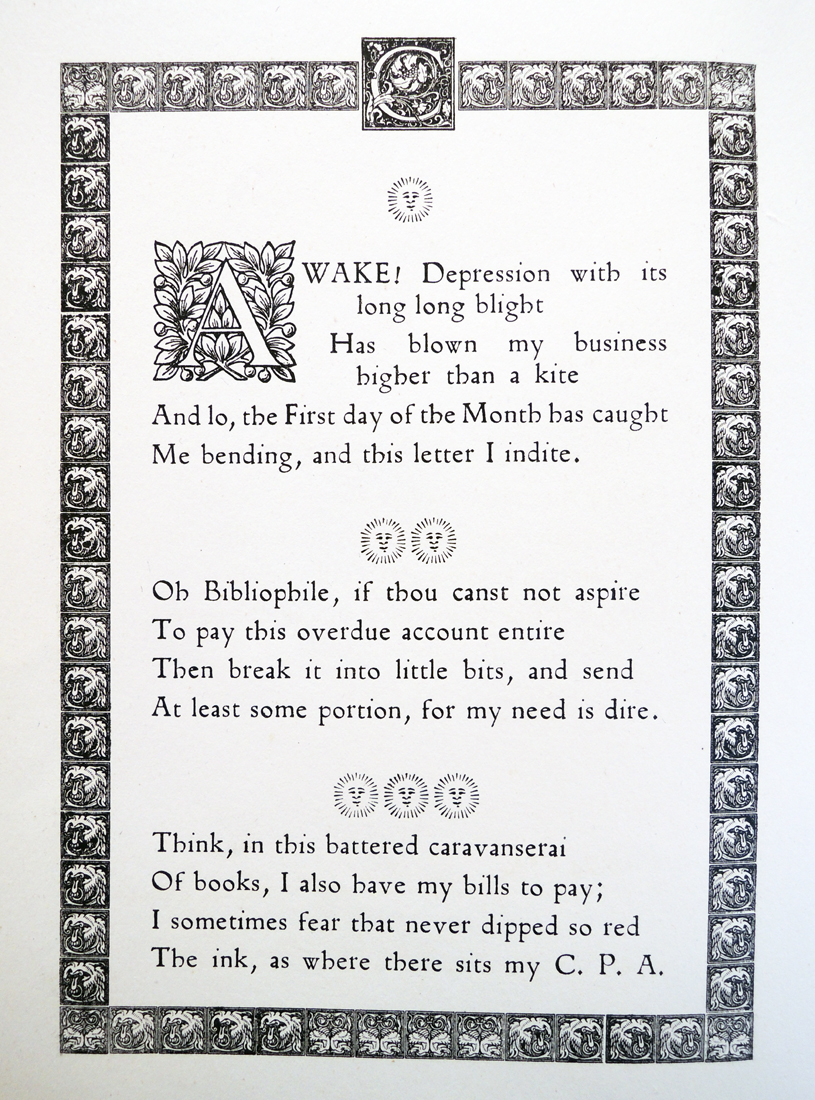
And so, when Christopher Morley (1890-1957) wrote the verse, “Rubaiyat of Account Overdue,” in response to the many unpaid bills at the Gotham Book Mart, it was Lew Ney who editioned the poem for Steloff.

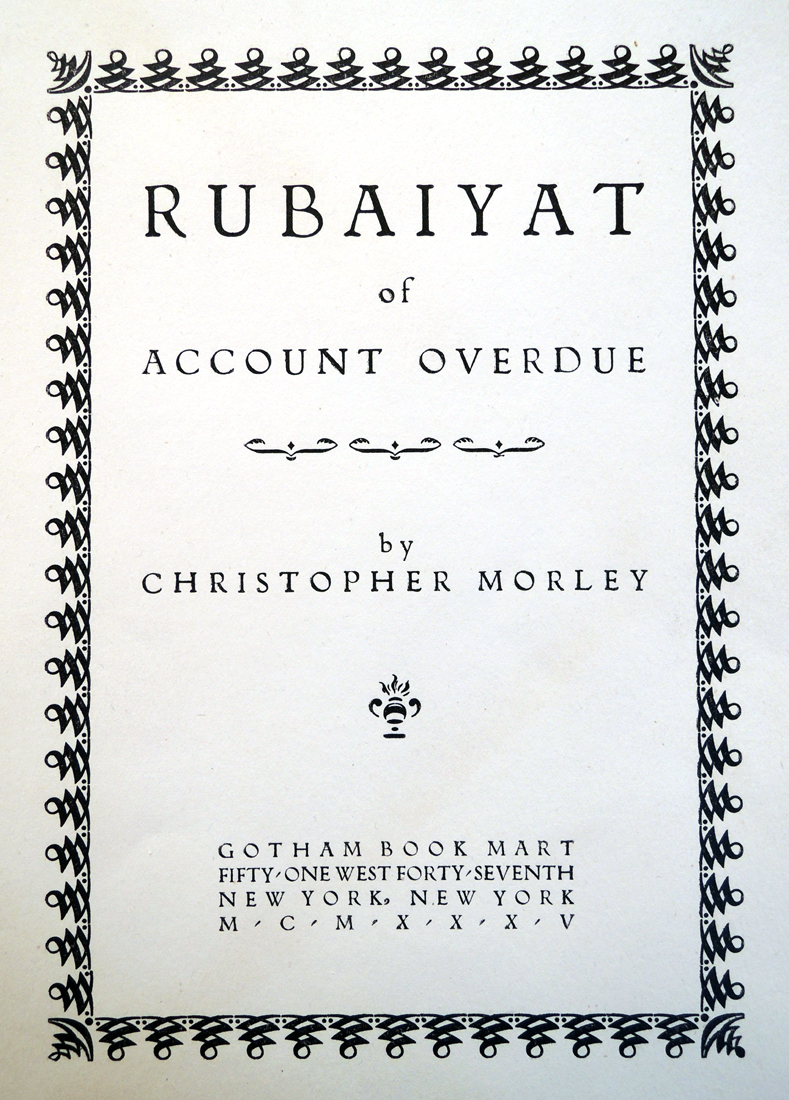
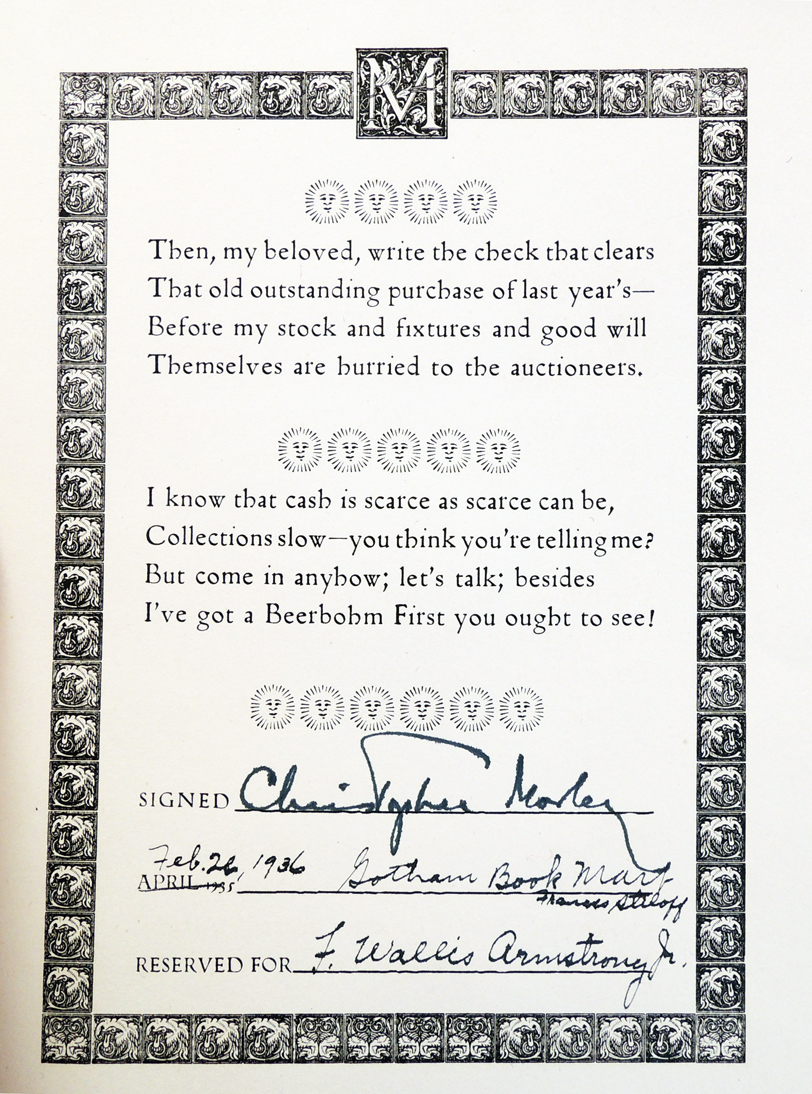
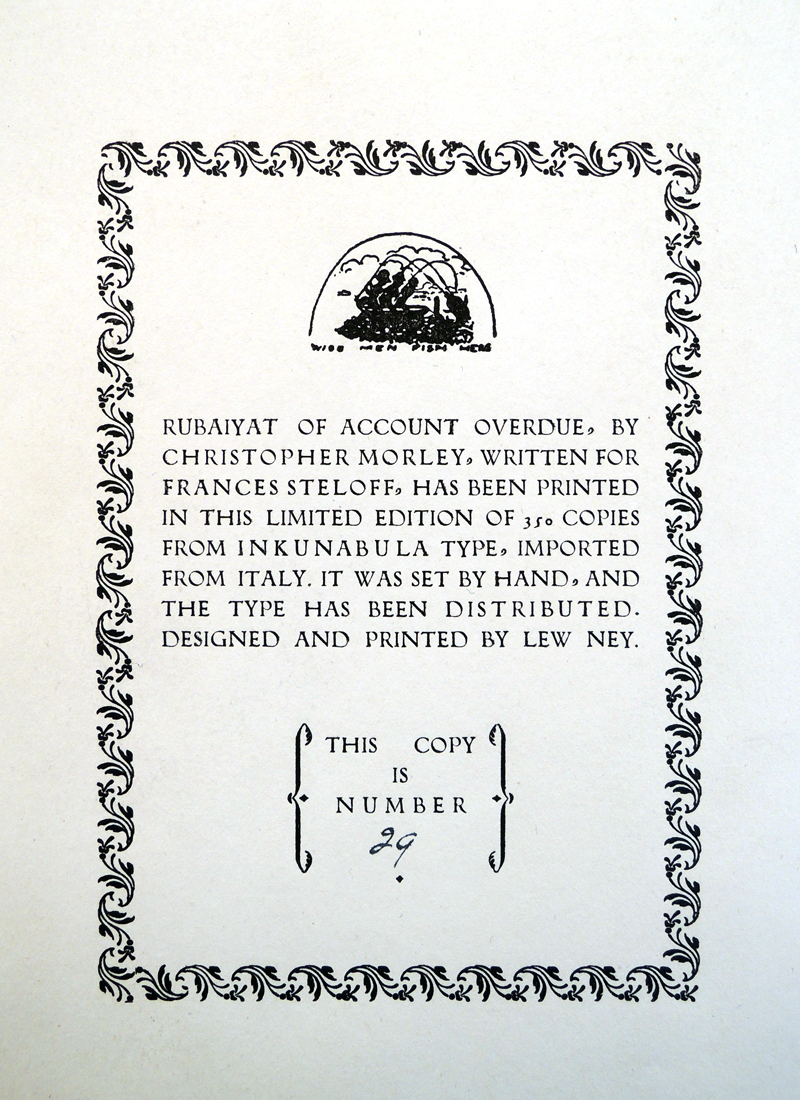
Lew Ney designed two separate formats: a narrow broadside that would go in an envelope with each overdue notice and a four page keepsake as a reward to those who paid their bills. He printed 350 of each, using his famous Inkunabula type. Morley signed them all and as they went out, Steloff added the date and her signature.

“That not only brought good results,” wrote Steloff, “but also a problem—our prompt paying customers then felt it was more rewarding to be delinquent.” [Special Gotham Book Mart issue of Journal of Modern Literature 4, no.4 April 1975): 792]morley rubaiyat5As soon as he finished Steloff’s project, Lew Ney was on to his next jobs, using the same Inkunabula type to set Robert Penn Warren’s Thirty-Six Poems; Williams Carlos William’s An Early Martyr and Other Poems; and Wallace Stevens’ Ideas of Order, among other project that year.

morley rubaiyat1       morley rubaiyat3

morley rubaiyat2     morley rubaiyat4

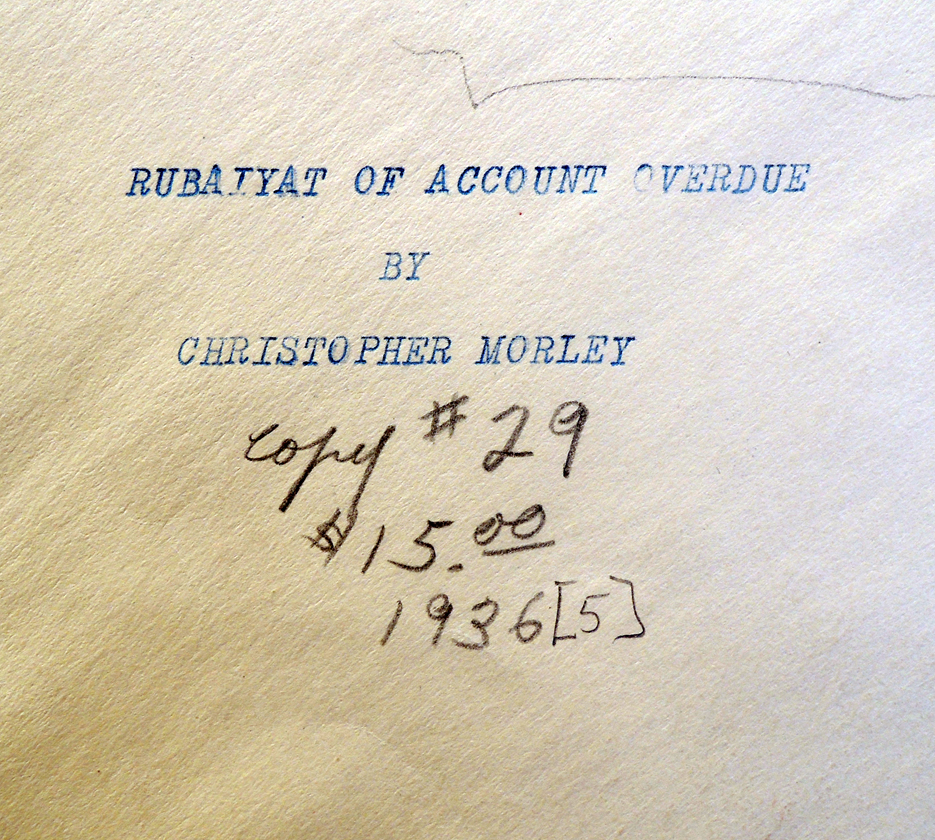
Christopher Morley (1890-1957), Rubaiyat of Account Overdue (New York: Gotham Book Mart, 1935). Copy 29 of 350. Rare Books (Ex) 3866.5.3785.1935

Christopher Morley ( 1890-1957), Rubaiyat of Account Overdue ([New York: Gotham Book Mart, 1935]). (Ex) Oversize 3866.5.3785q

Moby Dick Goes to Moscow

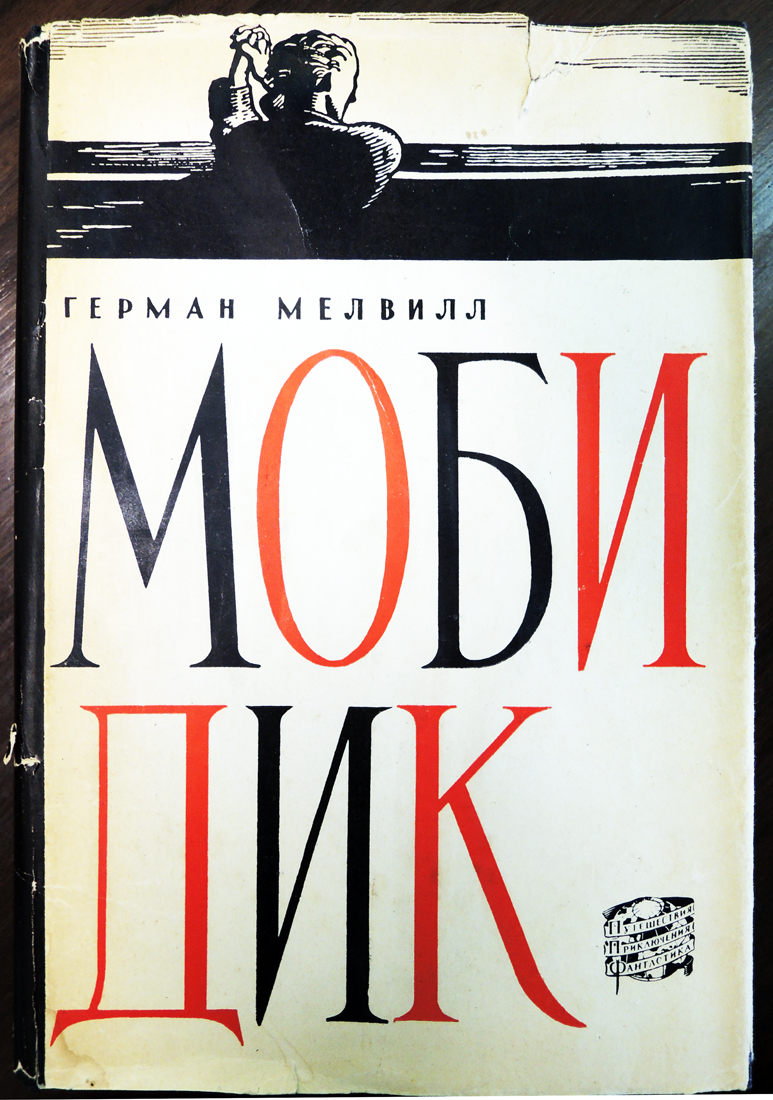
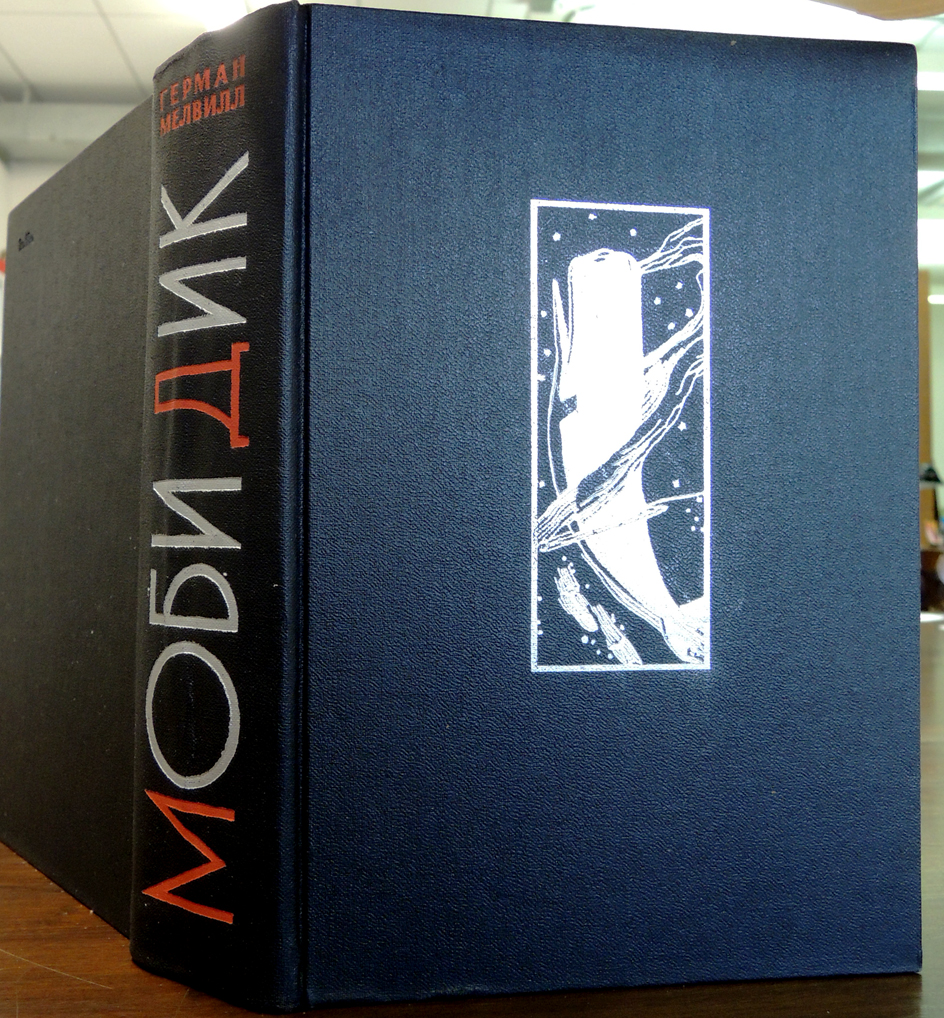
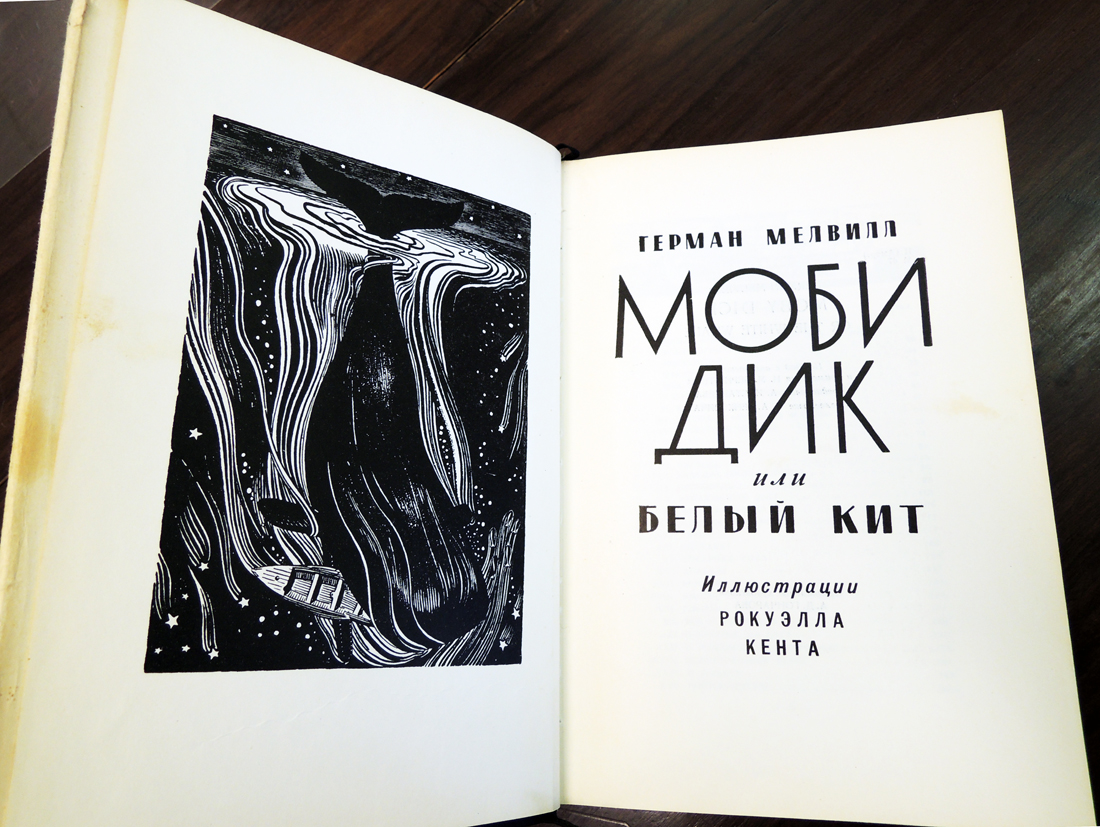
mobydick russian2Herman Mellville (1819-1891), Mobi Dik, ili Belyi kit [Moby Dick]. Москва: Gosudarstvennoe Izdatepbstvo Geografickoj Piteratury [Moscow: State Publisher of Geographical Literature], 1961. Graphic Arts Collection 2013- in process

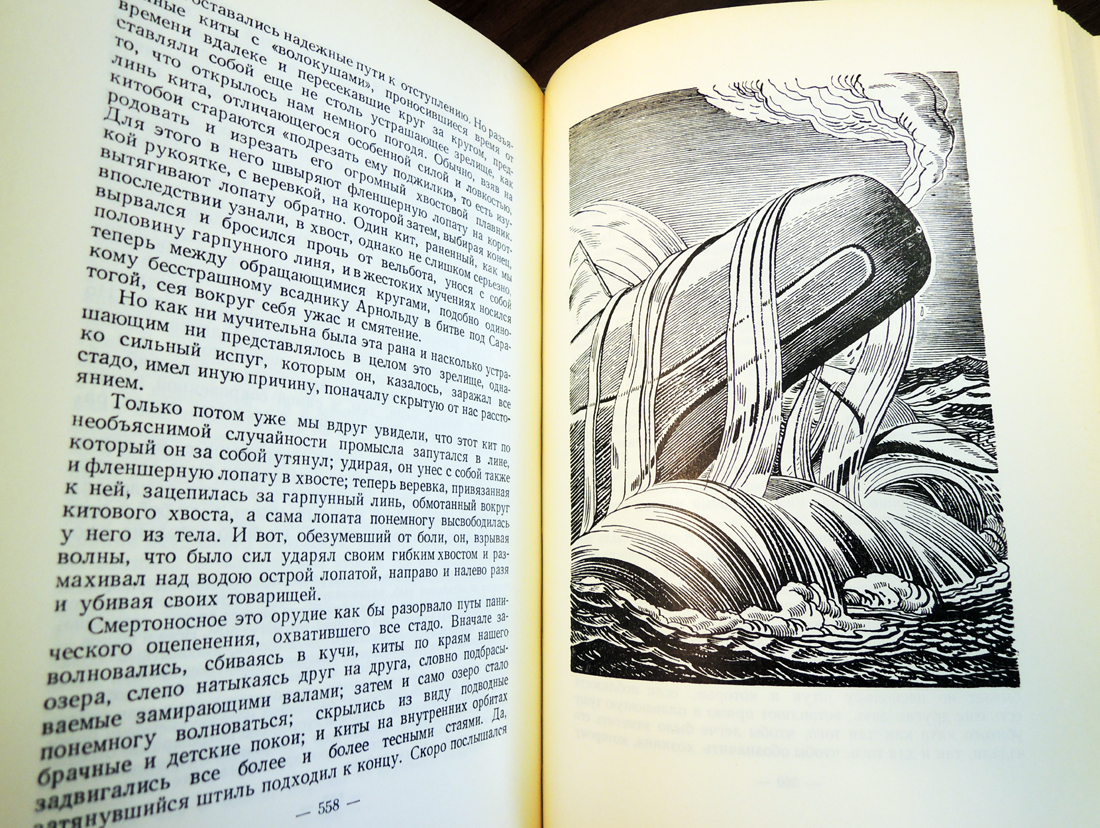
mobydick russian1 In 1930, Rockwell Kent (1882–1971) completed the illustrations for a three-volume set of Melville’s Moby Dick for Lakeside Press. The deluxe edition of 1,000 sold out immediately and Kent’s images became firmly identified with Melville’s story.

Over thirty years later, Melville’s text was translated and published along with Kent’s illustrations in a Russian edition. It was thanks to the popularity of the artist rather than the author that led to this publication.

A radical Socialist who was an outspoken critic of Joseph McCarthy, Kent had to fight with the U.S. government for the right to travel outside the country. (The details of Rockwell Kent VS John Foster Dulles can be read at http://www.law.cornell.edu/supremecourt/text/357/116)

Kent was not able to attend the 1957 opening of an exhibition of his work at the Pushkin Museum but after it closed, the artist donated several hundred of his paintings and drawings to the Soviet people. In gratitude for this gift, Kent’s Moby Dick was released in Moscow the following year. Kent went on to became an honorary member of the Soviet Academy of Fine Arts and was awarded the Lenin Peace Prize in 1967.

The Graphic Arts Collection recently acquired the first edition of the Russian Moby Dick in its original dustjacket. Along with Kent’s Illustrations the book includes a preface by A. Startsev and an afterword by V. A. Zenkovich. Here are a few of the pages.

mobydick russian3
mobydick russian4
mobydick russian5

Sergeĭ Nikolaevich Khudekov

khudekov4

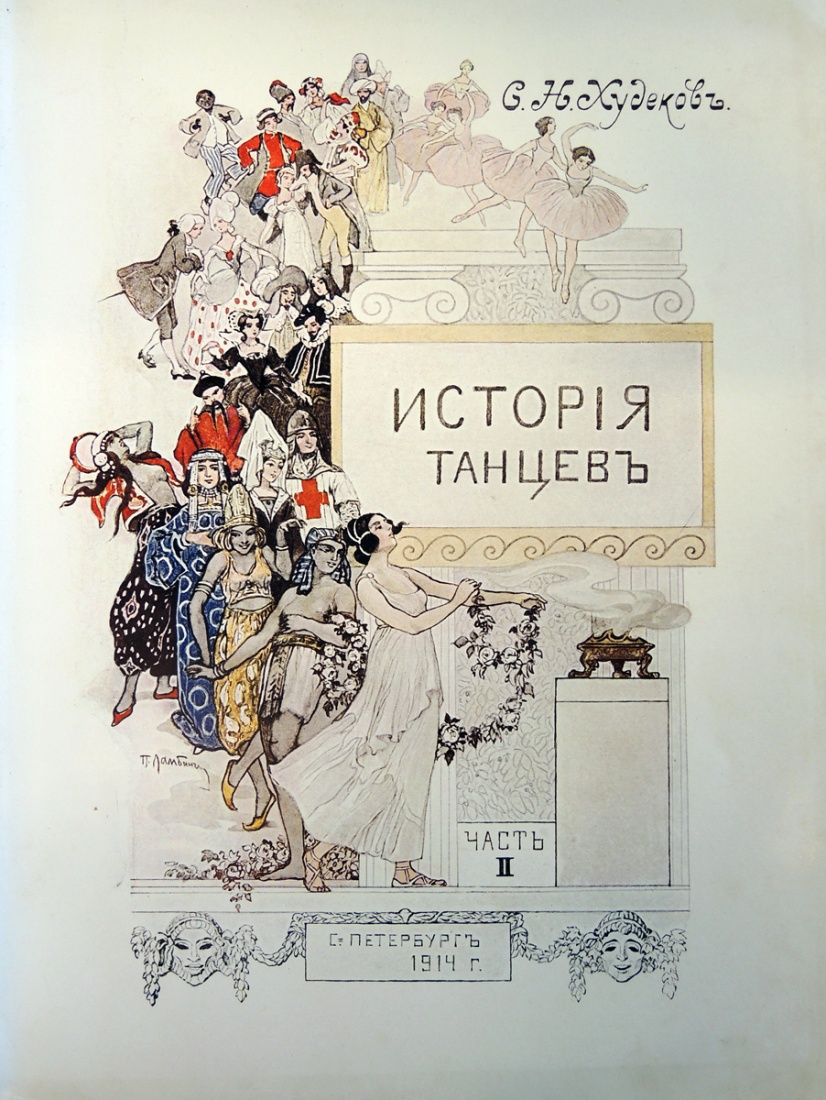
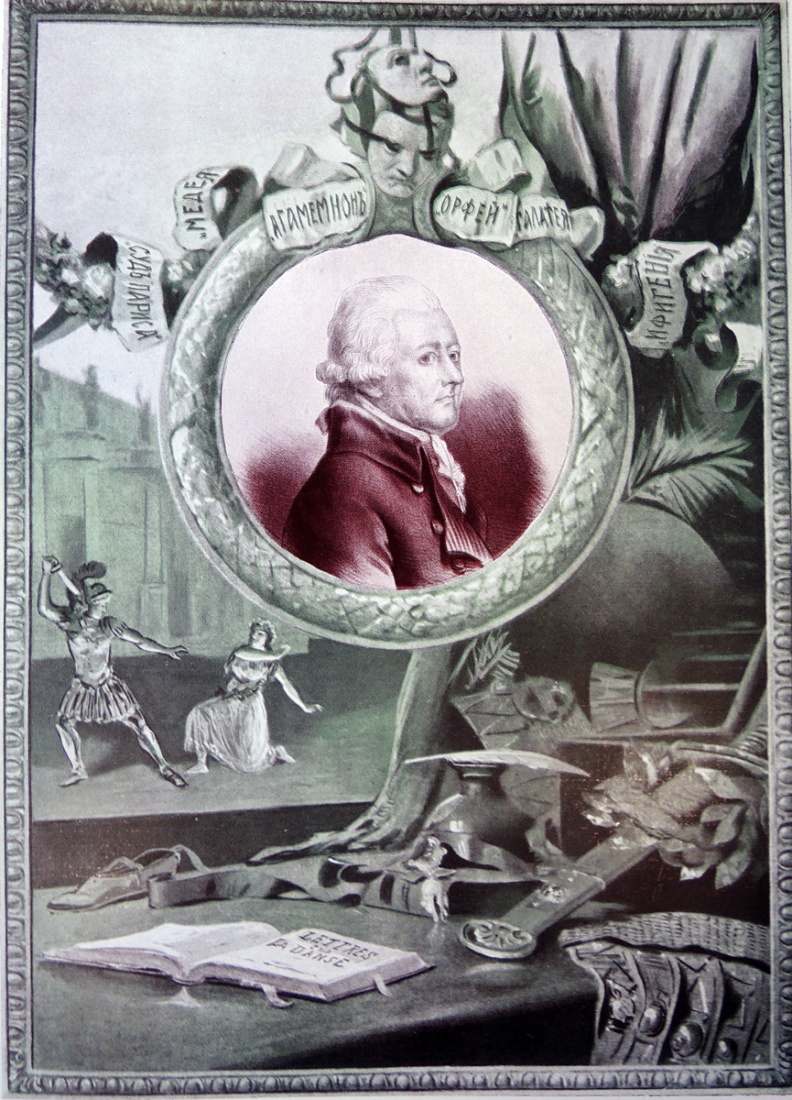
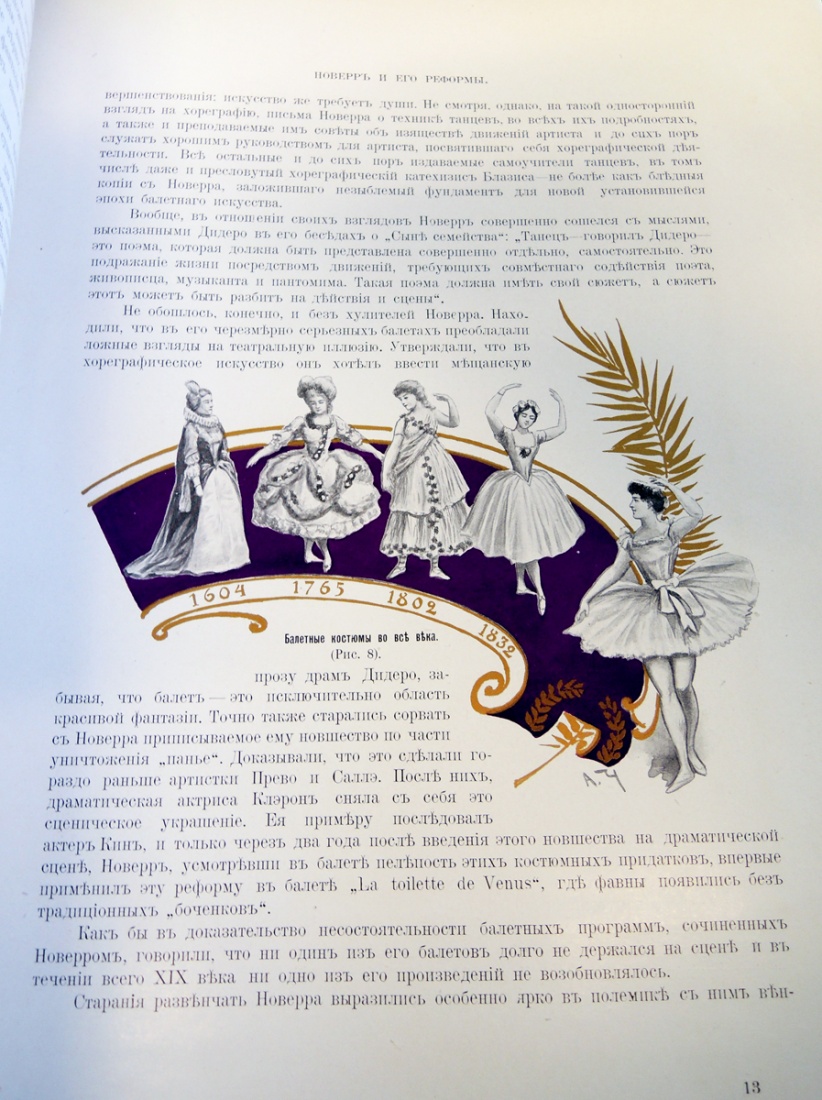
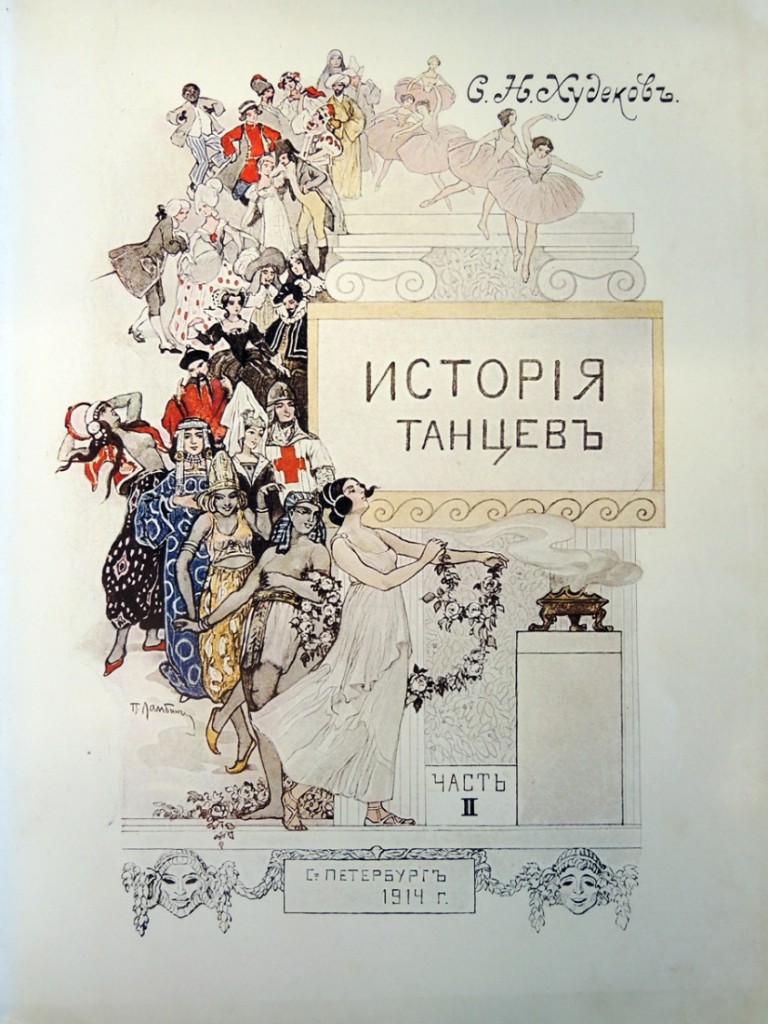
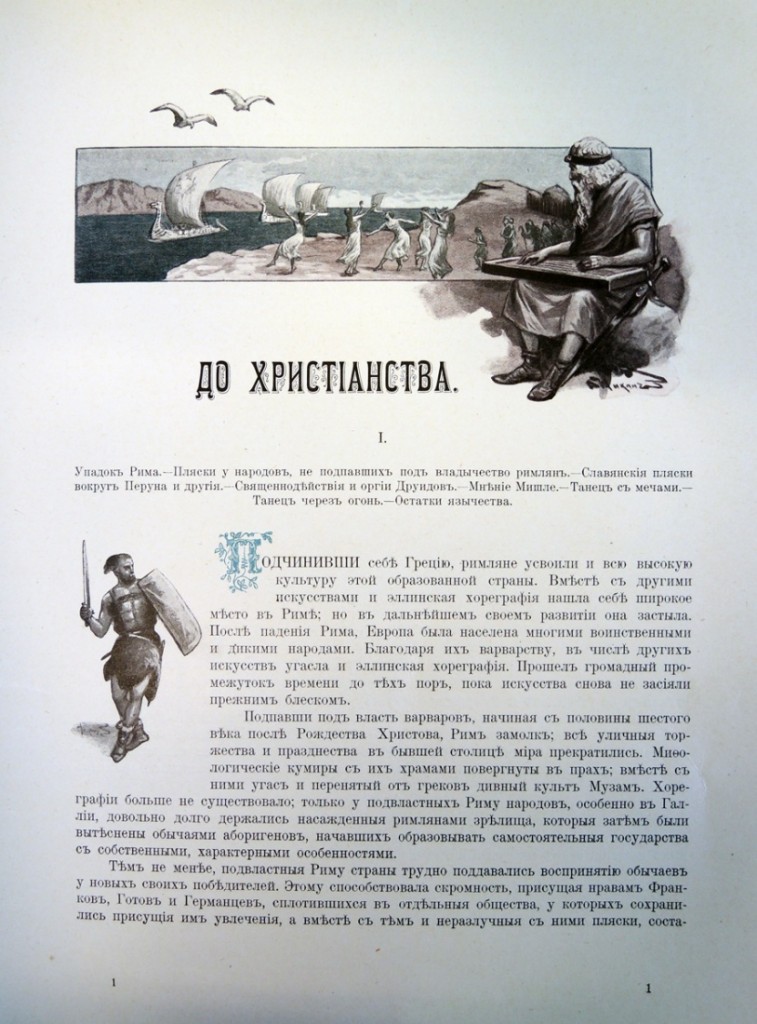
Sergei Nikolaevich Khudekov. Istoriia tantsev. Chast’ I–III. [The History of Dance. Part I–III]. S.Peterburg (1913, 1914, 1915). Purchased jointly by Slavic, East European and Eurasian Studies; Mendel Music Library; and Graphic Arts Collection GAX 2013- in process.

Written by Thomas Keenan
Slavic, East European and Eurasian Studies Librarian, Princeton University Library

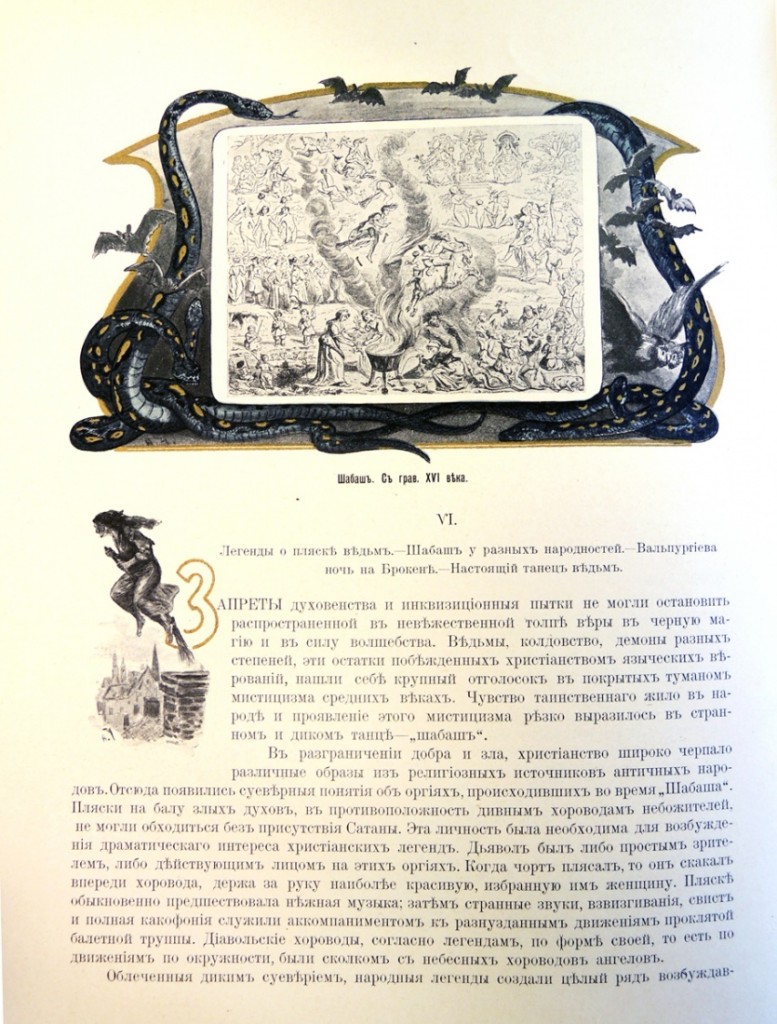
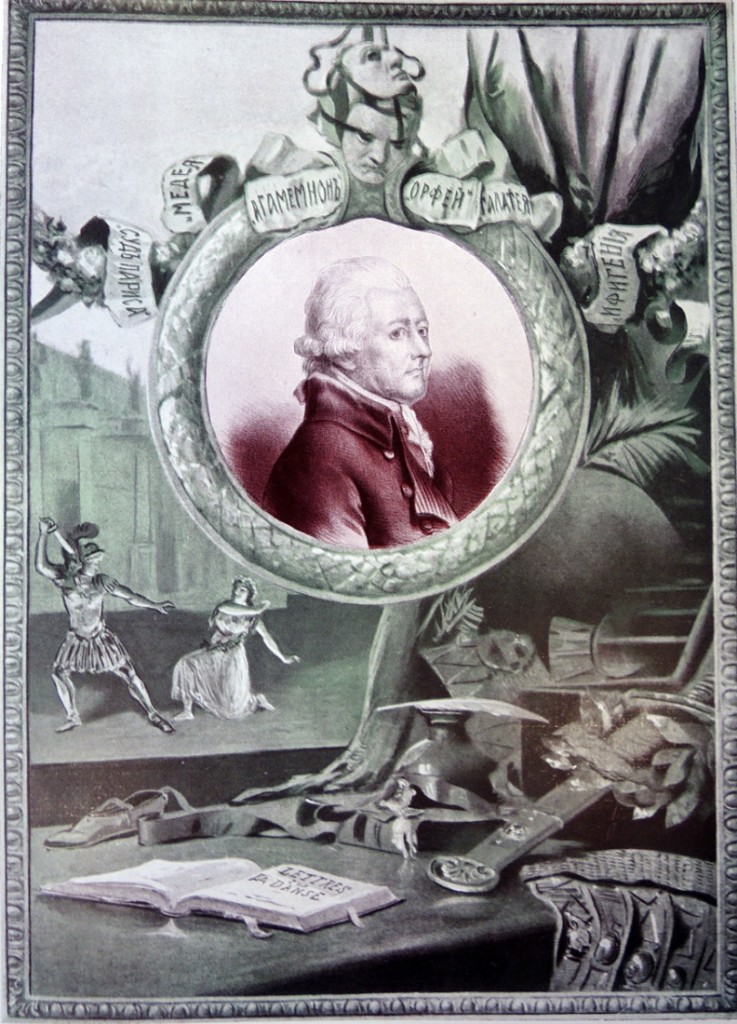
A survey of the history of dance written by the Russian dance critic Sergei Khudekov, who was also a collaborator with Marius Petipa on the libretto for the ballet La Badayère. These volumes were produced in a volatile sociopolitical and cultural environment: St. Petersburg at the end of the First World War, less than ten years after the 1905 Revolution and less than 5 years before the 1917 Revolution.
khudekov7                    khudekov6

khudekov5From a balletic point of view, Khudekov’s stock-taking of the history of dance appears at the time when Sergei Diaghilev was exporting a new Russian ballet that in many ways represented an aggressive departure from the academic narrative balletic tradition of which Petipa had been the most famous exponent.

Khudekov’s first volume, which covers the history of dance in the ancient world, opens with the declaration “Dance is the first chapter of human culture”, which is interesting given that it was published in 1913, the same year that the Paris première of Ballet Russes’ Le Sacre du Printemps scandalized its audience with the jarring primitivism of its rhythmic, tonal, and choreographic representation of pre-civilized man.
khudekov3                        
Slavic, East European, and Eurasian Studies also collaborated with Graphic Arts on this delightful volume:
beaumont impressions2

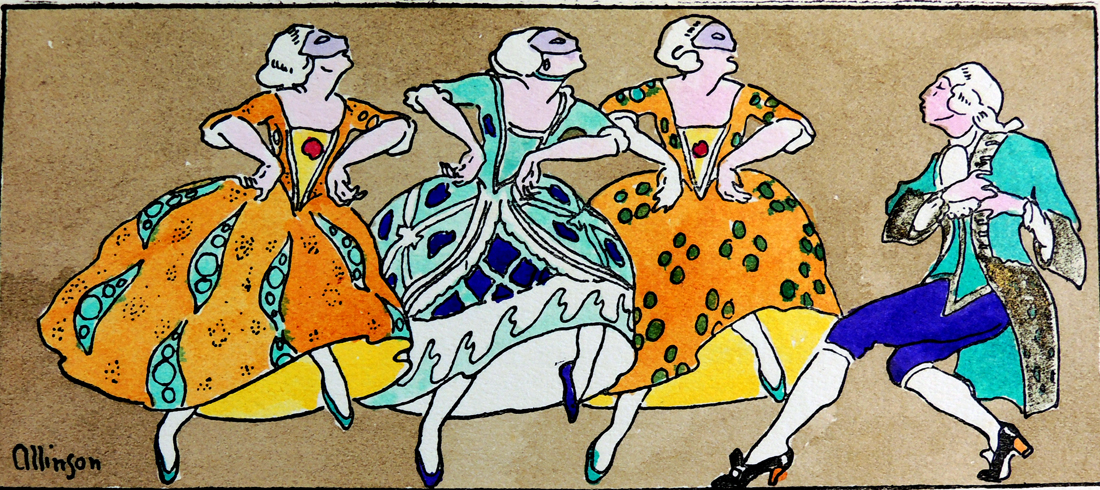
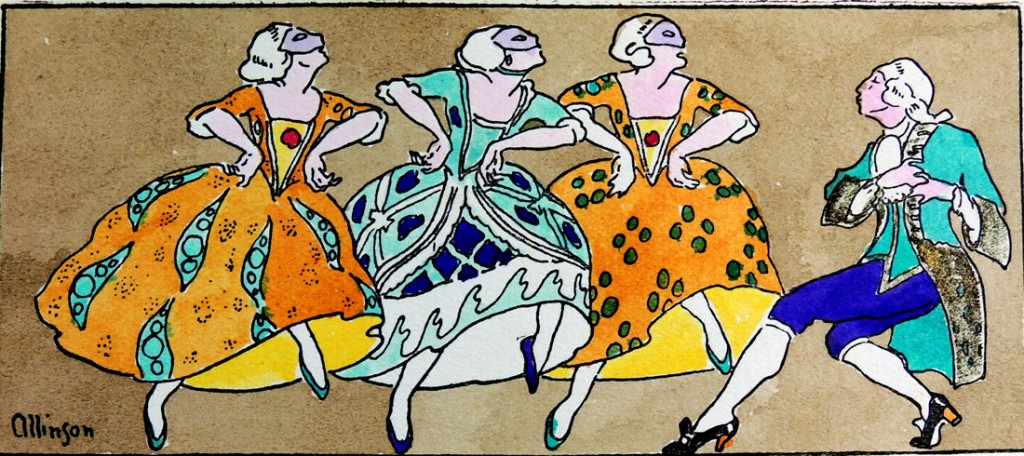
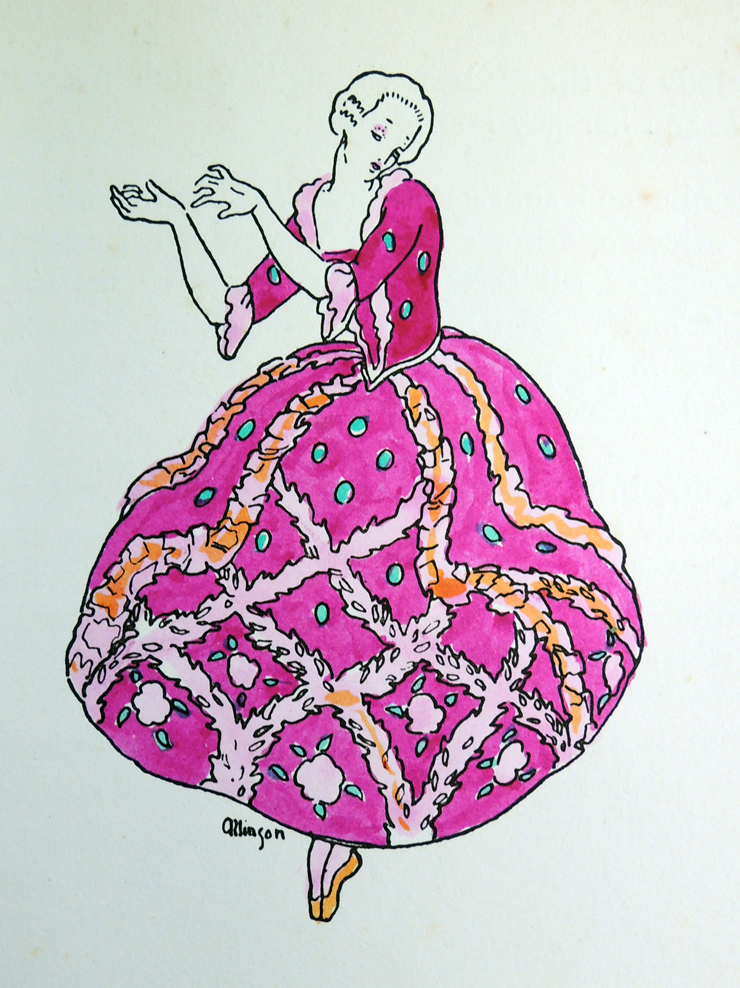
Beaumont, Cyril W. Impressions of the Russian Ballet 1918. The Good Humoured Ladies. Decorated by A.P. Allinson. London, C.W. Beaumont. (1918). Purchased jointly by Slavic, East European and Eurasian Studies and Graphic Arts Collection GAX 2013- in process

A small book produced by the English bookseller and dance historian Cyril Beaumont with hand-done watercolor illustrations by the painter Adrian Paul Allinson. The book is a response to a 1918 London performance of the Ballets Russes production of Les Femmes de Bonne Humeur choreographed by Leonide Massine. The ballet, based on a Goldoni play with music by Scarlatti, was the first of Massine’s to be staged in London.
beaumont impressions
After the initial breach with Nijinsky in 1913, Ballets Russes impresario Serge Diaghilev had reinstated Michel Fokine as the company’s principal choreographer. Massine, who had been discovered as a dancer by Diaghilev in 1913, replaced Fokine and made his debut as choreographer with Le Soleil de Nuit in 1915.

Cyril W. Beaumont set up shop in 1910 in Charing Cross Road as a bookseller specializing in literary classics, but switched his focus to dance after being profoundly impacted by performances of Diaghilev’s touring Ballets Russes company. Beaumont documented his early fascination with the Ballets Russes in a series of short illustrated books, each dedicated to an individual production.

For the books in this series Beaumont worked with a number of artists, including Ethelbert White and Randall Schwabe. The Good Humored Ladies, with illustrations by Adrian Paul Allinson, is the second in this series. Among the many monographs on ballet written by Beaumont, who would go on to become one of the most important dance historians of the twentieth century, are two on the Ballet Russes: Michel Fokine and His Ballets (1935) and Diaghilev Ballet in London (1940).
 

Shizhuzhai shuhua pu

ten bamboo 6

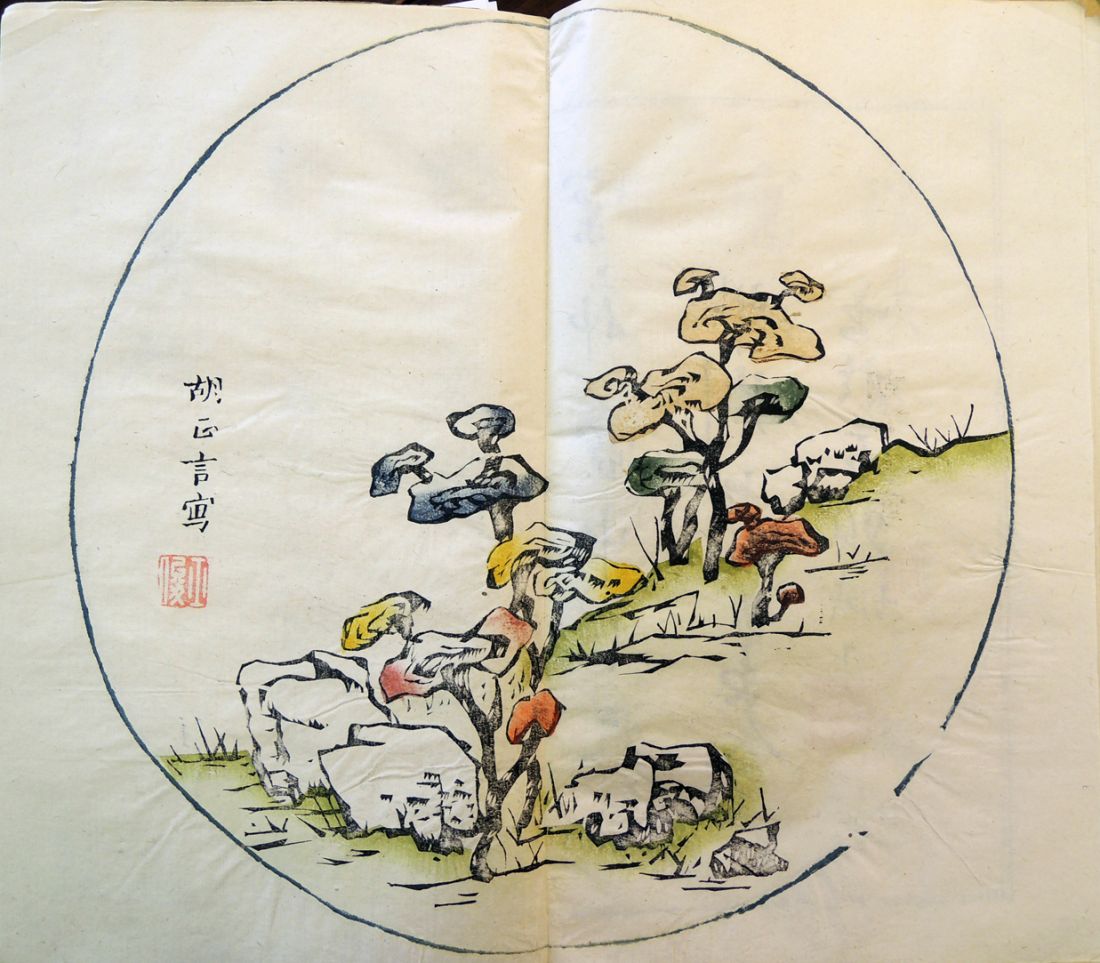
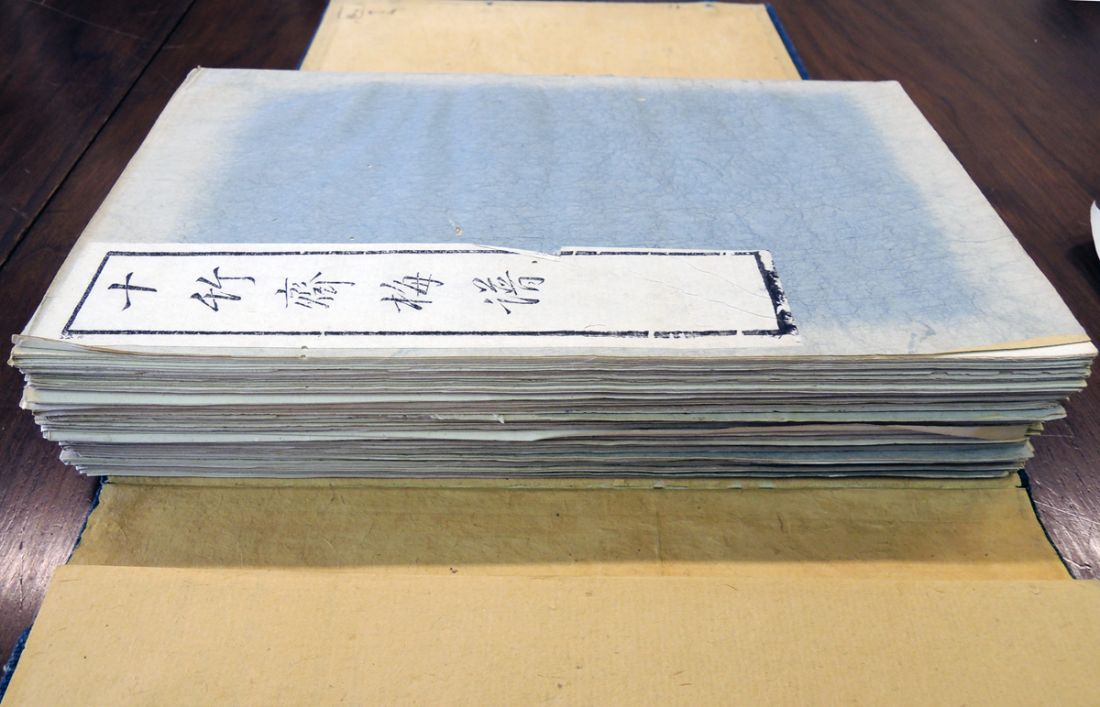
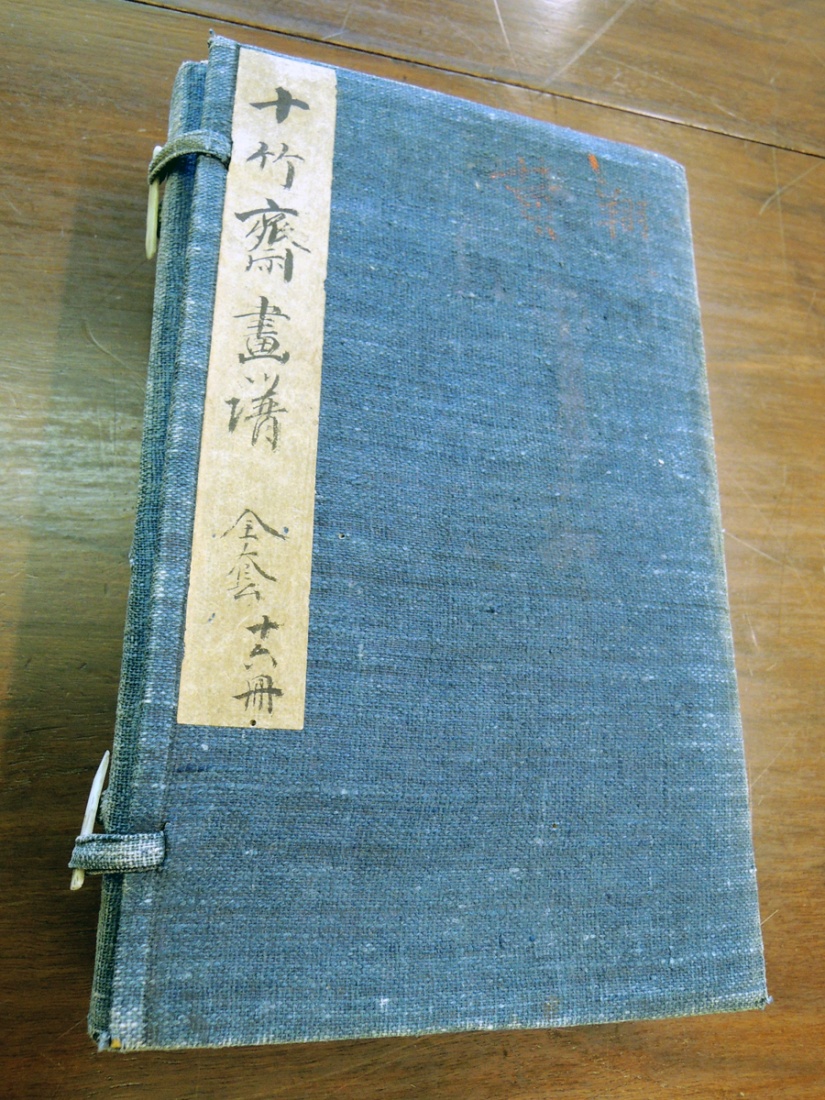
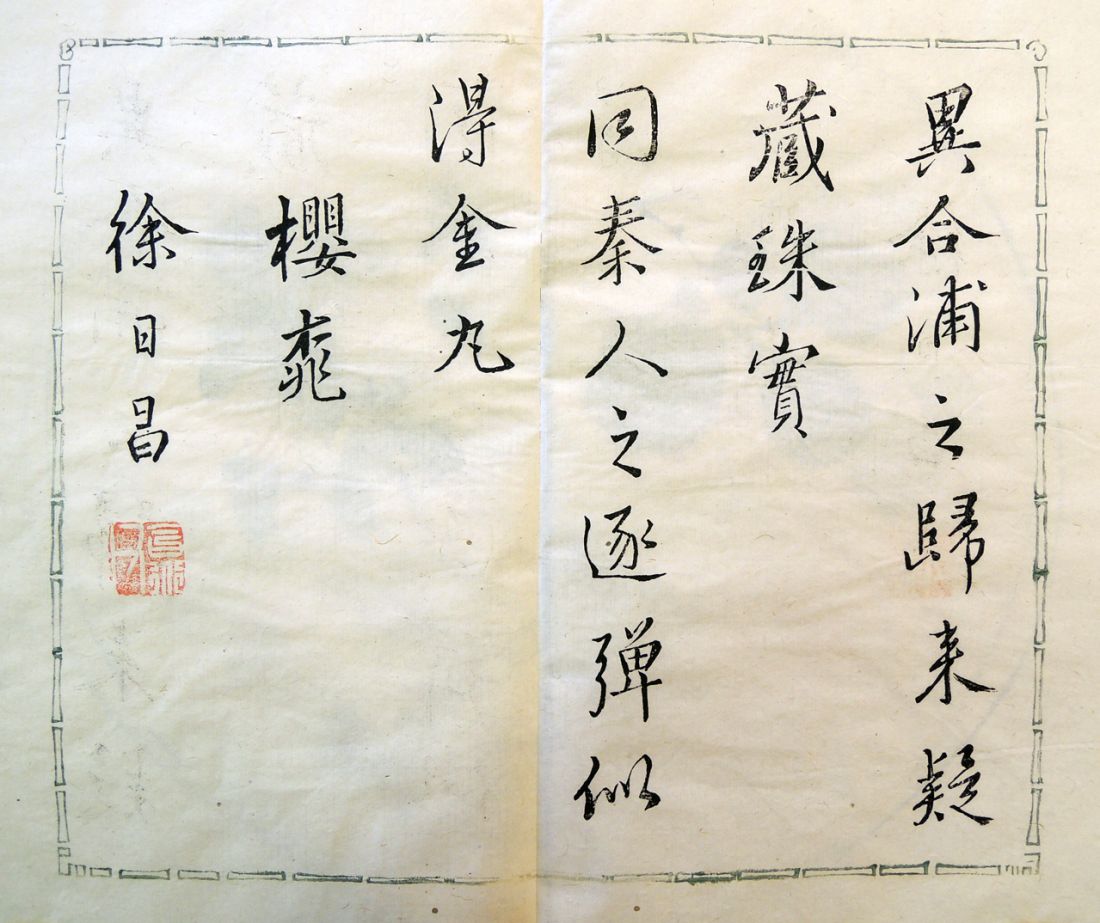
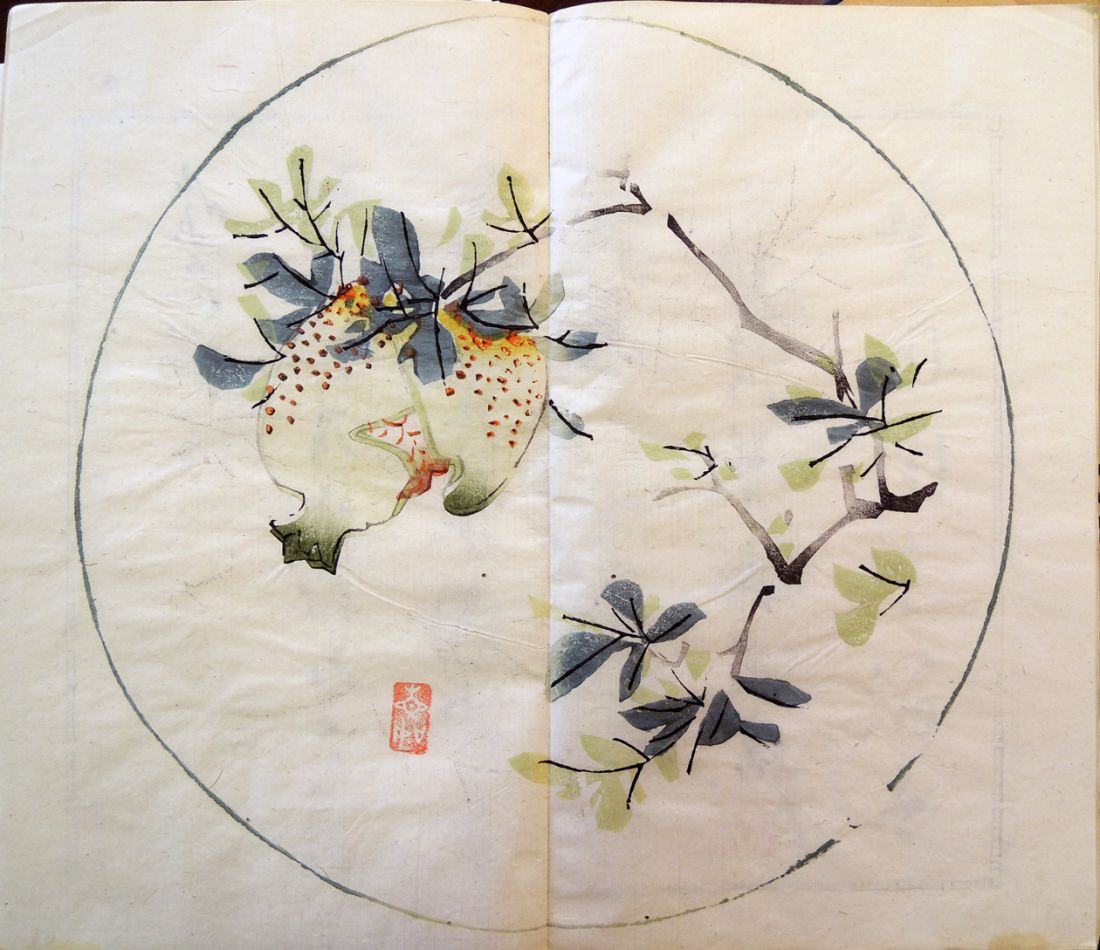
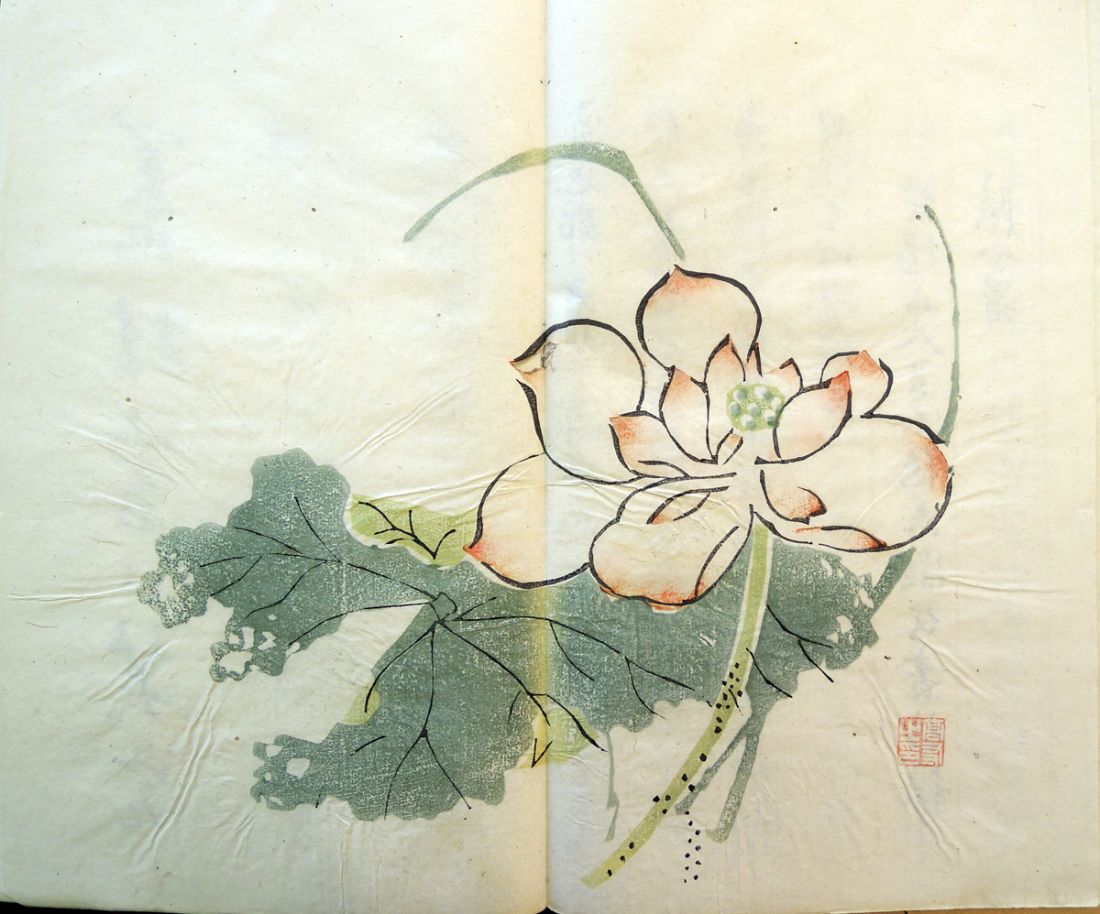
Hu Zhengyan, Shizhuzhai shuhua pu (‘A Manual of Calligraphy and Painting from the Ten Bamboo Studio’). uncatalogued books, Graphic Arts Collection 2013 in process
ten bamboo 2
ten bamboo 1“During the first third of the seventeenth century the Chinese publisher Hu Zhengyan (1584–1674) produced one the very first examples of color woodblock printing.  His publication was perhaps the most beautiful set of prints ever made, the Shuzhuzhai  shuhuapu (Ten Bamboo Studio Collection of Calligraphy and Painting).”

This is how Thomas Ebrey begins his wonderful article “The Editions, Superstates, and States of the Ten Bamboo Studio Collection of Calligraphy and Painting”  in Princeton University’s The East Asian Library Journal 14, no. 1 (2010): 1-119, available full-text online at : http://gest.princeton.edu/EALJ/ebrey_thomas.ealj.v14.n01.p001.pdf

Ebrey continues, “The Ten Bamboo Studio Collection consists of a pair of fascicles (ce) for each of eight subjects, with ten pictures in most fascicles; for seven of the eight subjects each picture is accompanied by a matching poem written out by a master calligrapher. The collection also includes additional leaves illustrating painting motifs, a general introduction to the whole work, as well as a preface to each subject.”

ten bamboo 5
“Altogether there are 186 pictures, 140 poems and 30 text pages for a total of 356 folio pages (i.e. double pages), usually bound into either eight double or sixteen single fascicles.  Although one of the poems was dated 1619 and others 1622, 1624, 1625, and 1627, the publication date usually given for the first edition of this book is 1633, the date of its general introduction.”
ten bamboo 8
ten bamboo 7The Graphic Arts Collection also holds an interesting catalogue of facsimile prints by a German author: Jan Tschichold (1902-1974), Der Frühe chinesische Farbendruck [ Exhibition of pictures of the Ten bamboo studio] (Basel: Holbein-verlag, 1940). “Die Faksimiles dieses Buches … sind mit zwei Ausnahmen einem sechzehnbändigen Exemplar der Bildersammlung der Zehnbambushalle [Hu Chêng-yens] entnommen, das aus dem Jahre 1643 zu stammen Scheint. Blatt 9 gehört einem anderen Exemplar derselben Ausgabe an; blatt 6 ist sehr wahrscheinlich ein wirklicher Erstdruck aus der Zeit zwischen 1619 und 1627”–Leaf 6. Graphic Arts Off-Site Storage Oversize RCPXG-7172600
ten bamboo 4

See also the British Museum’s page highlighting their copy: http://www.britishmuseum.org/explore/highlights/highlight_objects/asia/h/hu_zhengyan,_shizhuzhai_shuhua.aspx


The Attorney-General’s Charges Against the Late Queen are now online

charges against Queen1
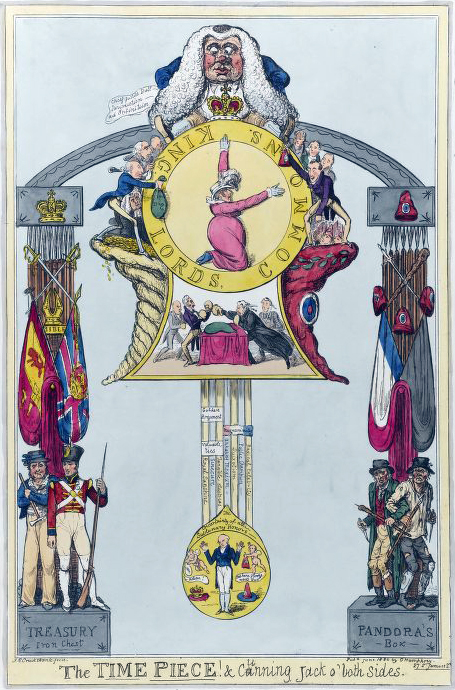
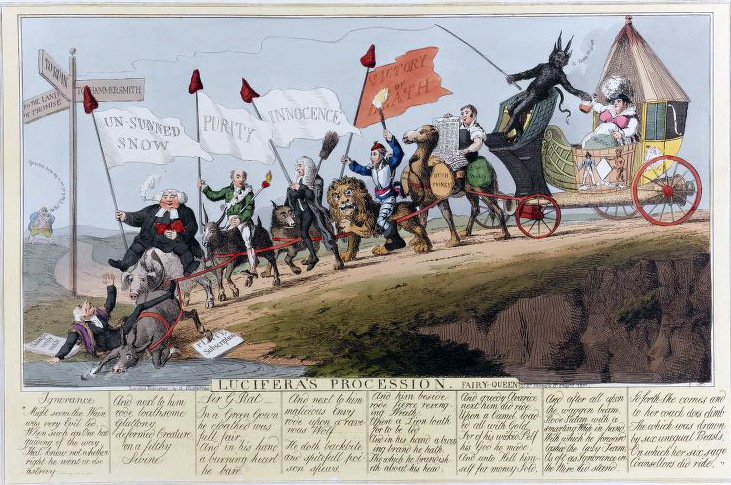
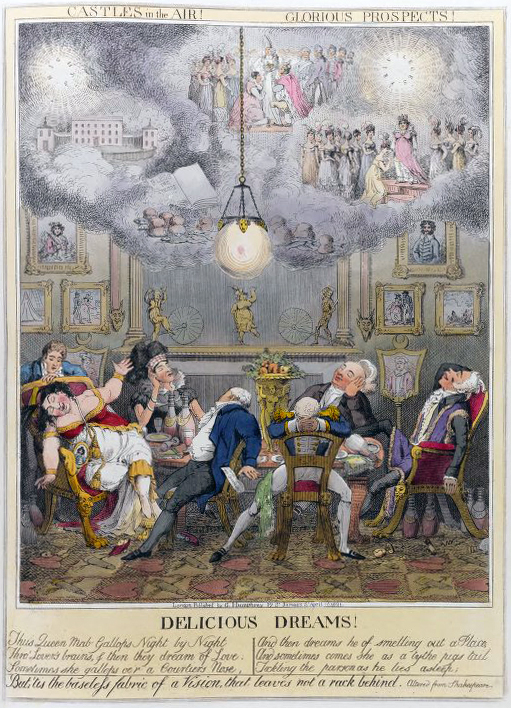
Graphic Arts is fortunate to own one of the few complete volumes of The Attorney-General’s Charges Against the Late Queen: Brought Forward in the House of Peers, on Saturday, August 19th, 1820, commissioned by George IV and published by George Humphrey. The transcript of the trial and all 50 hand colored plates attributed to Theodore Lane (1800-1828); George Cruikshank (1792-1878), and Robert Cruikshank (1789-1856), have now been digitized and are available at http://pudl.princeton.edu/objects/dj52w599c

charges against queen3

Attributed to Theodore Lane (1800-1828), The Attorney-General’s Charges Against the Late Queen, Brought Forward in the House of Peers, on Saturday, August 19th, 1820 (London: George Humphrey [1821]). Gift of Richard Waln Meirs, Class of 1888. Graphic Arts Collection (GA) Oversize Cruik 1820.29E

The volume begins with a view of Humphrey’s shop-window where 42 of these prints are on view. The focus of these caricatures is Caroline of Brunswick (1768-1821) and her alleged affair with Bartolommeo Bergami (active 1820). She renamed him Pergami (as being more aristocratic), and appointed him Grand Master of the Order of St Caroline.

In 1820, her estranged husband George became King of the United Kingdom and Hanover, and Caroline assumed she would become Queen. Instead, George attempted to divorce her by introducing the Pains and Penalties Bill to Parliament. A campaign was launched through George Humphrey, funded by George IV, to discredit her. The following year, in July 1821, Caroline was barred from the coronation, fell ill, and died three weeks later.
charges against queen2


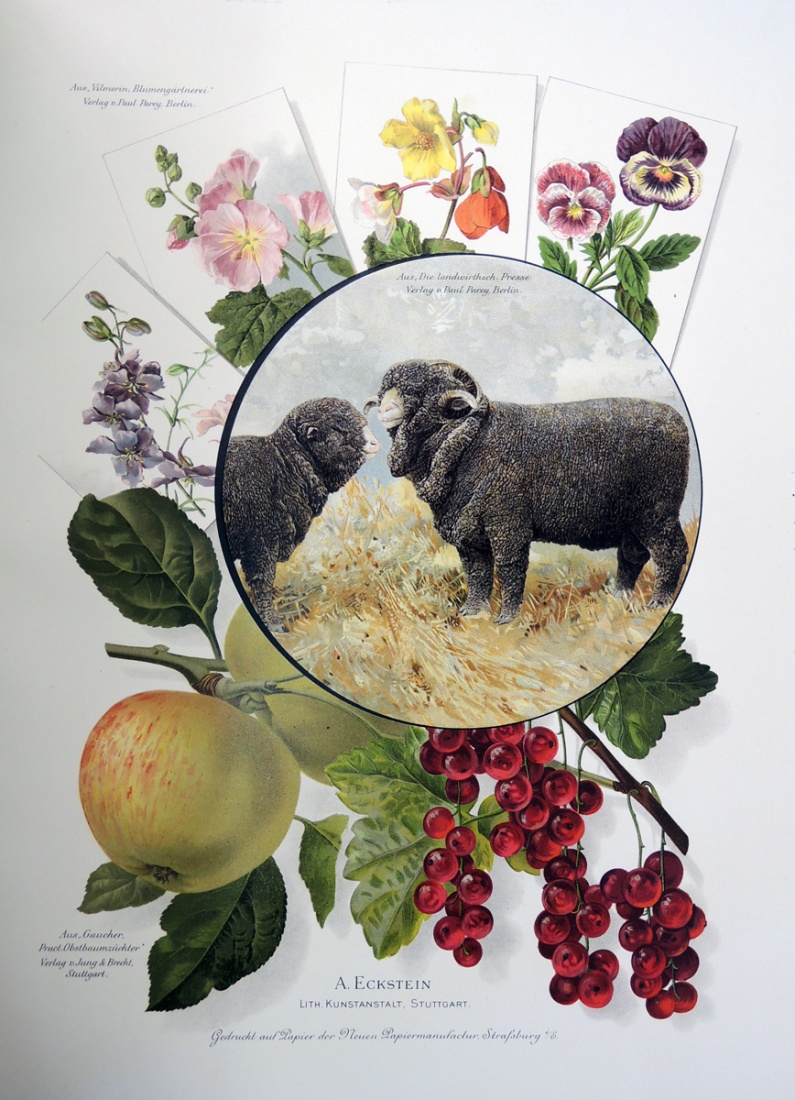
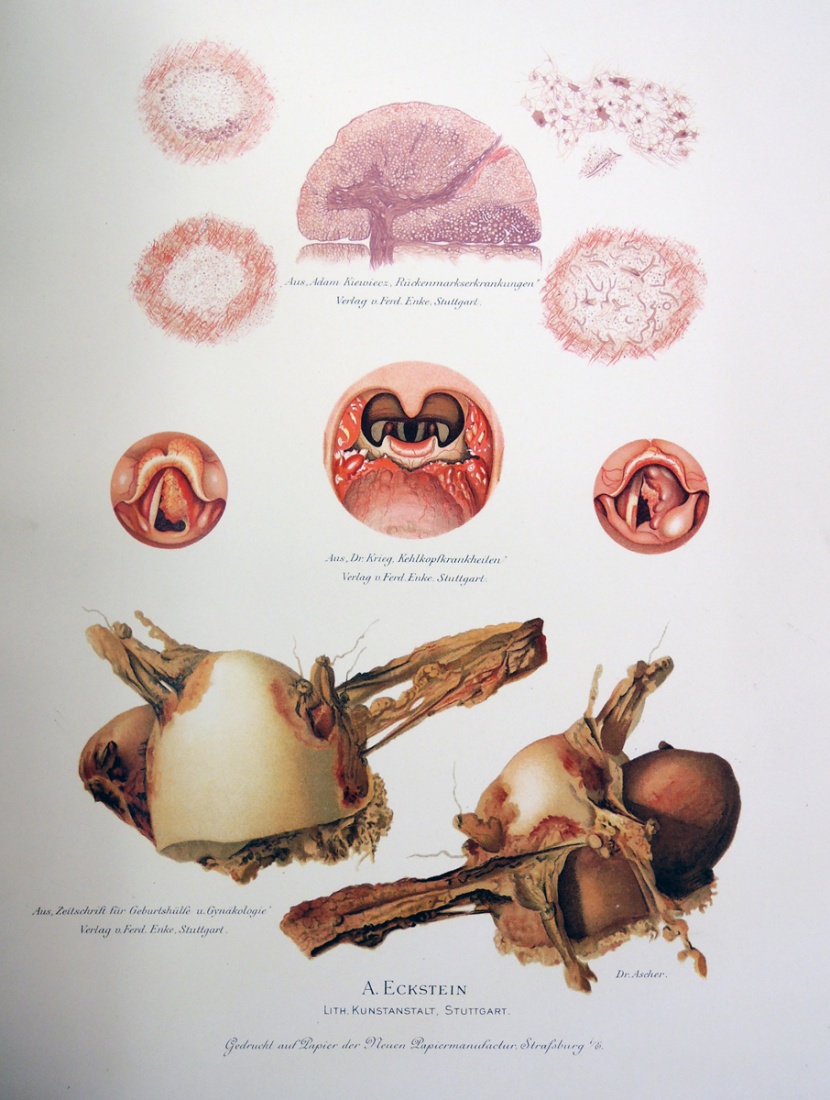
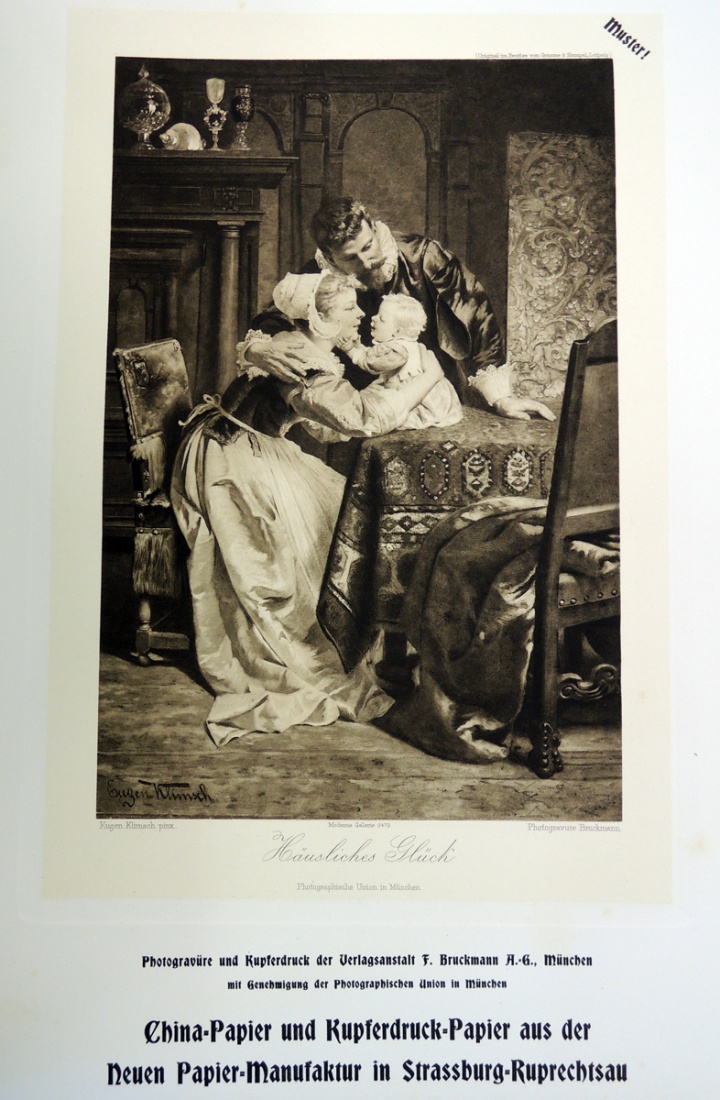
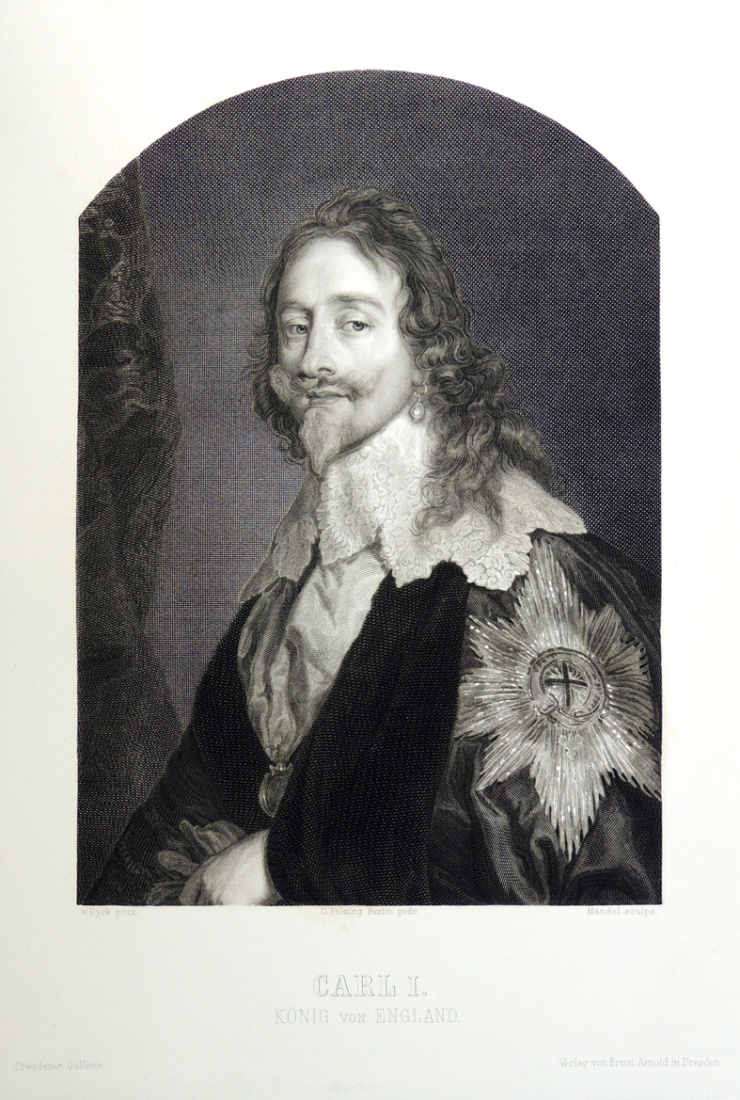
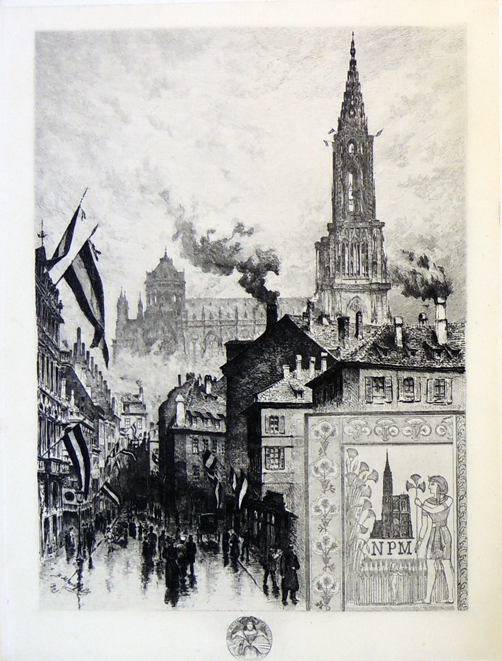
Elucidations on a Collection of Sample Prints on Strasbourg Special Papers

paper sample book strassburg7

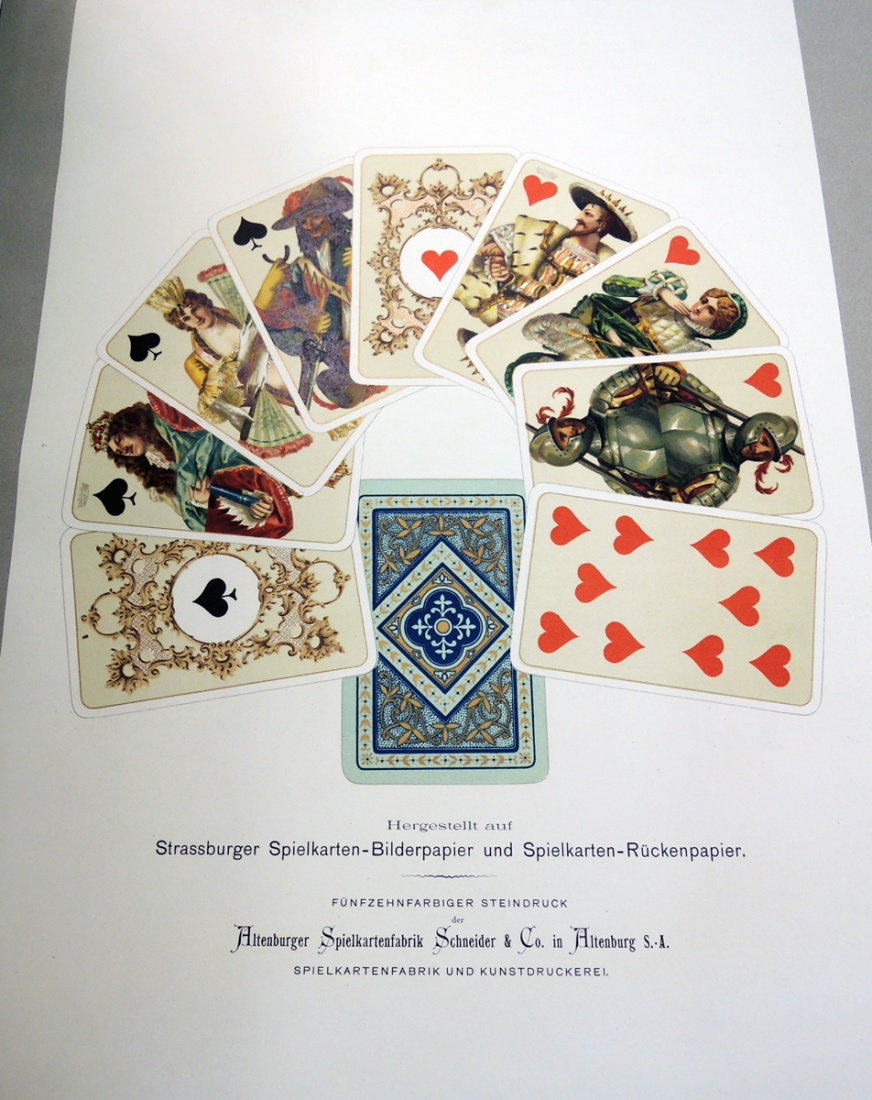
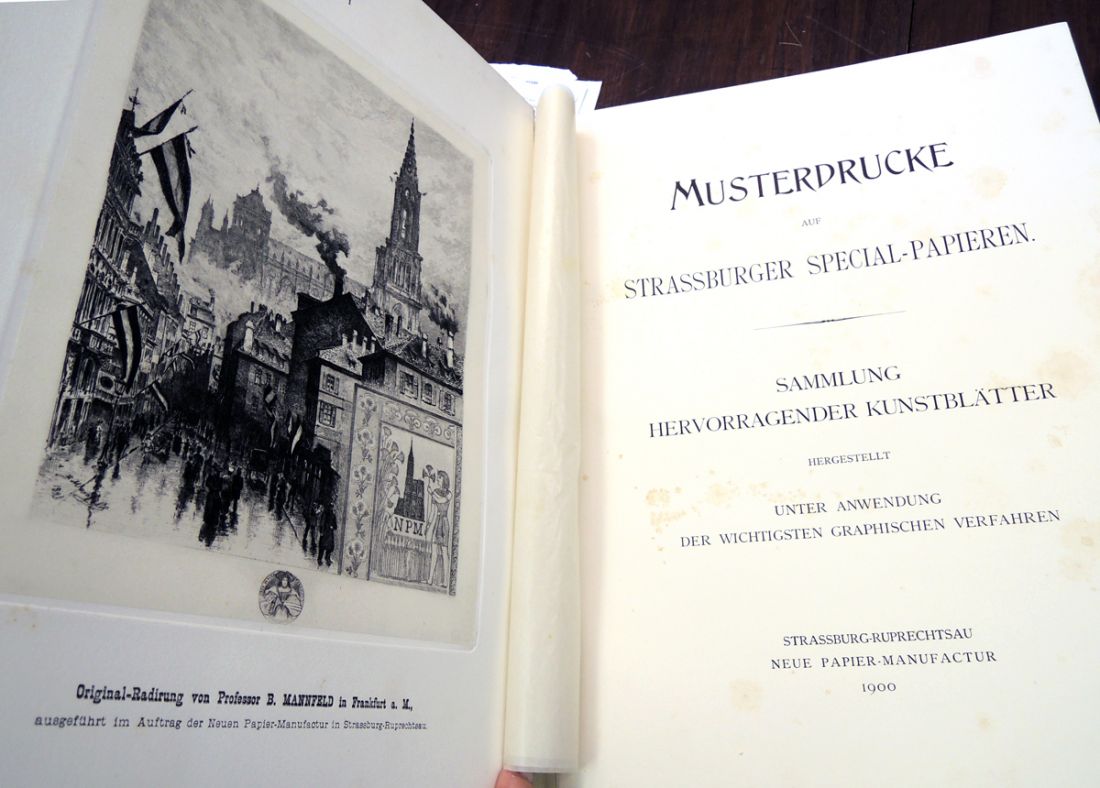
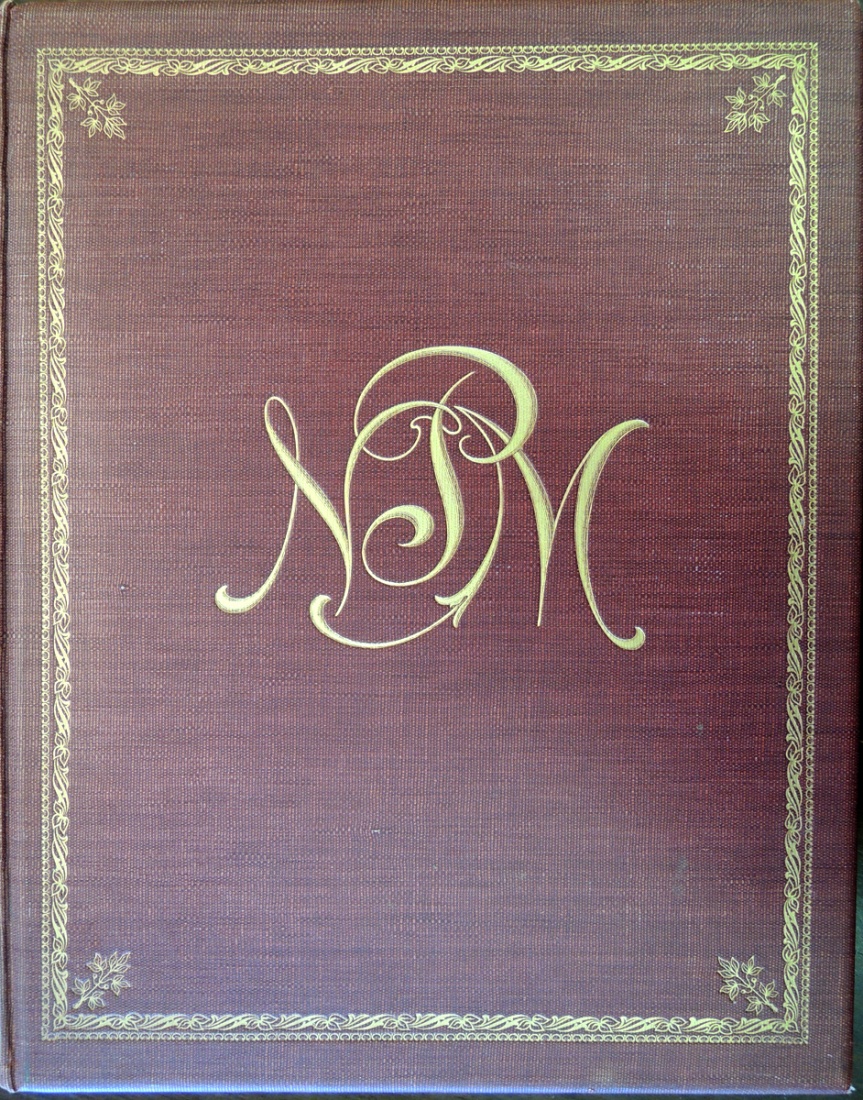
Theodore Goebel (1829-1916), Musterdrucke auf Strassburger Special-Papieren. Sammlung hervorragender Kunstblätter hergestellt unter Anwendung der wichtigsten graphischen Verfahren [Sample Prints on Strasbourg Special Papers. An Excellent Collection of Works on Paper Prepared Using the Most Important Printing Techniques] (Strassburg-Ruprechtsau: Neue Papier-Manufactur, 1900). Graphic Arts Collection GA 2013- in process.

paper sample book strassburg8        paper sample book strassburg5

In celebrating the bibliophile and historian Theodor Goebel’s 70th year as a printer, The Inland Printer referred to him as the Nestor of typography in Germany. Bigmore and Wyman, vol. 1, describes Goebel as “one of the most earnest and accomplished among German students of the history and antiquities of printing. In addition to this, he is a sound practical printer”

The author of several distinguished volumes, Goebel angered traditionalists when he brought printing history up-to-date with Die graphischen Künste der Gegenwart [The Graphic Arts of the Present Time] in 1895. Five years later, Goebel lent his essay Erlauterungen zur Sammlung von Musterdrucken auf Strassburger Specialpapieren [Elucidation on a Collection of Sample Prints on Strasbourg Special Papers] to a wonderful specimen book prepared by the Strasbourg Neue Papier Manufactur.

For the first time, a copy of this extraordinary volume has reach the United States and can be found in the Graphic Arts Collection at Firestone Library.
paper sample book strassburg4   paper sample book strassburg3
paper sample book strassburg6

The book is a “state of the art” survey of printing techniques to the turn of the last century, including etching, engraving, photogravure, heliogravure, phototypies, lichtdruck or collotype, autotype, lithography, chromolithography, and much more. There are examples of paper for playing cards in color (spielkarten), maps in color (landkartendruck) and other special papers.

Near the end is an astonishing progressive series of lithographic proofs showing a bird’s eye view of the actual Neue Papier factory.

paper sample book strassburg2

paper sample book strassburg1

paper sample book strassburg9


Lorenzo Homar 1913-2004

homar plenas6
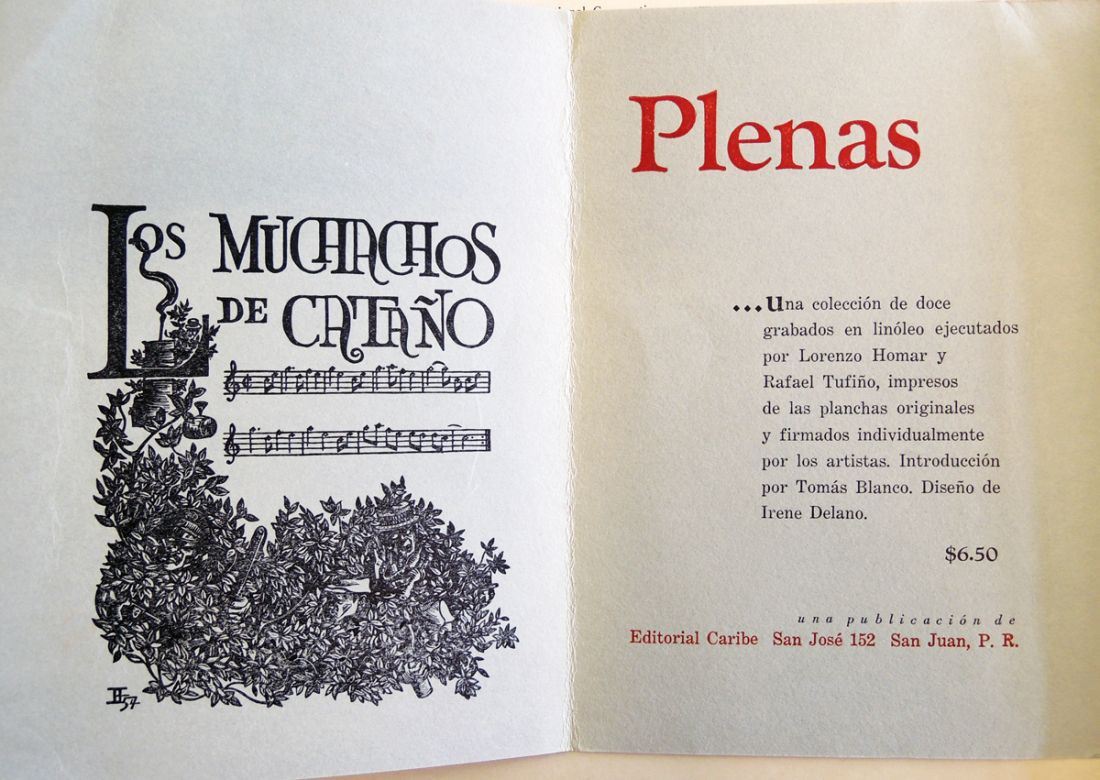
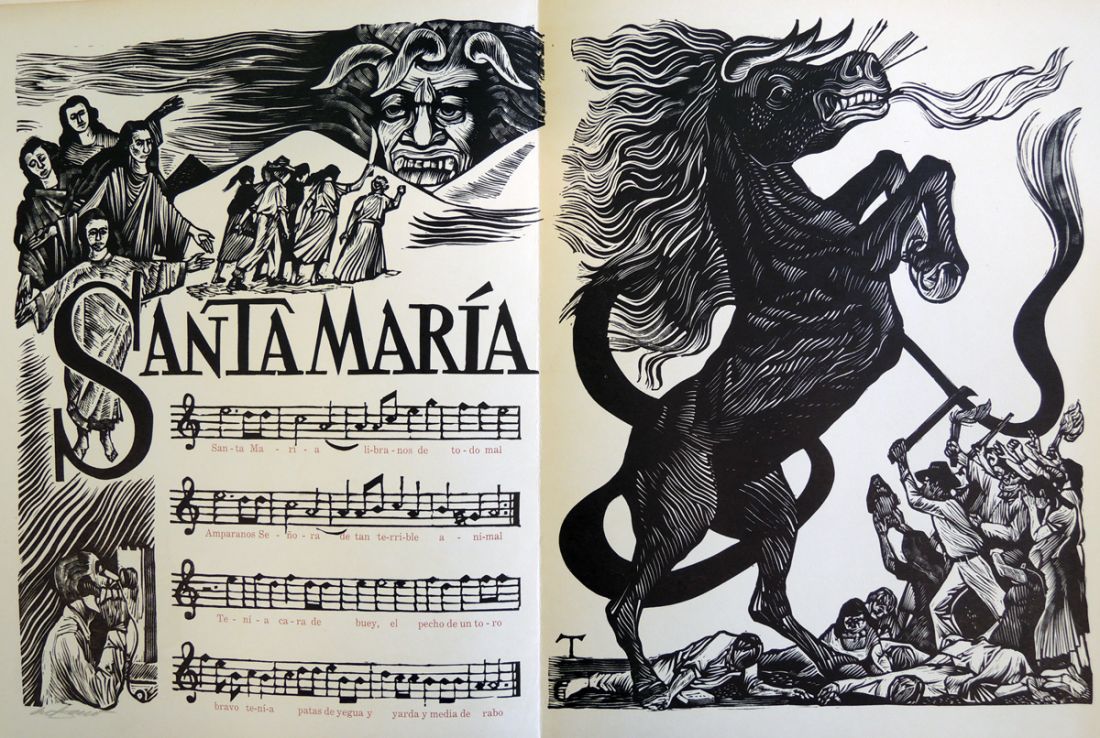
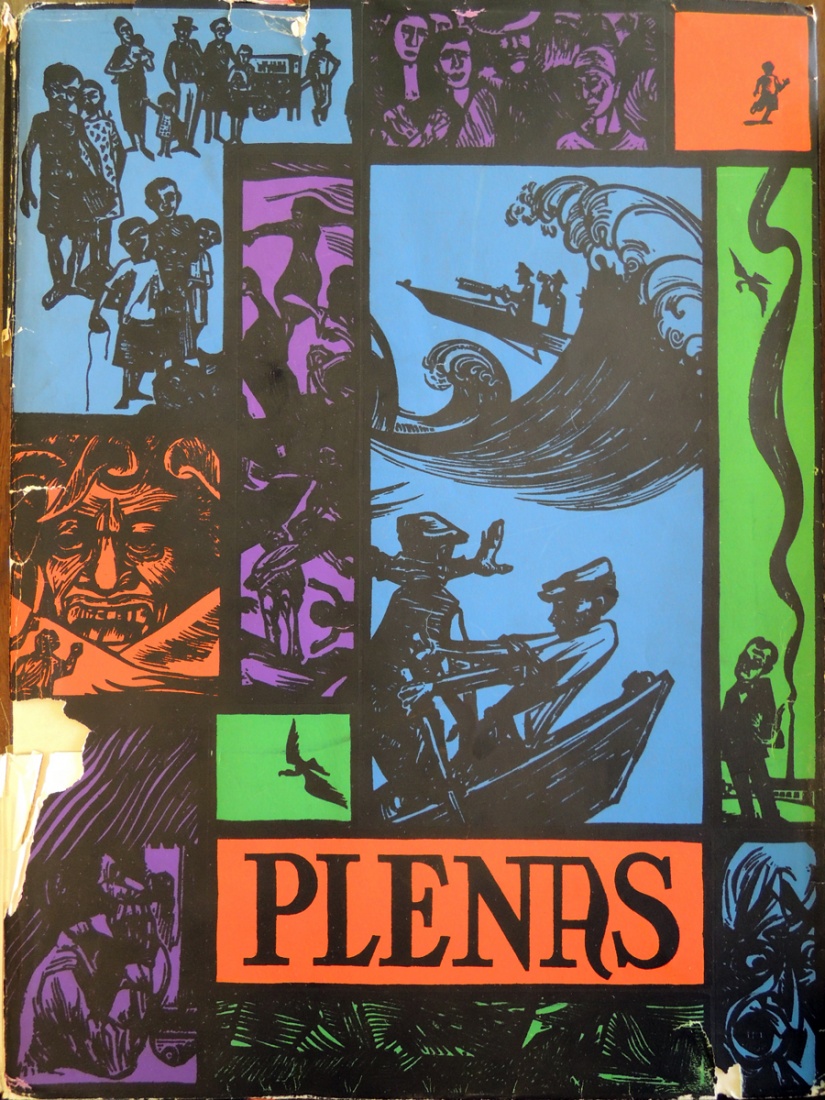
2013 is the centenary of the Puerto Rican artist Lorenzo Homar’s birth. In his honor, Arcadio Díaz-Quiñones will bring his Latin American Studies Seminar: Islands, Literature and History in Latin America and the Caribbean to graphic arts and we will view some of Homar’s wonderful prints, posters, and books. Here’s one we already pulled.

homar plenas2
homar plenas1    homar plenas4

Lorenzo Homar (1913-2004) and Rafael Tufiño (1922-2008), Plenas: 12 grabados de Lorenzo Homar y Rafael Tufiño. Introducción por Tomás Blanco; Diseño de Irene Delano; Dedicado a Manuel Jiménez (Canario), quien tanto hizo por dar a conocer la plena puertorriqueña y a todos los otros compositores y músicos que han cultivado este género- entre ellos Rafael Hernández, “Bum Bum”, “Jarea”, Augusto Cohén, Julio Alvarado, “Malango”, “Tripope” y muchos otros (San Juan, P.R., Editorial Caribe, 1955). Copy 540 of 850. Graphic Arts Collection GAX Oversize NE585.H66 A4 1955q

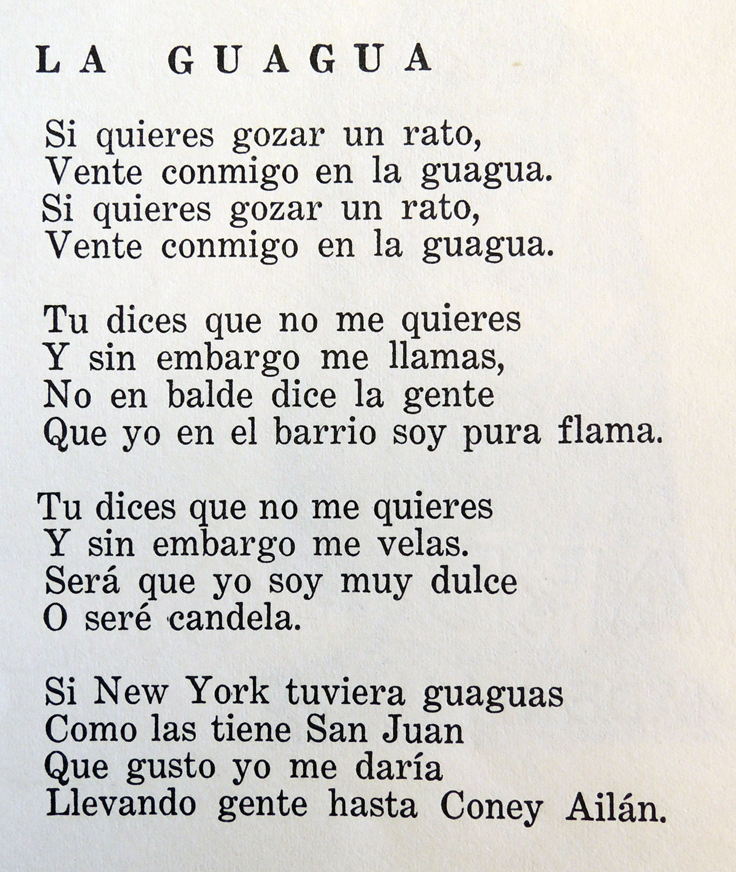
Each signed print illustrates a Puerto Rican folk song, including the melody with Spanish words.

homar plenas7

homar plenas5

homar plenas3


Adding a gold stamp

simplex gold stamping3

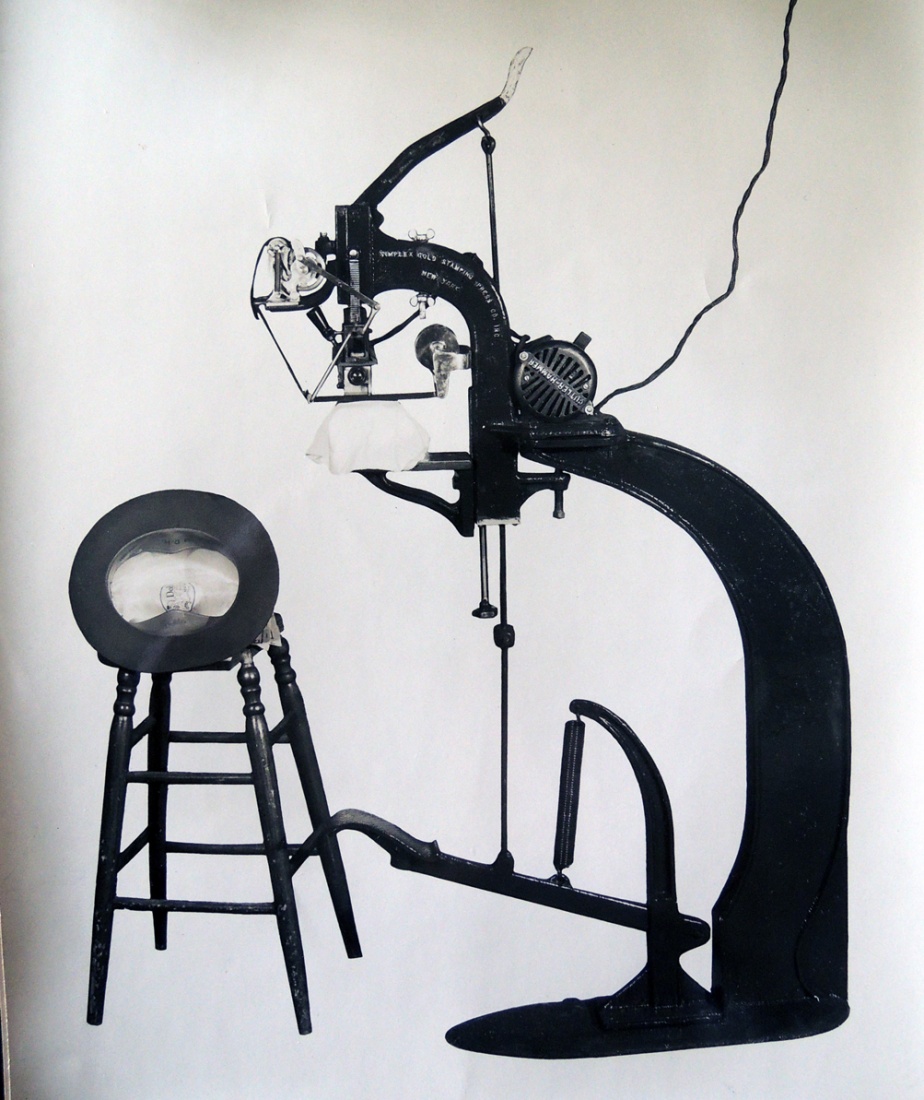
Simplex Gold Stamping Press Company, New York, 1929. Graphic Arts Collection GAX 2013- in process

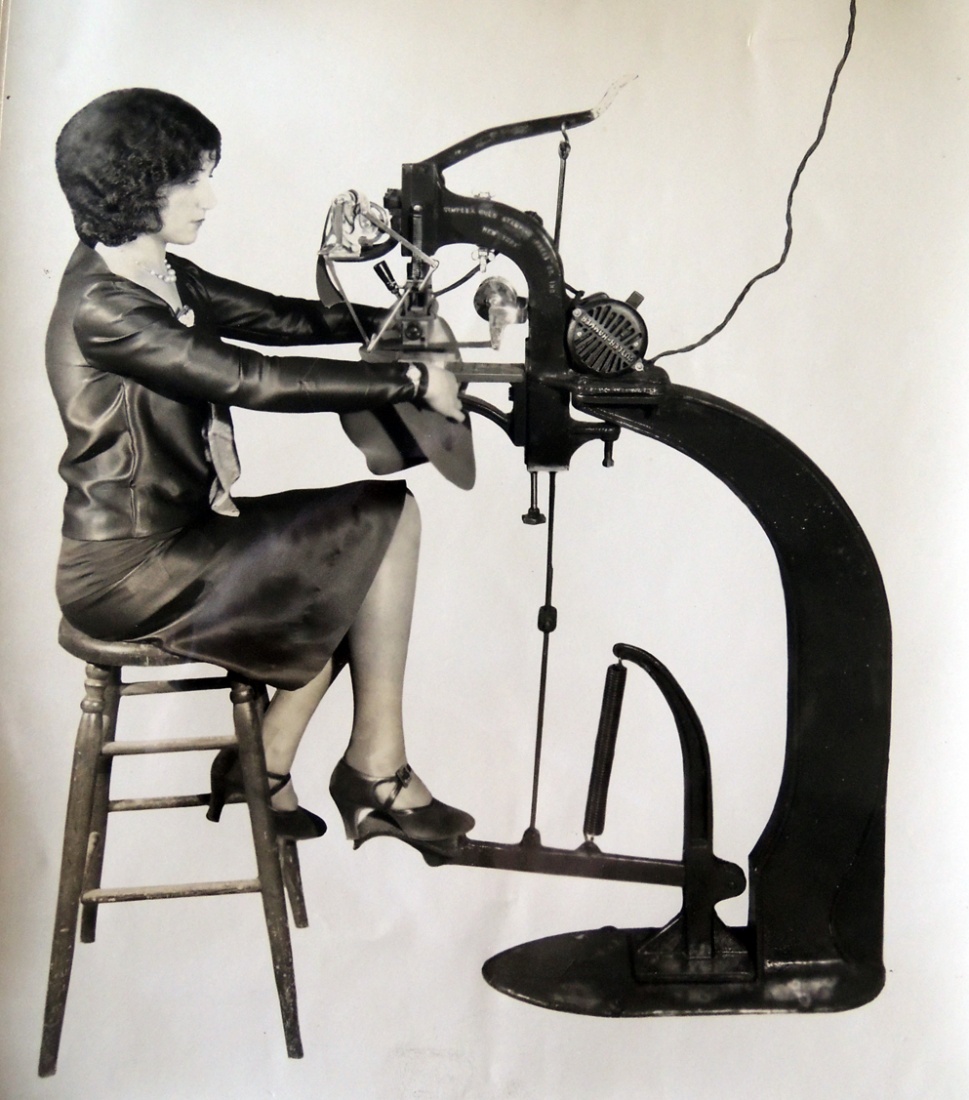
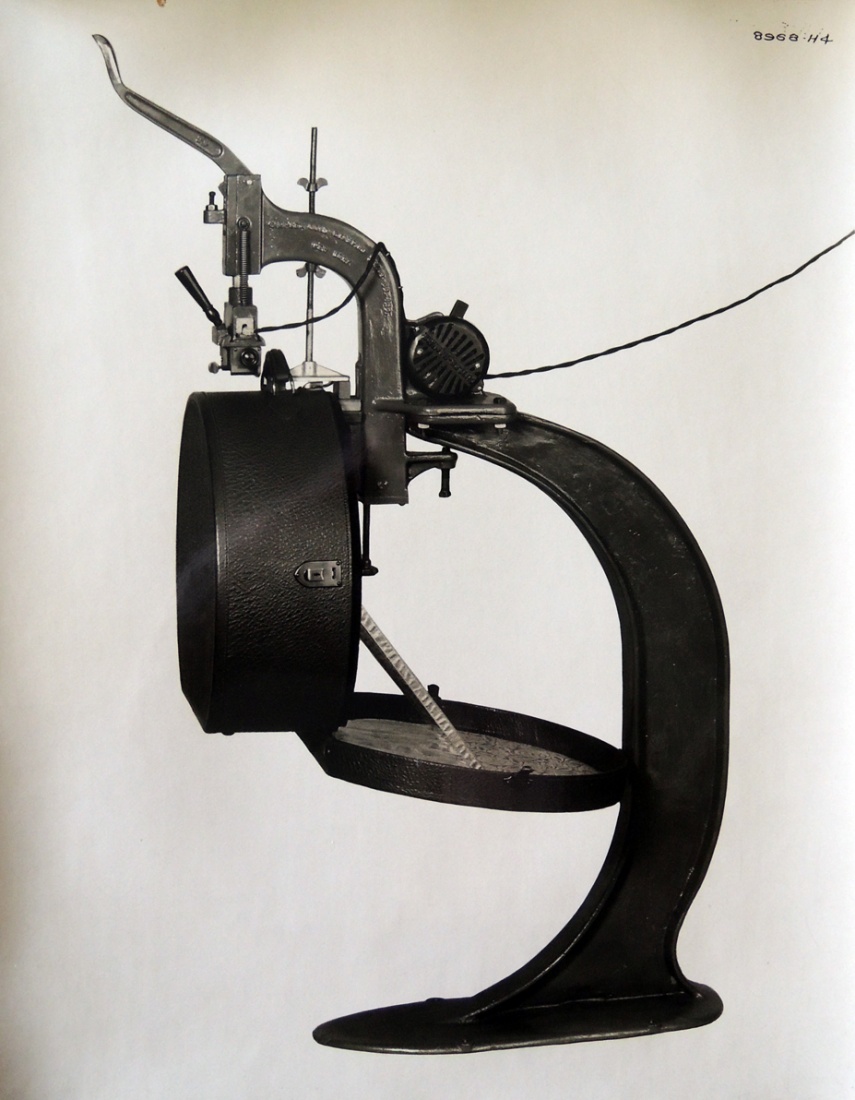
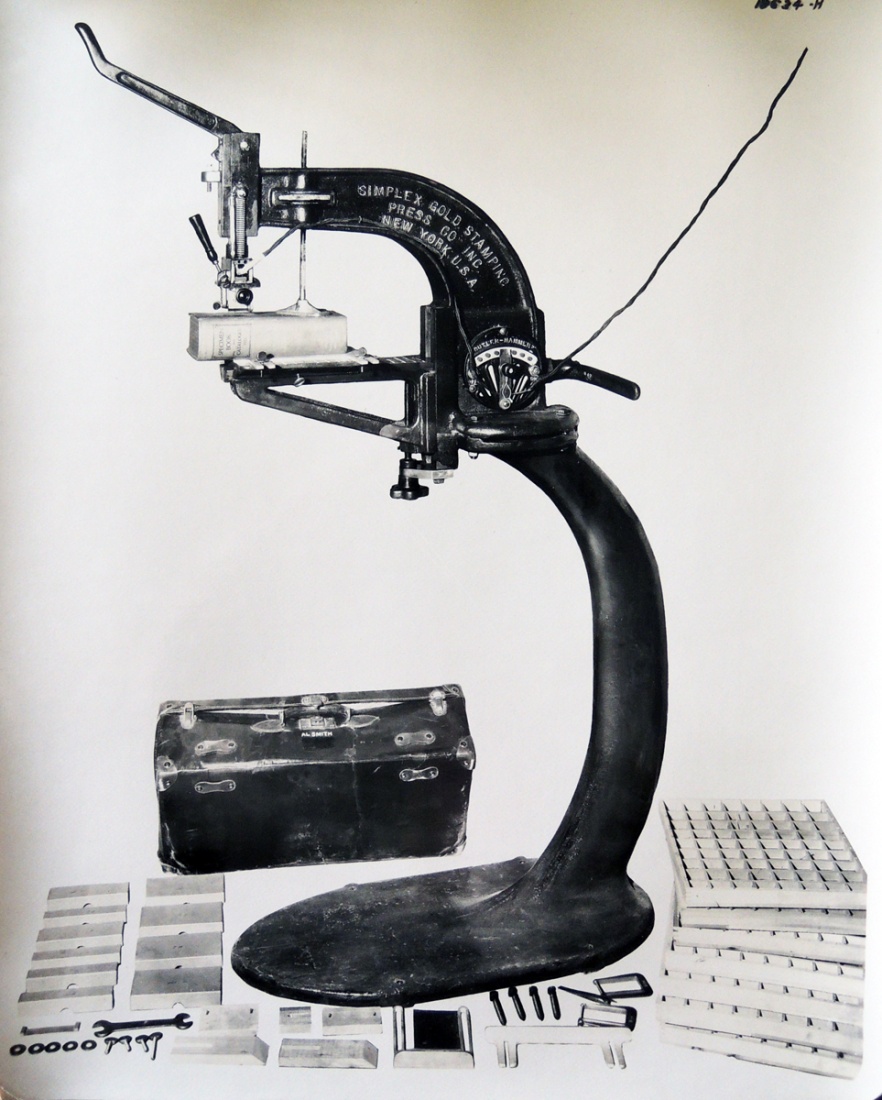
The Graphic Arts Collection recently acquired this salesman’s sample catalog with six mounted examples of leather stamping, 19 linen backed photographs of stamping machinery, 34 photographs of endorsements and 27 leaves of tipped in brochures for the company’s products. A number of images show hatboxes, suitcases, hats, books and other objects being stamped in gold leaf.
simplex gold stamping6“A major development of the mid-nineteenth century was the widespread adoption by publishers of cloth-case bindings and gold stamping for the vast majority of trade books,” writes Scott Casper in The Industrial Book, (2007). “The implications of this development are difficult to overstate: for the first time, the publisher was responsible not only for the typography and appearance of the printed sheets but also for the design and production of the binding in which they were sold to the public, bindings that in most cases were treated as permanent.”

simplex gold stamping5
Some of the photographs are stamped on the verso Edwin Levick (1868-1929), the Stadler Photographic Co., or Diem studios. This was one of the last projects completed by Levick before he died at the age of 61 and the peek of his career. The Mariners’ Museum (Newport News, Virginia) offers the following biography:

Edwin Levick came to America in 1899 from London to work as a translator of Arabic for the Guaranty Trust Company in New York City. He soon turned his attention to photography and was supplying his photographic services to the Chicago Tribune, The New York Times, and the New York Herald Tribune as well as Rudder and Motorboat Magazine. He began to write for newspapers and photograph for magazines of the day; he eventually decided to specialize in maritime photography.

simplex gold stamping4


Lew Ney (aka Luther Widen)

lew ney in praise of pain3

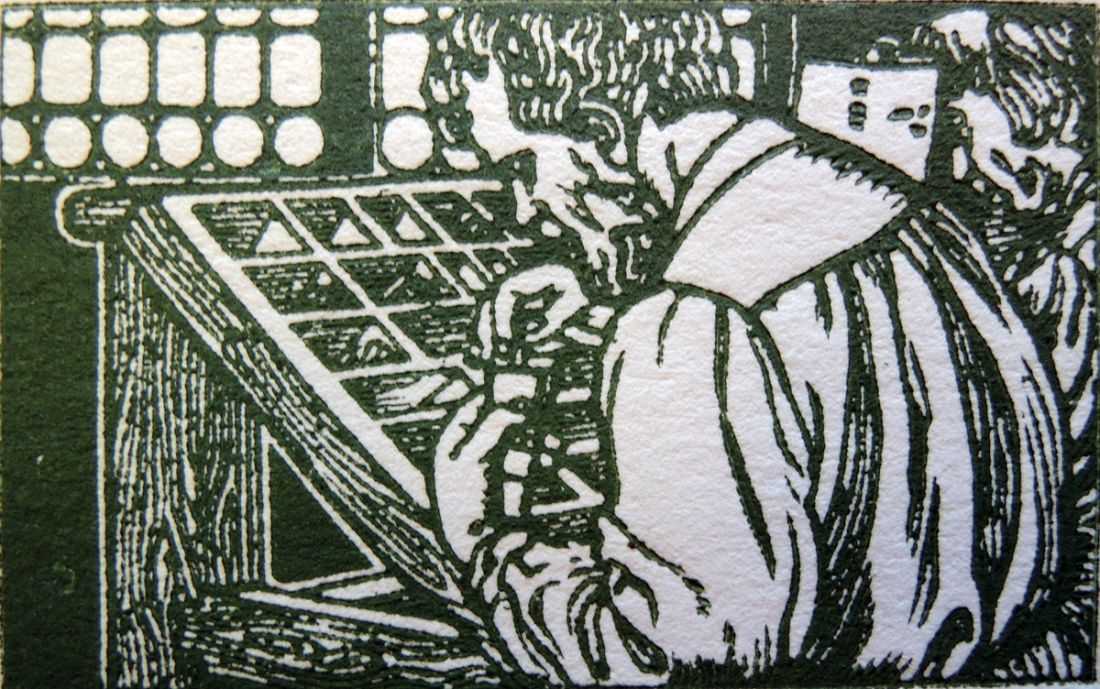
This is not, as previously thought, a cut created for Ruth’s book but a stock print taken from “American Specimen Book of Type Styles : Complete Catalogue of Printing Machinery and Printing Supplies” by the American Type Founders Company, 1912.

The printer/publisher Lew Ney (pseudonym for Luther Emanuel Widen, 1886-1963) was born in Iowa of Swedish parents and grew up in Austin, Texas. He left school to run the Southwest Book and Publishing Company and in 1908 became the southwestern representative for publications at Charities and the Commons, a National Journal of Philanthropic, Civic, Industrial and Social Advance (Jacob Riis was the New York representative). Eventually, Widen made his way to New York, where he settled on West 4th Street in Greenwich Village.
lew ney in praise of pain2

Beginning on August 23, 1920, Widen typed and distributed a newspaper called The Vagabond. For six months and 48 issues, he circulated his writing throughout the neighborhood until, one day Widen was arrested, directed to stop publishing his paper, and banned from Greenwich Village. As reported in the New-York Tribune, Widen was arrested because a detective investigating a robbery next door, at the Studio of Gertrude Vanderbilt Whitney, became suspicious when Widen tried to help by announcing the name of the thief, which he said he discovered psychologically.

lew ney in praise of pain1

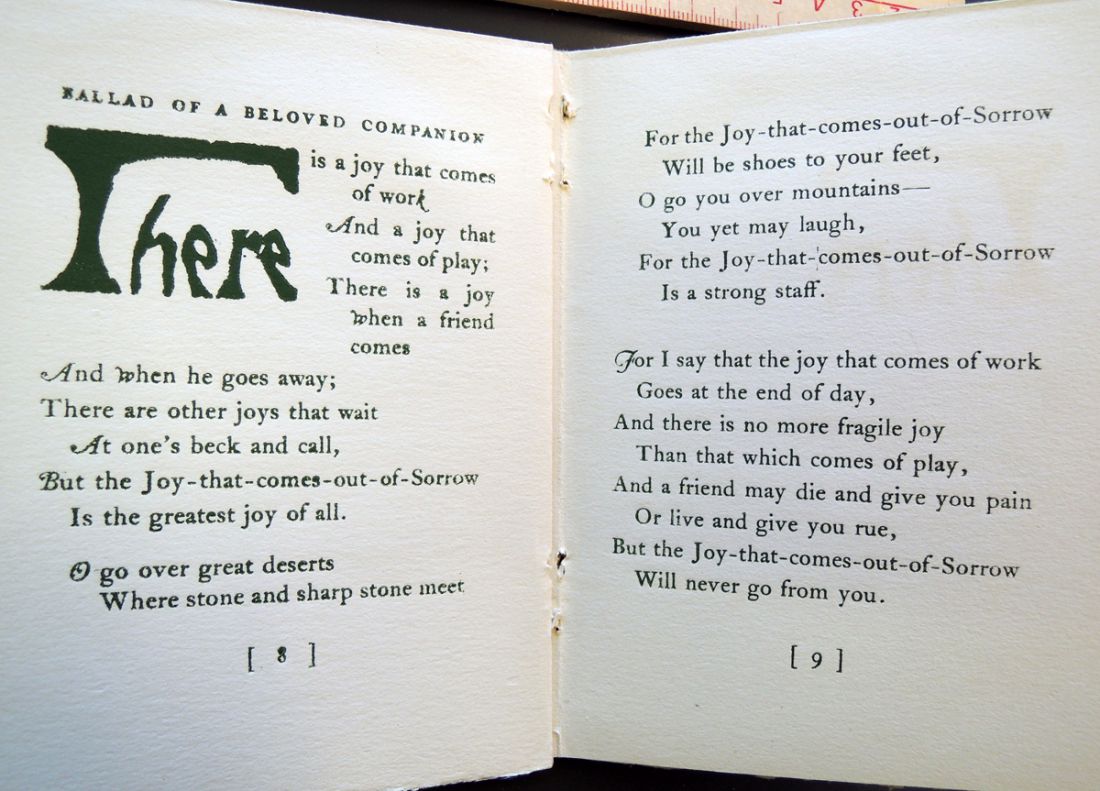
Ruth Widen, In Praise of Pain (New York: Parnassus Press, 1928). Graphic Arts Collection GAX 2013- in process

lew ney in praise of pain5

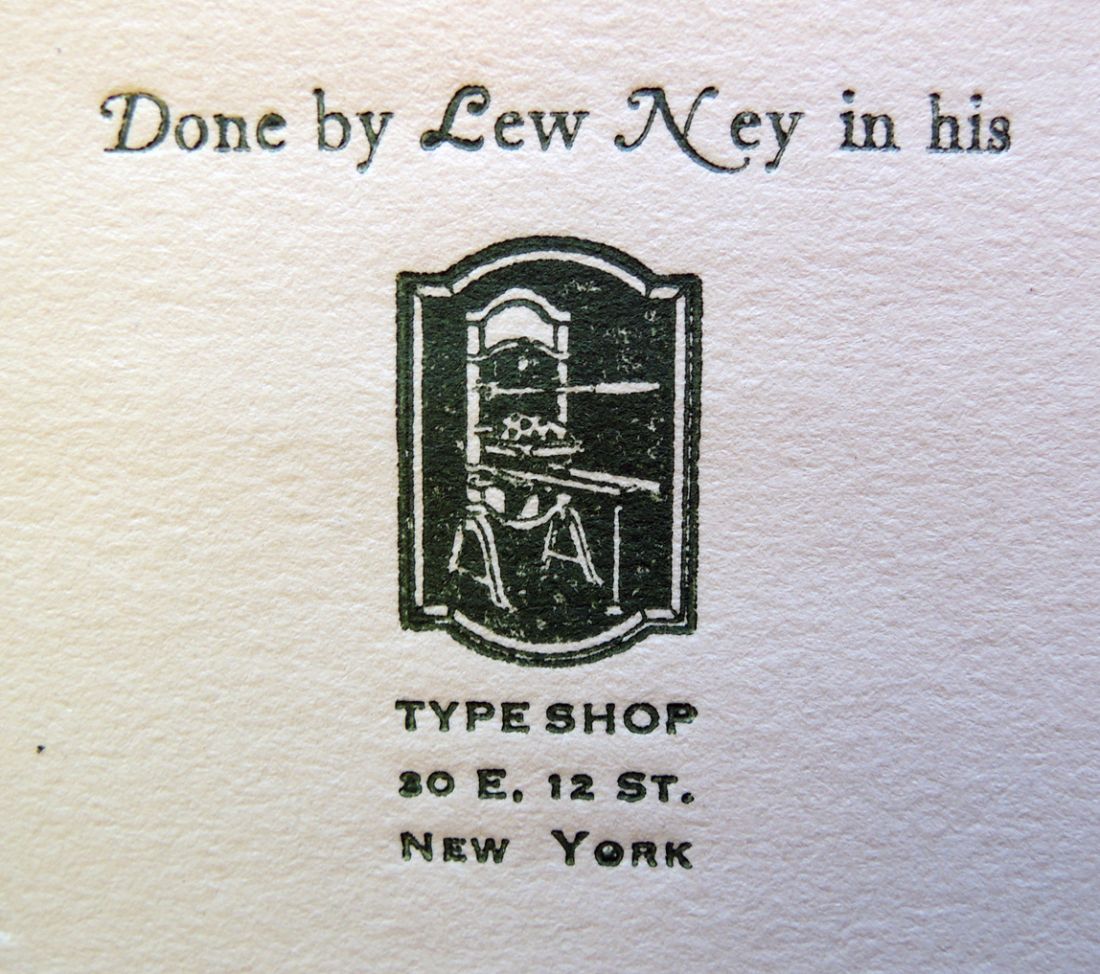
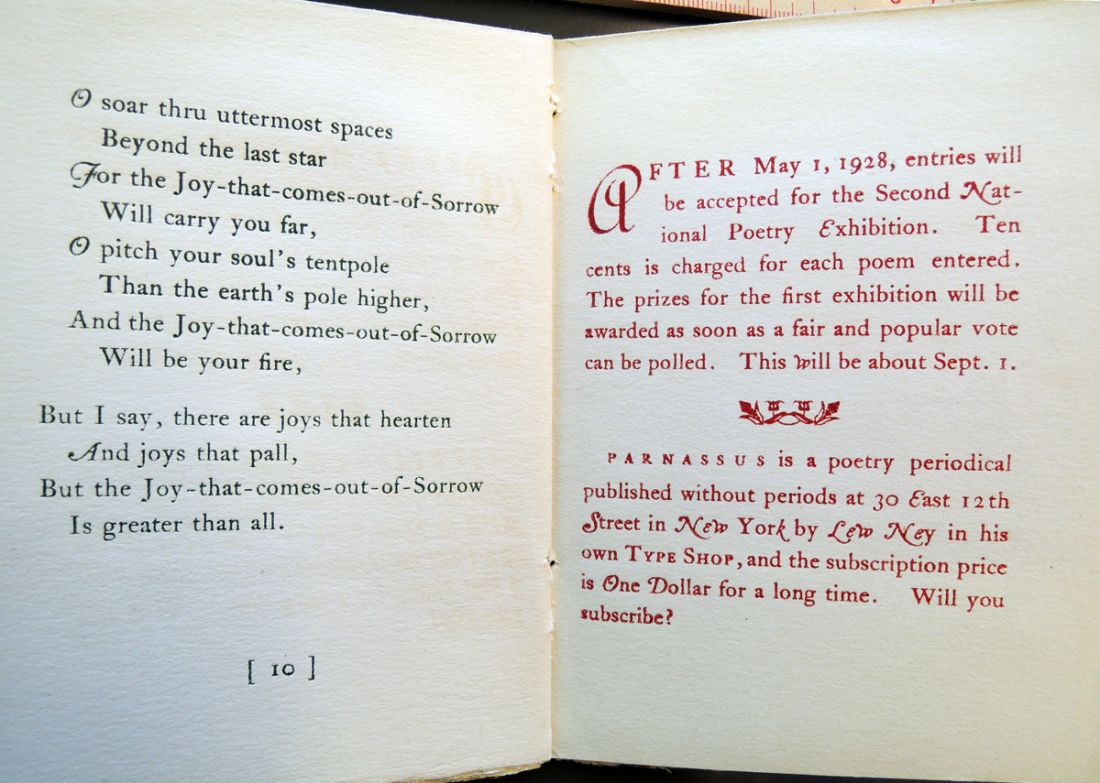
Although he agreed to the ban rather than be committed to Bellevue Hospital, Widen merely moved the office a few block north, took the pseudonym Lew Ney, and established a new Type Shop on 12th Street. In 1928, he was married (a second time) to writer Ruth Willis Thompson, who joined the shop and served as editor for many of their Parnassus Press books. As a wedding present for their friends (who took up a collection to pay for the marriage license), Widen hand-set and printed Ruth’s In Praise of Pain. He also reprinted the stock image above as an illustration.
lew ney in praise of pain6

I am working on a complete biography of Ney and welcome any information on his life.