Keynote Address at the 2004 Democratic Convention

obama2Franklin McMahon (1921-2012), Senator Barack Obama (D, Ill.) Keynote Address at the 2004 Democratic Convention, Boston, Massachusetts, July 26, 2004, 2004. Acrylic paint, watercolor, and pencil on paper. Provenance: collection of Margot McMahon. Graphic Arts Collection GAX 2015- in process.
signing peace accord4

Nearly twelve years ago, Illinois State Senator Barack Obama presented the keynote address at the 2004 Democratic National Convention held in Boston, Massachusetts. That Tuesday night in July became the decisive moment that propelled Obama forward and let him to become President of the United State.

Artist and visual journalist Franklin McMahon was in the audience that night and captured the drama of the moment in this acrylic painting, recently acquired by the Graphic Arts Collection. Unlike the multitude of photographs published, this sketch places the viewer in the middle of the audience and gives us a sense of the excitement of that event.

The Graphic Arts Collection is pleased to have acquired several important paintings on paper by Franklin McMahon (1921-2012), documenting key moments in recent American history. We thank, in particular, his granddaughter Irene Burke, Class of 2016 and a member of the PUAM Student Advisory Board, for her help with these acquisitions. We also thank Jeremy Darrington, Politics Librarian, and David Magier, AUL for Collection Development, without whom these acquisitions would not have been possible.

obama1See also:

The Speech: Race and Barack Obama’s “A more perfect union,” edited by T. Denean Sharpley-Whiting (New York: Bloomsbury, 2009). Firestone Library (F) E184.A1 S698 2009

Barack Obama, An American Story: the Speeches of Barack Obama: a Primer by David Olive (Toronto: ECW Press, 2008). Firestone Library (F) E901.1.O23 O45 2008

Barack Obama, Barack Obama in His Qwn Words edited by Lisa Rogak (New York: Public Affairs, 2008). Firestone Library (F) E185.97.O23 A25 2008

Barack Obama, Dreams from My Father: a Story of Race and Inheritance (New York: Crown Publishers, 2004). Firestone Library (F) E185.97.O23 A3 2004b

José Rosa

jose rosaIn preparation for SPA 327/URB 327/LAO 327 Latino Global Cities, taught by Arcadio Díaz-Quiñones and Germán Labrador Méndez, we pulled this poster for a 1977 exhibition by the printmaker and painter José Rosa, printed “under the auspices of the Department of Hispanic Studies at the University of Puerto Rico.” The image is based on a wonderful book by Luis Rafael Sánchez, La guaracha del macho Camacho (Buenos Aires: Ediciones de la Flor, 1976). Firestone Library (F) PQ7440.S235 G8

Born in 1939, Rosa studied at the Taller del Instituto de Cultura Puertorriqueño (Graphic Arts Workshop of the Institute of Puerto Rican Culture) run by Lorenzo Homar (1913-2004) and later succeeded Homar as the workshop’s director. As this print demonstrates, he was a master of screen printing. The print was later exhibited and reproduced in the catalogue José Rosa: Exposición Homenaje: Obra Gráfica, 1963-1996: Antiguo Arsenal de la Marina Española, Viejo San Juan, Puerto Rico, 29 de abril al 31 de agosto de 1998 ([San Juan, P.R.]: Programa de Artes Plástica, Instituto de Cultura Puertorriqueña, 1998).


jose rosa3


Bookseller identified

bookseller3Johann Amos Comenius (1592-1670), Zrelishche vselennyia na frantsuzskom, rossiiskom u nemetskom iazykakh [Pageant of the Universe in French, Russian and German languages] (Sankt Peterburg, 1788). [8] 142 p., LXXX engr. pl. 20 cm. Cotsen Children’s Library (CTSN) European 18 115bookseller4
Thank you so much to Claudia Dias, John Overholt, Gabriel Swift, and Ian Dooley, who helped with the identification of the unattached bookseller who has been drifting through the Graphic Arts Collection. The plate appears to be from the 1788 Russian adaptation of the Orbis Pictus or Orbis Sensualium Pictus (Visible World in Pictures also called the Pageant of the Universe), a textbook for children first published by Czech educator Johann Amos Comenius in 1658. Happily the plate was not removed from Princeton’s copy.

There are many editions, translations, and illustrations for this textbook. Here’s an English version: Johann Amos Comenius (1592-1670), Orbis sensualium pictus… translated into English by Charles Hoole (London, J. Kirton,. 1659). Cotsen Children’s Library (CTSN) English 18 128

Here are a couple more plates:

bookseller6
bookseller5


See also: Adam Fijałkowski, Orbis pictus: świat malowany Jana Amosa Komeńskiego = Orbis pictus : die Welt in Bildern des Johann Amos Comenius (Warszawa: Uniwersytet Warszawski, 2008). Accompanies an exhibition at the Biblioteka Uniwersytecka w Warszawie and the Herder-Institut in Marburg. Firestone Library (F) LT101.C63 F55 2008

Kupferstichkabinett

eMuseumPlus2Paul Wunderlich (Eberswalde/Brandenburg 1927 – 2010 Saint-Pierre-de-Vassols), à deux, 1960. Farblithographie in 10 Farben, Hamburger Kunsthalle, Kupferstichkabinett. Schenkung Dieter Brusberg, Berlin, 2010 Inv.-Nr. 2011-54

Thank you to Laura Giles, Heather and Paul G. Haaga Jr., Class of 1970, Curator of Prints and Drawings, for mentioning a new online source for over 4,000 German, Netherlandish, and Italian old master drawings and 11,000 Italian prints from the Hamburger Kunsthalle.

“You are invited to stroll through the database of the Kupferstichkabinett, which you can access via the website of the Hamburger Kunsthalle: http://emp-web-48.zetcom.ch/eMuseumPlus. Over the next years . . . we will add another 120,000 works on paper to this pool of online data. For 2016 we are planning to include the last 20 % of our Italian prints as well as our collection of Spanish drawings, and major parts of our 19th-century German prints and drawings.”

Congratulations to Dr. Andreas Stolzenburg and Dr. David Klemm of the Leiter Kupferstichkabinett, Hamburger Kunsthalle, Glockengießerwall, Hamburg, Germany.

www.hamburger-kunsthalle.de
www.netzwerk-graphische-sammlungen.com

eMuseumPlusAlbrecht Dürer (Nürnberg 1471 – 1528 Nürnberg), Adam und Eva, 1504. Kupferstich. Hamburger Kunsthalle, Kupferstichkabinett Inv.-Nr. 10554

The Stage and its Stars

stage and stars6Miss Ellen Terry as Portia
stage and stars7Sarah Bernhardt as Mrs. Clarkson
stage and stars2Howard Paul (1835-1905), The Stage and its Stars Past and Present: a Gallery of Dramatic Illustration and Critical Biographies of Distinguished English and American Actors from the Time of Shakespeare till Today, edited by Howard Paul and George Gebbie; [with] 128 photogravure portraits and scenes from steel plates, and over 400 portraits in the text (Philadelphia: Gebbie, 1887). 28 parts unbound. Graphic Arts Collection GAX in process
stage and stars4
stage and stars8The Merchant of Venice
stage and stars3
stage and stars5“The work will contain in all 112 steel engravings, part by etching and part by photogravure, and about 500 engravings on wood. it will be issued in twenty-eight parts at one dollar each; each part will contain 4 steel plates; each plate will be accompanied by descriptive text, and each number will contain at least 8 pages of illustrated biography of the actors and history of the Stage. One number will be issued monthly until the whole is completed. no subscriber’s name will be taken for less than the entire work. the work is payable when delivered by our agents; no cash is to be paid in advance, and no credit given. We will guarantee that the work will be in every respect equal to the samples shown by our agents, and no representation outside this statement of terms and condition will be binding on the publishers.”–prospectus
stage and stars9stage and stars

Thank You Thank You Thank You

ding7One more day to see Jaime Ding’s senior show in the Lucas Gallery at 185 Nassau, which is closing March 4, 2016. THANK YOU THANK YOU THANK YOU, a show about things bags are, from Jaime Ding ’16.  http://arts.princeton.edu/events/thank-thank-thank-senior-art-show-jaime-ding/

ding6ding5

ding3ding2ding1thankyou

Association of European Printing Museums

aepmThe Graphic Arts Collection is proud to be a member of the Association of European Printing Museums (AEPM), an international printing heritage network. As their website states, “the aim of the AEPM is to encourage the sharing of knowledge, experience, initiatives, and resources in all fields of the graphic arts as they have been practised from the time of Gutenberg until the present day. Originally founded as an association of European printing museums, the AEPM has gradually enlarged its remit to include a broad range of organisations and individuals interested in printing heritage, both in Europe and beyond.” We encourage others to join as well. http://www.aepm.eu/

Along with other activities, the AEPM holds annual conferences and has recently placed a CFP for their upcoming gathering. The 2016 conference will be held at the Nederlands Steendrukmuseum (Dutch lithography Museum) in Valkenswaard (Netherlands) from 3-5 November 2016. It is being jointly organised with the IADM (Internationaler Arbeitskreis für Druck- und Mediengeschichte). The theme of the conference is:

From Stone to Chip. Lithography. Few people know what it is, and even fewer know how it works. Yet we are permanently surrounded by documents and objects printed by this long-established process. Introduced in the early years of the 19th century, lithography mutated in the early 20th century to become offset lithography which went on to replace letterpress as the principal industrial printing process. For more information, see their website.


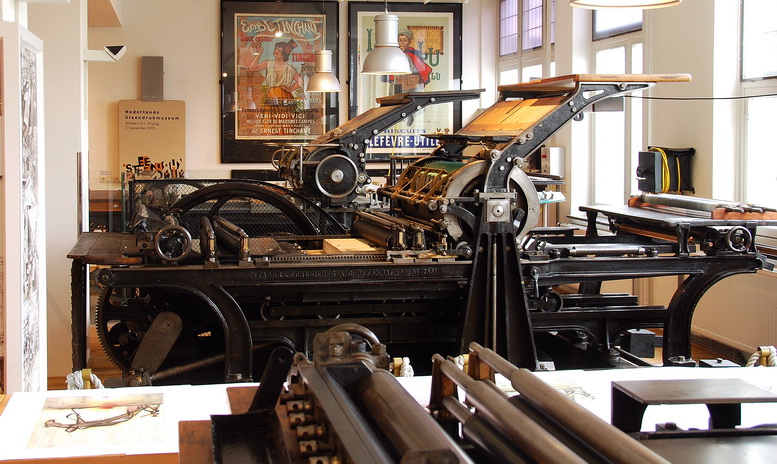
steendrukmuseum-0872One of the many press rooms highlighted in the website’s gallery. This is the Nederlands Steendrukmuseum, Valkenswaard (Netherlands).

Coleridge and Doré

dore rime3Samuel Taylor Coleridge (1772-1834), The Rime of the Ancient Mariner, illustrated by Gustave Doré (London: Doré Gallery, 1876). Graphic Arts Collection GAX Over 2006-0220F

dore rime1
dore rime8
“Gustave Doré’s illustrations to Coleridge’s The Rime of the Ancient Mariner (1876) have been widely known since their initial publication in London. They appeared the following year in the United States, where they passed rapidly through nine editions and were then reprinted (and pirated) many times. During the 1880s the folio edition was published in France, Germany, Italy, and Russia. After a gap of more than half a century when Doré fell out of fashion, interest in his art once again revived in the 1960s…. Grant F. Scott, “The Many Men so Beautiful: Gustave Doré’s Illustrations to The Rime of the Ancient Mariner,” Romanticism. 16, Issue 1 (April 2010): 1-24

dore rime7
dore rime6

“The name of Gustave Doré, who died at Paris January 23, is one so familiar to everyone at all acquainted with modern book illustration, that a summary of those of his many art-works which were published in book-form is not out of place in a book-trade journal. The New York Tribune for January 24 gives, perhaps, the fullest account of his life, and from this we borrow the following: ‘Doré published his first lithographs at the age of eleven. When fifteen years old he published his first series of sketches, The Labors of Hercules, in the Journal pour Rire, to which he became a regular contributor . . . His first important work was in illustrating the legend of The Wandering Jew, in 1854, which made him famous outside of France. There followed chronologically his illustrations of Rabelais, Balzac’s Contes drolatiques, Montaigne (1857), Taine’s Voyage aux Pyrenees (1859), Dante (1861-68), Chateaubriand’s Atala (1862), Don Quixote (1863), Milton’s Paradise Lost (1865), the Bible (1865-66), Tennyson’s Idyls of the King (1866-68), La Fontaine’s Fables (1867) and Coleridge’s Ancient Mariner.”–The Publishers Weekly, January 27, 1883.
dore rime5
dore rime4


Listen to Richard Burton read from The Rime of the Ancient Mariner by Samuel Taylor Coleridge


Do you recognize this bookseller?

bookseller2 booksellerThis plate turned up recently depicting a bookseller identified in four languages: Latin, French, German, and Russian. The woodcut on laid paper is number 75 from an unknown publication. If you recognize the source, please let us know.

Graphic Arts Collection Unidentified GC 079 box 4.


In Scripture Lands: New Views of Sacred Places

phil photographer6In 1882 the American journalist Edward Wilson traveled to the Middle East. His obituary described this as “the largest photographic expedition ever attempted in those countries, visiting and photographing through Egypt, Arabia and Palestine. Returning to America he utilized the vast source of pictorial material thus secured in the lecture field and in the preparation of articles for The Century and Scribner’s Magazine, His exploration of the buried city of Petra in Arabia was recognized by savants as a distinct achievement. In recognition of the value of his work in the East, as supplying lost links in Biblical history, the Washington and Jefferson College of Pennsylvania honored him with the degree of Doctor of Philosophy.” —Wilson’s Photographic magazine July 1903.

Wilson’s glass negatives were transported and stored for ten months before printing yet the resulting prints are crisp and powerful. He published this print in his own magazine Wilson’s Photographic Magazine (previously The Philadelphia Photographer) with the following explanation:

We offer our readers this month another memento of our Nile travel. The picture before us is a view in the Nubian district. Sailing along the Nile towards the cataracts, there suddenly burst upon the astonished vision of the traveler one of the most lovely sights imaginable; a scene fantastic as a dream, an echo of the past reflected in the present. …The view before us was taken from the top of the famous temple of Isis, on the Island of Philae, and presents in the immediate foreground the ruined kiosk of their goddess, whose mysteries were worshiped over the whole of Egypt, and even found devout votaries among the most distinguished of the Greeks and Romans. Winding about this lovely gem; we see the Nile flowing in beautiful curves, and in the distance the Nubian hills. It may be of interest to know that the little steamboat which lies moored has since been lost.

The plates upon which the subject was made were six in number, every one of which turned out perfectly satisfactory, although the exposures were made in the month of January 1882 and not developed until the following October. Having survived all the vicissitudes of travel, they revealed to us again when placed in the developing tray, a renewed impression of the beautiful scene we had beheld, and we trust that our readers may gain an adequate idea of its loveliness from the beautiful print we present them in this number.

After a series of articles in Century Magazine, 150 of Wilson’s Middle Eastern photographs were engraved on wood and published by Scribner’s as In Scripture Lands: New Views of Sacred Places (1890). Firestone recap 1793.977wilson book