Exiles


Also uncovered during the renovation of the Princeton University Library was this small but important playbill from a French production of James Joyce’s Exiles, held at the Théâtre Gramont, Paris. The play in three acts was written in 1914 and published simultaneously in an English and an American edition on May 25, 1918. To read Edna O’Brien’s review of the National Theatre’s production in 2006, see: https://www.theguardian.com/stage/2006/jul/29/theatre.fiction


To mark the acquisition of the Leonard L. Milberg ’53 Collection of Irish Theater, the Princeton University Library mounted the exhibition, Players & Painted Stage: The Leonard L. Milberg Collection of Irish Theater, running October 2006 to April 2007. The show merged holdings from the library, newly acquired Milberg material, and other donations. View the exhibition website: http://milberg.princeton.edu/highlights

See also: James Joyce (1882-1941), Exiles; a play in three acts (New York: B. W. Huebsch, 1918). First American edition. Rare Books (Ex) 3807.38.333.1918a


See also the Abbey Theatre production at: http://www.rte.ie/bosco/components/player/iframe.html?clipid=3703810&thumbnail=000990e6&subheader=off

Ichikawa Danjuro IX (1838-1903) meets Adolfo Farsari (1841-1898)

Utagawa Yoshiiku 歌川 芳幾 (1833-1904), [Meeting between the Kabuki actor Danjuro IX and the Italian photographer Adolfo Farsari], [Tokyo: Nichinichi Shinbun, 1874]. Color woodblock print. Graphic Arts Collection GAX 2017- in process A vault

“Utagawa Yoshiiku was a Japanese printmaker and illustrator. As a printmaker, he designed a wide range of prints including those depicting bijin (beautiful women), musha (warriors), yakusha (actors), and the sensationalized pictures of blood-stained mayhem called chimidoro-e and muzan-e, among others. From 1874 to 1875 he designed nishiki-e shinbun for the Tokyo newspaper Nichinichi Shimbun, which he co-founded.”

“. . . The founders of Tōkyō nichinichi shinbun are: Johno Denpei (1832-1902, pseud. “Sansantei Arindo” as gesakusha: popular fiction writer), Nishida Densuke (1838-1910, former clerk of TSUJI Den’emon’s kashihon’ya: lending library), and Ochiai Ikujiro (1833-1904, pseud. “Utagawa Yoshiiku” as Ukiyoe print artist).” –See William Wetherall’s News Nishiki website; Amy Reigle Newland, The Hotei Encyclopedia of Japanese Woodblock Prints (Hotei Publishing Company, 2005), p. 505.

One of the prints Yoshiiku designed for his newspaper was this meeting of the renowned Kabuki actor, Ichikawa Danjuro IX (1838-1903) and the Italian-born photographer, Adolfo Farsari (1841-1898).

According to the Japanese text, in May 1872 an unidentified “yojin” (“ocean person”) visited Danjuro IX backstage and asked to photograph the actor in exchange for some European cigarettes.

The Westerner, not identified in the text, was almost certainly Adolfo Farsari, who took up residence in Japan in the early 1870s and became one of the most prominent photographers in the country.


To read the entire newspaper, see: Tōkyō nichinichi shinbun [microform] = 東京日日新聞 (Tōkyō: Nippōsha, 東京 : 日報社, Feb. 21, 1872- Dec. 31, 1942). East Asian Microfilms (HYGF): Forrestal Annex Microfilm J00057

For more on Farsari, read the catalog of an exhibition held at the Villa Contarini, Piazzola sul Brenta, Italy, Dec. 18, 2011-April 1, 2012: East Zone: Antonio Beato, Felice Beato e Adolfo Farsari : fotografi veneti attraverso l’Oriente dell’Ottocento / a cura di Magda Di Siena ; testi di Magda Di Siena, Rossella Menegazzo (Crocetta del Montello (Treviso): Antiga, 2011). Marquand Library use only DS508.2 .E27 2011

Avalon Ballroom

What do these pictures, above and below, have in common?

The postcards were found during the renovation of rare books and special collection’s technical services offices. Manufactured by Family Dog Productions, the corporation that managed The Avalon Ballroom in San Francisco, the cards advertise Avalon rock concerts presented from 1966 to 1969.

Our cards announce concerts by the Grateful Dead, Quicksilver Messenger Service, the Steve Miller Band, Moby Grape, the Butterfield Blues Band, and Big Brother and the Holding Company, with designs by Rick Griffin, Stanley Mouse, Alton Kelley and Victor Moscoso.

Like our offices, the Avalon’s building was renovated many times and since 1969, has housed a Regency movie theater, American Pacific Linens, Wantful.com (internet startup), and currently, the ad agency Argonaut.


Thanks to Maria Grandinette, Preservation Librarian, who found these cards and other ephemera.

The Language of the Lament

Lynne Avadenka. Lamentations = Ekhah. Lamentations = איכה (Huntington Woods, Mich.: Land Marks Press, 2009). Copy 8 of 8. “This edition of Lamentations was created with woodcuts, photopolymer plate printing and stencils, and letterpress printed with Centaur and Koren types on Yamada Hanga cream paper”–Colophon. Housed in a cloth-covered oblong clamshell box, which has a woodblock inset on its top. Text of the book of Lamentations in Hebrew, with English translation from the Jewish Publication Society: leaves [3-12]. Graphic Arts Collection GAX in process


Additional digital images available at: http://www.lynneavadenka.com/gallery.html

Colophon [above]: “Echoes, reverberations, multiplicities, repeats: the long narrow sheet – a scroll unrolled – like the original Book of Lamentations; prints from wood, the same material from which houses are built, with traces of home cut out: doors, windows, openings; orbits linked and overlapped, inked and overprinted, suggesting absence, presence, and interconnected lives.”


Many other versions of the Lamentations are available in the Princeton University Library, including: Sefer Ḳol bikhyi: reʼu zeh ḥadash ḳetsat ḥidushim ʻal sefer Iyov… ṿe-ʻimo nilṿeh sefer Metsudat Daṿid le-vaʼer ʻinyana . . . / Raḥamim Bukhrits (Liṿorno: Sh. Belforṭe, 657 [1897]). Rare Books (Ex) BS1415 .K642 1897

We also hold a number of artists’ books featuring Jewish themes. Here are only a few:
Sue Coe, X (with Art Spiegelman). Design by Françoise Mouly (New York: Raw Books & Graphics, 1986). Rare Books (Ex) N6797.C55 A4 1986 Milberg
Mark H. Podwal, A Sweet Year: a Taste of the Jewish Holidays (New York: Random House Children’s Books, 2003). Graphic Arts Collection (GAX) 2004-2542N
Carol Rosen, The Holocaust Series. XXI, We All Disappear ([Califon, N.J.?: C. Rosen, 2004?]). Graphic Arts Collection (GAX) Oversize 2014-0939Q
Paul Auster, Reflections on a Cardboard Box; Drawings Henrik Drescher ([Mt. Horeb, Wis.]: Perishable Press, 2004).Rare Books (Ex) 2005-2248N
D.R. Wakefield, Pugilistica Judaica: Jewish Prize-fighters in London 1785-1840 ([East Yorkshire]: Chevington Press, 2006).Graphic Arts Collection (GAX) Oversize 2008-0022F
Art Spiegelman, Breakdowns: Portrait of the Artist as a Young [squiggle][star]! 1st rev. ed. (New York: Pantheon Books, 2008). Rare Books (Ex) Oversize 2008-0492Q
Lynne Avadenka, Plum Colored Regret (Huntington Woods, Mich.: Land Marks Press, 2010). Graphic Arts Collection (GAX) Oversize 2011-0060Q
Sarah Horowitz, Alpha Botanica ([Portland, Or.: Wiesedruck, 2007]) Graphic Arts Collection (GAX) 2014-0009S

Comparing collections in Oslo, Glasgow, Oxford, and Princeton

We are offering a guest post today written by Larry J. Schaaf, Director, William Henry Fox Talbot Catalogue Raisonné, Bodleian Libraries, University of Oxford with additional information from Tone Rasch, Curator, The Norwegian Museum of Science and Technology, Oslo, Norway. Our sincere thanks to them both.

unidentified-ntm-2774-vp
“In 2009, Tone Rasch of the Norwegian Museum of Science and Technology contacted me about a mysterious paper negative in their collection [left]. It depicts a man standing among the ruins of a once-grand urban building. In 1935 this museum had been one of the recipients of Miss Matilda Talbot’s distributions of her grandfather’s photographs but I knew straight away that it was not the work of Talbot.

This negative had come into the museum through the collection of the Swedish professor of photography, Helmer Bäckstöm. He had made some notes on the negative and elsewhere suggested that it was by the Edinburgh photographers Hill & Adamson.

Some years before I had catalogued Glasgow’s collection of their work and I was immediately reminded of two negatives taken during the 1848 demolition of the 15th-century Trinity College Church, then shamefully being demolished to make way for Waverly Station.
http://special.lib.gla.ac.uk/hillandadamson/search/detail.cfm?Haa_GUL_Number=HA0636 and
http://special.lib.gla.ac.uk/hillandadamson/search/detail.cfm?Haa_GUL_Number=HA0758
but the association was not convincing.”

willattsalbum_princetonQuite separately one of the entries that I contributed to the biographical dictionary in Roger Taylor’s Impressed by Light [(SAPH) Oversize TR395 .T39 2007q] a couple of years before was on John Sherrington, an English Catholic who had moved to Rotterdam in 1838 after a bank failure. http://www.luminous-lint.com/app/photographer/John__Sherrington/A/

We knew very little about Sherrington’s calotypes save for the fact that some prints from them were included in the fabulous Willats album at Princeton University. Permanent Link: http://arks.princeton.edu/ark:/88435/k930bx11x [leaf 37, seen left ]

I have to freely confess that none of these disparate threads came together in my mind at the time. However, for whatever reason, last week when I was reviewing the online version of the album the memories all fell into place – it is clear that the Norwegian negative and the Willats print are from the same session.

Just when was this fire that destroyed the theatre? Surely it would have been mentioned in the accounts of the Great Fire of 1849 that destroyed the commercial heart of the city, but curiously, so far no mention of the destruction by fire of the Rotterdam theatre has been traced.

What little we know of Sherrington at this point is primarily through the fame of his daughter, the soprano Madame Lemmons-Sherrington. https://books.google.com/books?id=p8ocAQAAIAAJ&pg=PA452&lpg=PA452&dq=rotterdam+%22john+sherrington%22&source=bl&ots=7Vg510BcQY&sig=sB5xSFVN50QVY8bOn-G2ZxFKLp0&hl=en&sa=X&ved=0ahUKEwiUvYPctajRAhWC7SYKHXykAnMQ6AEIKjAD#v=onepage&q=rotterdam%20%22john%20sherrington%22&f=false

close-upCropped and Photoshopped

This quest fits in well with the multiple intents of the William Henry Fox Talbot Catalogue Raisonné, now being prepared for online publication by the Bodleian Libraries at the University of Oxford. http://foxtalbot.bodleian.ox.ac.uk/. We presently have item-level records on about 25,000 original negatives and prints done by Talbot and his close associates and distributed through collections worldwide. It had been common practice in the past for most any early paper photograph to be attributed to Talbot, mostly because of a lack of information on just how many photographers were experimenting on paper in the 1840s. I remember many years ago Dr David Thomas, then curator of photographs at the Science Museum, telling me that anytime somebody turned up an early paper photograph in one of their collections he simply placed it in one of the Talbot boxes because there was no other place to store it. Hence is history created. The Catalogue will recognise these historical associations and attempt to properly attribute them.”


Here Tone mentions “I contacted Martin Jürgens at the Rijksmuseum in Amsterdam and he found another version of the Willats picture. http://collecties.stadsarchief.rotterdam.nl/publiek/detail.aspx?xmldescid=415896&tag=gebeurtenis;akten;archieven;algemeen&view=lijst&volgnummer=1&positie=7&beschrijvingssoort=157879244&doc_beschrijvingssoort=157879244&a_z=%5BARGS_PLACEHOLDER%5D This is a bit confusing because this text differs from the album text, telling that ruin is from the fire in Rotterdam in 1849 from the sugar refinery of Mr. Tromp. Not at all a theater fire.

This photograph is not attributed to Sherrington, as are 11 other photos in the city archive, among these the wheel boat that is in the Willats album as well. I have sent a mail to the archive to ask if they have any further information on Sherrington or the sugar refinery. I have also sent a mail to Copenhagen Museum that has the collection of Frederik Riise who once owned the paper negative. The text that tells about the gift of Frederik Riise is written on the back side of the negative, same thing with the unreadable words at the right side of the picture.

And just to clarify, “The paper negative was photographed in 2009 when it was mounted between two glasses with an exhibition text. As you will see, the picture is less distinctly than the newer positive print. You can see the 2009 picture here:https://digitaltmuseum.no/011024238926/fotografi?aq=owner%3A%22OMU%22+text%3A%22papirnegativ%22&i=0”

 
New information can be found at http://www.tekniskmuseum.no/nyheter-fra-samlingene/1318-fotografi-fra-1849-identifisert

willats-volumeThe Willats album was purchased for Princeton by Gillett Griffin (1928-2016). Please save the date for the inaugural Gillett G. Griffin Memorial Lecture: “The London Circle: Early Explorations of Photography” delivered by Sara Stevenson on Sunday, 2 April 2017 at 3:00 p.m. in The Friends Center, Princeton University corner of William Street and Olden Street, Princeton, New Jersey. https://graphicarts.princeton.edu/2016/11/11/the-inaugural-gillett-g-griffin-memorial-lecture/

Entertaining Knowledge here – Trump Trump Trumpery Trump

trump-trump6Charles Jameson Grant (active 1830-1852), The Penny Trumpeter!, September 20, 1832. Lithograph. Published by G.S.Tregear, 123 Cheapside. Graphic Arts Collection GAX 2017- in process

The subject of C. J. Grant’s print is Henry Peter Brougham (1778-1868), satirized as a newsboy blowing a small trumpet to publicize his Penny Magazine. Lord Brougham was responsible for establishing the Society for the Diffusion of Useful Knowledge and through it, publishing numerous booklets and magazines with generic information for a mass audience. Complex histories or scientific theories were reduced to overly simplistic articles of little value except entertainment, a genre that became known as Trumpery.trump-trump

The Penny Magazine appeared in March 1832 and by September, Grant was already satirizing its bland articles illustrated with black and white wood engravings printed from cheap stereoscopic plates. In his own work, Grant specialized in bright, hand colored lithographs, deliberately radical in their politics. Here he trumpets “Entertaining Knowledge here—Trump Trump Trumpery Trump—Just printed and published the Penny Magazine, All works not issued by the Society for the Diffusion of Useful Knowledge are Illegal—Orders now taken for the forthcoming New Penny Cyclopaedia, Trump Trump.”

an00677553_001_l-2Grant’s Penny Trumpeter also appeared in one of his mock frontispieces for the magazine (the British Museum holds two versions of the broadsides), with multiple vignettes criticizing Brougham and his publication.


The Penny Magazine of the Society for the Diffusion of Useful Knowledge (London: Charles Knight, 1832-1845). Vol. 1, no. 1 (Mar. 31, 1832)-v. 14, no. 882 (Dec. 1845). Graphic Arts Collection (GAX) Oversize 2006-0186Q

Richard Pound, editor, C.J. Grant’s Political Drama: A Radical Satirist Rediscovered (London: University College, 1998)

trump-trump2“Materials for the Penny Cyclopaedia to commence in 1833 & to end the Devil knows when…”

Mark Peters wrote about the history of the word Trumpery for Salon: http://www.salon.com/2016/03/05/trump_really_does_stand_for_b_s_trumpery_an_old_fashioned_word_thats_proving_useful_today/


Horizontorium, 3D views in 1832

horizontorium2John Jesse Barker after a design by William Mason (active 1822–1860), Horizontorium, 1832. Lithograph. Published by R. H. Hobson, 147 Chestnut Street, Philadelphia, PA. Graphic Arts Collection GAX 2017- in process [photographed at an angle]

Before the advent of 3D glasses, print collectors enjoyed optical views like this one to experience the world in more dimension than the usual flat image. This print was to be laid on a flat table and each viewer meant to put their chin on the bottom center so as to see the building at an extreme angle. This is one version of anamorphosis, sometimes also designed to be viewed in a circular reflection.

Here are two other examples from the Graphic Arts Collection collection: https://graphicarts.princeton.edu/2015/03/25/anamorphic-images/ and https://blogs.princeton.edu/graphicarts/2008/02/anamorphic_self-portrait_by_ch.html .


horizontorium

horizontorium5Note the spot for your chin, if you want optimal 3D viewing.

horizontorium4

The building seen here has been identified as the Gothic-style bank erected in 1808 after the designs of Benjamin Henry Latrobe at the southwest corner of Fourth and Chestnut streets in Philadelphia. The Philadelphia Bank or Bank of Philadelphia (predecessor of the Philadelphia National Bank), was formed in 1803 and incorporated in 1804 as the unofficial bank of the commonwealth. Unfortunately the building was lost in 1836, not long after this print was made.

Researchers believe this print is the only recognized American “Horizontorium” and I have not been able to prove them wrong. The Library Company of Philadelphia, which also owns a copy of this print, suggests that the probable printer was Childs & Inman. For more information, try Nicholas B. Wainwright, History of the Philadelphia National Bank; a century and a half of Philadelphia banking, 1803-1953 (Philadelphia, 1953). HG2613.P5P7 and Nicholas B. Wainwright, Philadelphia in the romantic age of lithography: an illustrated history of early lithography in Philadelphia, with a descriptive list of Philadelphia scenes made by Philadelphia lithographers before 1866 (Philadelphia: Historical Society of Pennsylvania, 1958 (1970 printing)) Graphic Arts Collection (GA) Oversize 2008-0429Q

A letter in St. Nicholas magazine, v. 6 (October 1879) p.844, suggests that “a good way to look at this picture is to take a piece of card-board, about three inches long, and bend the bottom of it, in the manner shown in this diagram. Two holes should be made in the card, and the one in the lower bent portion should be so placed that the point of sight can be seen through it. The hole in the upright portion should be 2 inches from the bottom, or the angle formed by the bent part. Through this upper hole the picture should be viewed, when all its peculiar perspective—or, rather, want of perspective—will disappear.” Read the entire piece in GoogleBooks: https://books.google.com/books?id=jqYzAQAAMAAJ&pg=PA844&dq=horizontorium+philadelphia&hl=en&sa=X&ved=0ahUKEwjfksD87abRAhUBVCYKHZj-B4UQ6AEINDAF#v=onepage&q=horizontorium%20philadelphia&f=false

Posted in honor of John Berger, 1926-2017, author of Ways of Seeing (London: British Broadcasting Corporation; Harmondsworth, Penguin, 1972). Firestone N7420 .W28 1972

Jesse Jackson at the Ebenezer Baptist Church

jackson1

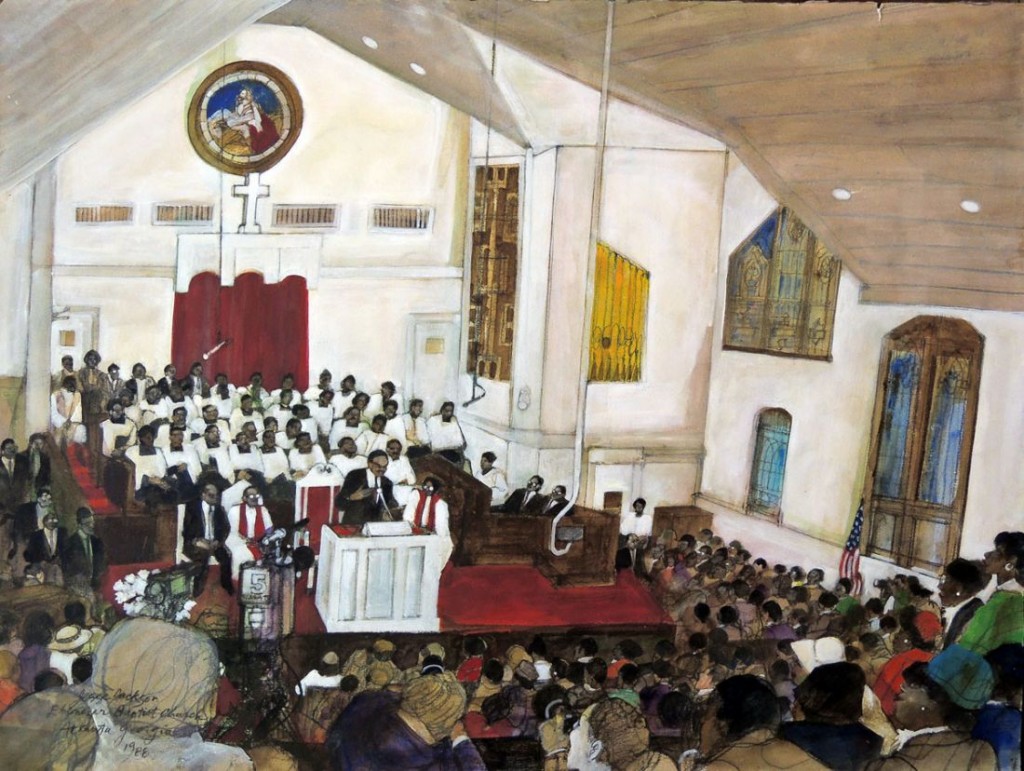
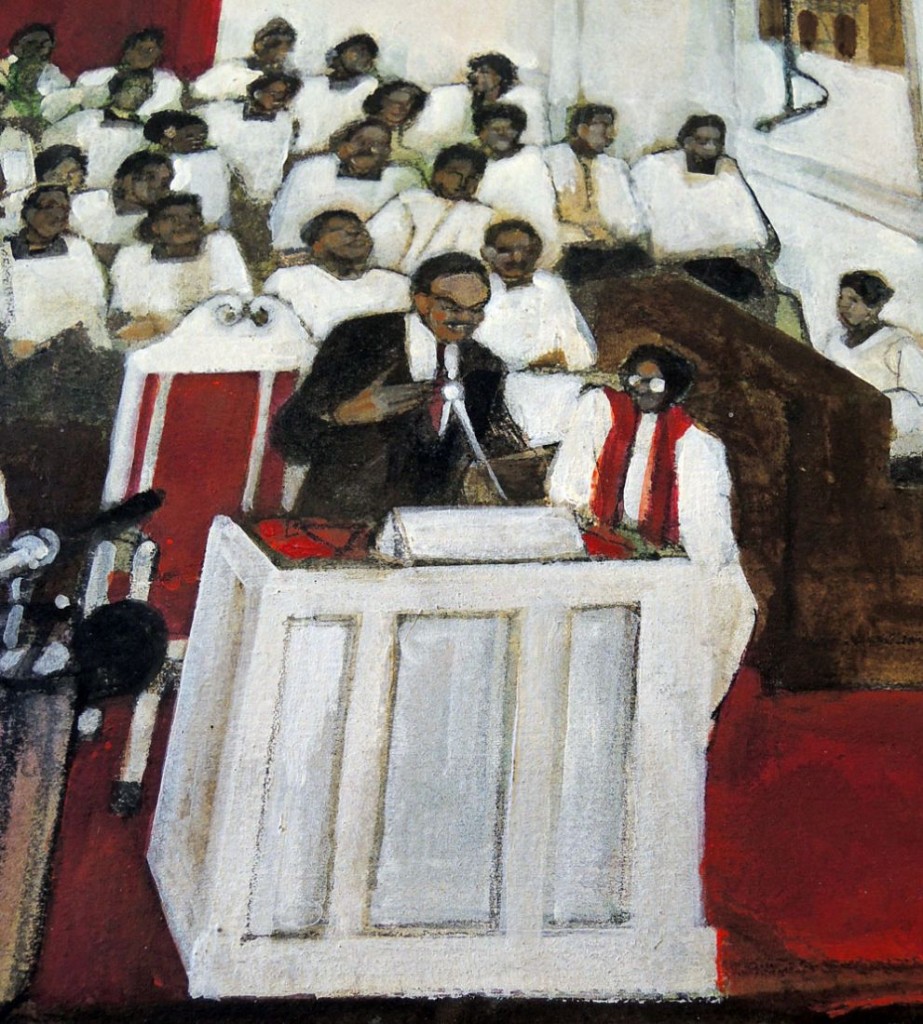
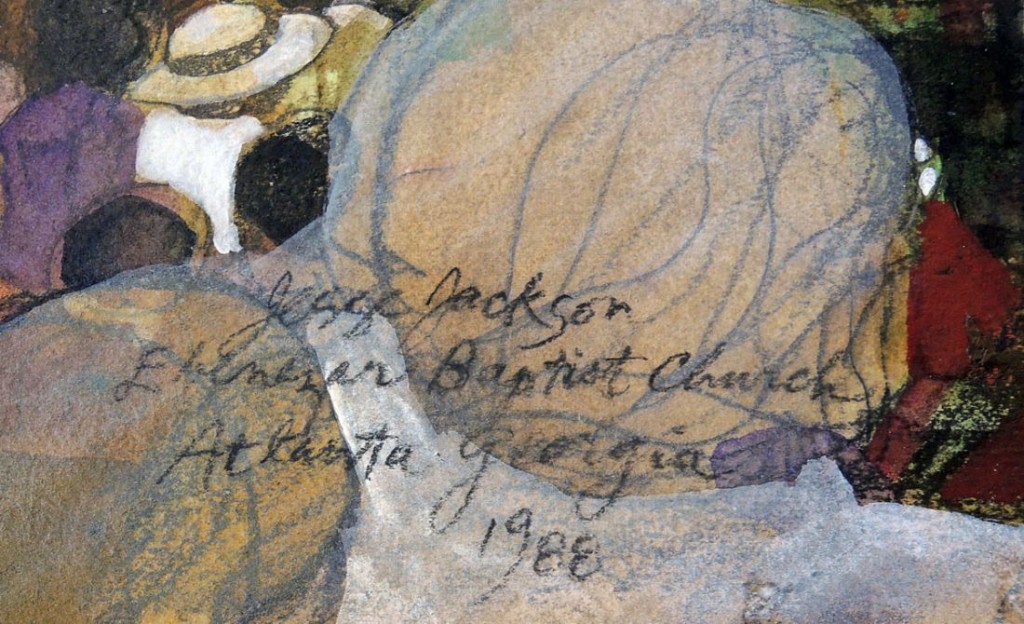
Franklin McMahon (1921-2012), Reverend Jesse Jackson, Ebenezer Baptist Church, Atlanta, Ga. 1988. Graphite, charcoal, and acrylic paint on paper. Graphic Arts Collection GA 2015- in process


ATLANTA, March 6— “The Rev. Jesse Jackson came to Ebenezer Baptist Church today to preach from the pulpit that once belonged to Martin Luther King Jr. and to cloak his Presidential campaign in the glory of the movement that Dr. King led. It was a rich mix of God, politics and history, of civil rights movement veterans, political leaders and average churchgoers, all crammed into the narrow wooden pews of Ebenezer Baptist, two days before the Super Tuesday primaries across the South.

Mr. Jackson, whose relations with Atlanta’s black establishment have often been prickly, seemed to revel in the day. The former lieutenant to Dr. King now stood in his mentor’s church on the brink of a political triumph unimaginable a quarter century ago. It was, undeniably, a religious service, with a pastor noting at one point, ‘It’s not Martin, nor is it Jesse, who’s going to get you to Heaven.’ But after the choir sang ‘God Give Us Faith’ and ‘I’m So Glad I Got My Religion in Time,’ after the reading from the Book of Ezekiel and the communion service, the church moved on to the matters of the world. ‘Bloody Sunday’ Anniversary The Rev. Joseph L. Roberts, senior pastor at Ebenezer, brought the congregation to its feet as he introduced Mr. Jackson ‘as one who hopes to break a barrier that’s never been broken before, but ought to be broken, a barrier that has stood for too long, depriving our people of their rightful due.’
jackson3

Then Mr. Jackson took his place at the simple white pulpit. He noted that it was the 23d anniversary of ‘Bloody Sunday,’ when civil rights demonstrators were beaten on a bridge in Selma, Ala., as they tried to march for the right to vote. He then paid tribute to John Lewis, now an Atlanta Congressman, who had led that march and been savagely beaten and on this Sunday morning was in a front pew. Mr. Jackson went on to present Super Tuesday as the outgrowth of the bloodletting on that Selma bridge. ‘Tuesday, 23 years later, we can transform the crucifixion,’ he said. ‘And on Tuesday roll the stone away, and on Wednesday morning have a resurrection: new hope, new life, new possibilities, new South, new America.’

‘I’m proud of the the New South,’ Mr. Jackson said. ‘No more governors standing in the school house door, no more dogs biting children.’ But, he continued, ‘It’s not enough to have kind governors and tame dogs. It’s not enough.’ He argued that ‘the fight for economic justice’ was the principle challenge before the South and the nation. It was a fight for the economic rights of garbagemen, Mr. Jackson noted, that drew Dr. King to Memphis, where he was assassinated in 1968. When Mr. Jackson had finished, the congregation sang him on his way with ‘I’m on the Battlefield for My Lord.’ And Mr. Roberts adlibbed, ‘And I promise not to serve him just ’till Super Tuesday but until I die.'”–Robin Toner, “Hosannas to God and Votes for Jackson,” Special to the New York Times, March 7, 1988.

This event was captured by Franklin McMahon, of whom the Times noted, “With sketch pads in hand, Mr. McMahon covered momentous events in the civil rights struggle, spacecraft launchings, national political conventions and the Vatican, turning out line drawings for major magazines and newspapers. Many were later colored by watercolor or acrylic paints, and most rendered scenes in a heightened, energetic style. ‘His goal,’ he said, ‘was to step beyond what he considered the limitations of photography to see around corners.’”–Douglas Martin, “Franklin McMahon, Who Drew the News, Dies at 90,” The New York Times, March 7, 2012.
jackson2

Holdup

dscn8387-3Emmett Williams (1925-2007) and Keith Godard (born 1942), Holdup (New York: Works Editions, 1980). Graphic Arts Collection 2016- in process


dscn8390-3

This is a book of famous thumbs.

Both printer Keith Godard and visual poet Emmett Williams had been collecting pictures of thumbs of friends and famous people for years and so, for their first collaboration, they combined their collections for a book of visual humor and visual poetry.

The two worked together at Godard’s studio and publishing house, Works Editions, only once again in 1983 producing A Little Night Book.

dscn8394-3

“Emmett Williams, an American poet whose transposition of words into visual art and performances made him one of the founding artists of Fluxus, a performance-oriented avant-garde art movement of the 1960s, died on Feb. 14 in Berlin. He was 81 and had lived in Berlin for many years. . . . In 1966 Mr. Williams took a job as editor in chief of The Something Else Press, a publishing house in New York City founded by Dick Higgins, another pioneer of Fluxus. By 1967 Mr. Williams had edited The Anthology of Concrete Poetry and written Sweethearts, two of his most widely recognized works. “When I have exhibitions, I do not say I am a Fluxus artist, I say it is my work,” Mr. Williams said . . . “And that makes me very comfortable. And it’s nice to outlive descriptive titles like that.” –Roja Heydarpour, “Emmett Williams, 81, Fluxus-Movement Poet, Dies” The New York Times March 1, 2007.

dscn8393-3

dscn8392-2

dscn8399-2
For more of Keith Godard see: http://www.studio-works.com/
For more of Emmett Williams see: http://www.emmett-williams.com/start.html

Rijks

Having just moved a library collection ourselves, it is fun to see how someone else accomplished it. According to their publicity, the first Rijksmuseum opened in 1800 and eight years later, the new King Louis Napoleon moved the collections to the Royal Palace on Dam Square, the former city hall of Amsterdam. In 1876 the architect, Pierre Cuypers, was commissioned to design a new building, which remained basically unchanged since its opening in 1885.

From 2003 to 2013, the entire building and presentation of their collections was renovated. For the first time, the museum’s Special Collections are also displayed so that visitors can enjoy objects from the applied arts, science, and national history, including their collection of magic lantern slides, hold-to-light prints, and optical devices [see below].

SONY DSC

Today

The building is also the home of the Cuypers Library, the largest and oldest art historical library in the Netherlands, holding 5,4 km (3 1/3 miles) of books. During their recent renovation, not only was the original study room updated but a viewing balcony for the visiting public was installed so non-researcher do not disrupt those actively using study materials.

The reading room is shared between the library and the print study collection, which holds more than 500,000 engravings, etchings, woodcuts, lithographs, and “sheets in other graphic techniques” dating from 1440 to the present. Fashion and ornament prints, maps, decorative papers, and popular prints are included alongside the Rembrandts, Picassos, and the other masterworks. More information about appointments can be found here: https://www.rijksmuseum.nl/en/research/reading-roomimg_1273-2

A Rijksmuseum Special Collections hold-to-light slide. This link takes you to similar views in the Graphic Arts Collection at Princeton. https://graphicarts.princeton.edu/2013/11/13/superbe-feux-dartifice/